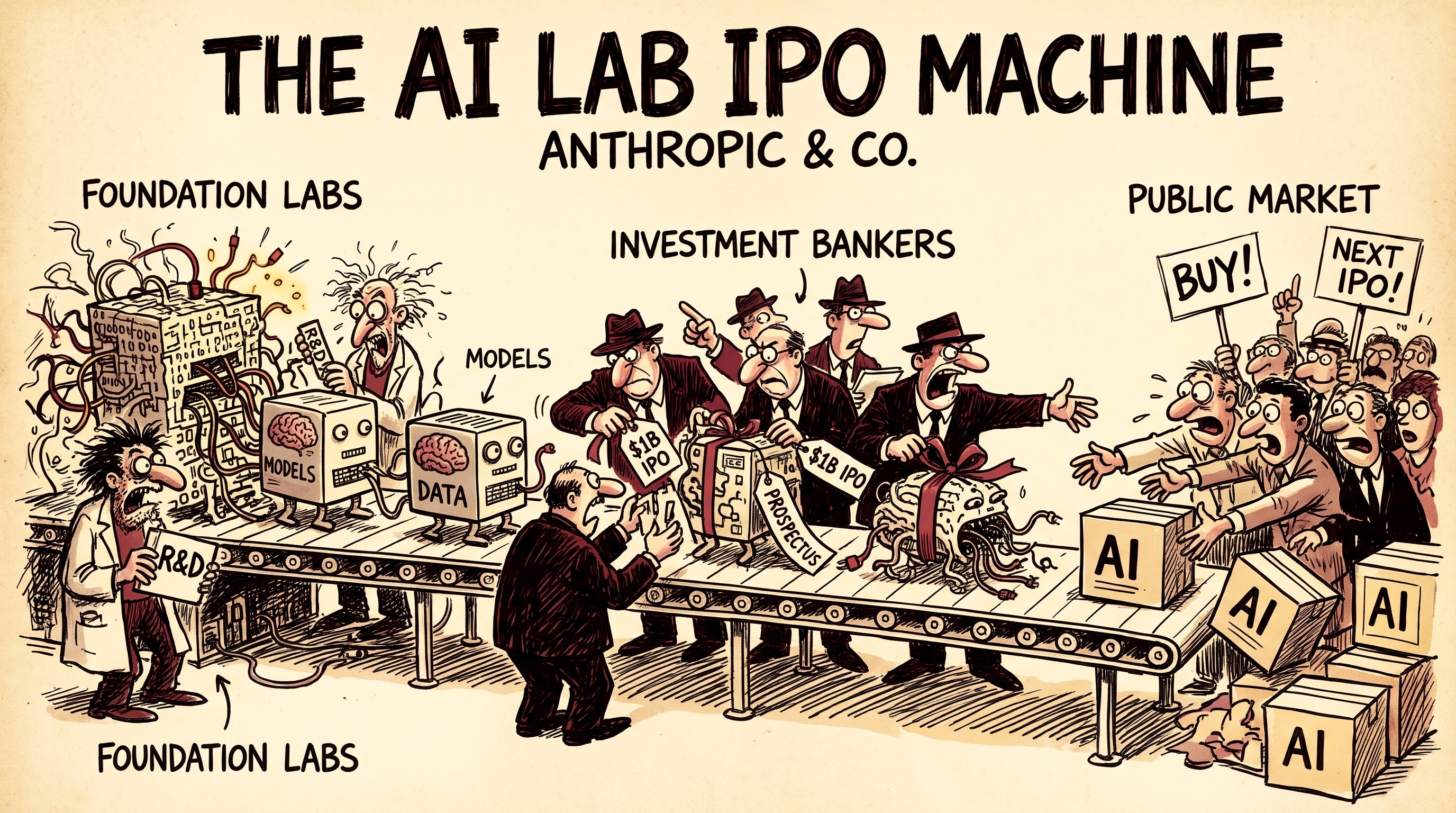
Anthropic's listing was a headline in its own right. But treating it as a single event misses what it actually signals. The IPO was a litmus test, and it passed. What comes next is a new pipeline that takes foundation model labs straight to the public markets, and it will change how AI gets funded.
A company unlike any that has listed before
Anthropic is, at its core, a single-product company. It researches artificial intelligence, develops it, and turns it into models. Everything else is an application of those models.
There are no drilling pipelines. There is no backlog of deals waiting to close. There are no semiconductors being designed. None of the abstract, intangible value that public investors usually have to take on faith. Anthropic builds large language models and other foundation models, and that's it.
What makes this remarkable is that the product's strength is directly measurable. I can measure it myself. I open Claude Code, put the latest model to work, and build whatever I want. There is no gap between release and value, and no multi-year timeline before the payoff. They ship it, I use it, and I can see the improvement immediately. With every release, the models get stronger.
There has never been a company like this on the stock market.
Capital was always the bottleneck
For the past five years, the biggest constraint on foundation model companies has been access to capital. Capital buys GPUs. Capital hires researchers and engineers. Capital pushes more models through the build pipeline, from pre-training to post-training and beyond.
Anthropic already has the formula. It has a pattern, and it will repeat it. The only real limit has been how quickly it could raise the money to run that pattern again at greater scale.
The public markets remove the bottleneck
That limit is now gone. With access to the public markets, through equity raises, debt raises or both, the old dance of venture capital rounds is over. No more negotiating with each new syndicate, and no more proving yourself all over again to a fresh set of partners.
Instead, Anthropic can raise money from people like me: people who actually use the product every day. I'm using it right now, it's phenomenal, so I buy more stock. The feedback loop between product experience and capital has never been this direct.
From one IPO to an engineered pipeline
Anthropic got to its massive valuation the slow way, round after round of venture capital over its life cycle. Some bankers will say it came to market overpriced. That isn't the point. The point is that it listed, the buyers showed up, and at roughly $1.75 trillion after its first day of trading, in the biggest IPO ever, the market's appetite is beyond doubt.
Investment banks will now do what they always do with a proven model: turn it into a process. They will go to small and mid-sized foundation model developers with a simple pitch:
You don't need to raise venture capital anymore. It's proven. We have buyers. You've met the bar. Whether you're building a small language model or a new world model, you can compete, and what you need is capital. We'll fast-track your listing.
Who gets the call
The list writes itself. OpenAI at the top end. Cohere. Sakana. And further down, the smaller labs that today might be acquisition targets. Palo Alto Networks just agreed to acquire Applied Compute for $4.5 billion, and there are many smaller Applied Computes out there that could just as easily choose a listing over a sale.
How they will list is still an open question. Some may go through SPACs. Others may use alternative exchanges or dual listings. The mechanics will vary, but the direction is clear.
Two kinds of AI company: labs and tailors
Not every AI model company is built the same way, and investors will need to know the difference.
Foundation model labs such as Anthropic and OpenAI pre-train models from scratch. They push vast amounts of data through enormous GPU clusters for months, and that is where general intelligence emerges. This is the part that costs billions, and it is where the magic of AI is actually created. The labs then post-train their own models to turn raw capability into products like Claude.
Post-training companies such as Applied Compute skip pre-training. They take an open-weight model someone else has built, such as Alibaba's Qwen or Moonshot's Kimi, and specialise it for one company using that company's data, mostly through reinforcement learning. Applied Compute calls this "Specific Intelligence": AI built for one company, trained on its proprietary data, and improving every time it is used.
The economics are very different. Post-training companies are far smaller but highly capital-efficient. Applied Compute reached a $100 million run rate in under 18 months and raised $350 million at a $3.25 billion valuation. Palo Alto Networks then agreed to buy it in an all-stock deal valued at $4.5 billion.
The catch is dependency. To change a model's weights, you need access to them, and closed labs don't hand theirs over. Post-training companies are built on other people's open-weight releases. If those releases slow down or fall behind, so do they.
Both types will be candidates for the new listing pipeline. But they are different bets: labs create intelligence, while post-training companies tailor it.
The market as the judge
The new method is simple: list, ship a product people use, and let the results speak. The smoke and mirrors of venture fundraising disappear, because the buyers are also the users, and they know immediately whether a model works.
Is it useful or not? Is it mainly serving enterprises that need help with regulatory compliance, or is it helping founders build large companies very quickly? Is it plugging into the entrepreneurship 3.0 and creator economy ecosystems? Is it delivering value to me? From day one, the answer is obvious.
You can already see it. The Gemini models aren't delivering in daily use. The Opus models are. Video models are emerging with extraordinary capabilities. And loyalty is fluid: Cursor was in the mix for a while, and now for many of us it's back to Claude Code alone.
The pendulum swings fast
That speed is the real story. In public markets, a lab lives or dies by its latest release, and the judgment comes in real time from the people using its models. That's healthier than a private valuation set behind closed doors.
The prediction
Anthropic's IPO proved that a pure-play intelligence company can list and thrive. Over the next few years, I expect the primary route to funding foundation models to shift from venture capital to a bank-run pipeline into the public markets. The labs that win won't be the best fundraisers. They'll be the ones whose models people can feel getting better.