

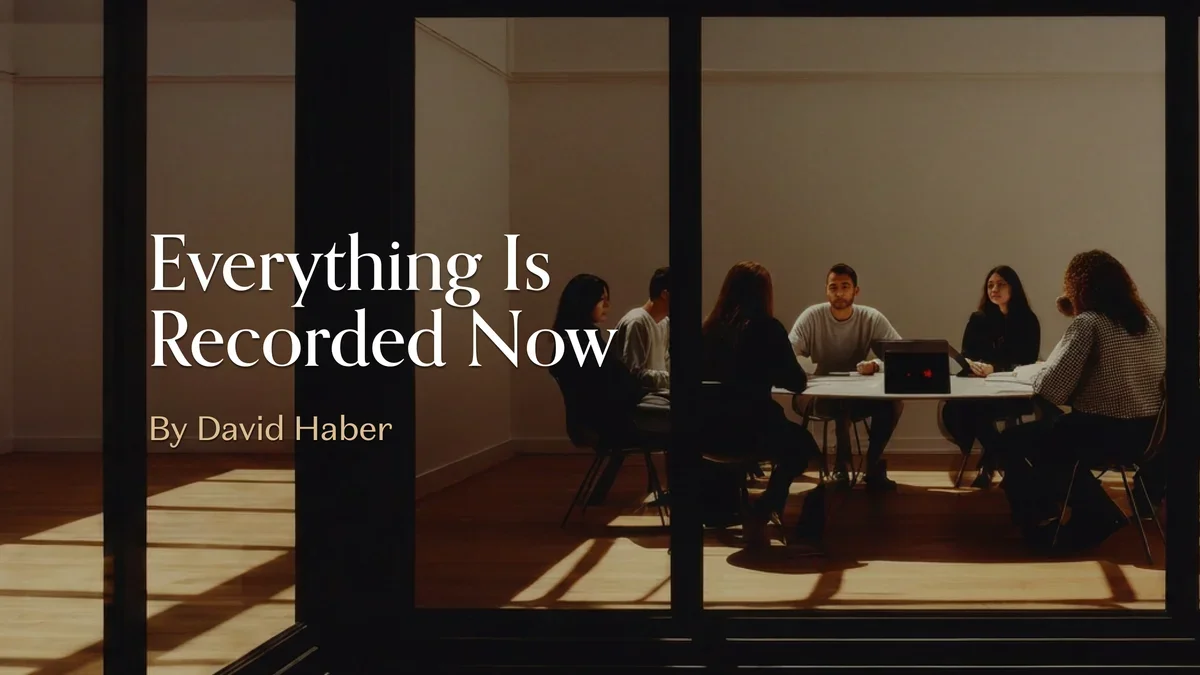
Work Discussions Are Now Recorded By Default

The future of work is recorded: AI's hunger for context is making continuous meeting capture the new default, reshaping how companies operate and compete.

Abstract visualization of sound waves transforming into data streams, representing AI meeting recording.
AI is turning spoken work discussions into structured data, creating a new layer of organizational context.· a16z Blog
Visual TL;DR
Work Discussions RecordedDriver
continuous meeting capture becoming the new default for professionals
From the articleThe way we work is undergoing a silent revolution: most work discussions are now recorded by default.
AI Needs ContextDriver
AI learns best through immersion in company dialogue and culture
From the article 4 mentionsInviting AI to meetings allows it to absorb the nuanced context, culture, and operational expectations that often remain unwritten.
Companies Embrace RecordingContext
Bridgewater and OpenAI are examples of extensive recording adoption
From the articleCompanies like Bridgewater and OpenAI have already embraced extensive recording, using AI agents to represent leaders in absentia.
Emerging System of RecordContext
continuous stream of company dialogue forms a new data source
From the articleFrom a technological standpoint, a new system of record is emerging from this continuous stream of company dialogue.
AI Learns NuanceCore
AI absorbs unwritten context, culture, and operational expectations
From the articleThe key insight is that AI, much like a new employee, learns best through immersion.
Living Context LayerEffect
enables AI agents to perform complex tasks effectively
From the articleThis 'living context layer' is what will empower AI agents to perform complex tasks.
Enhanced AI ProductivityOutcome
From the article 2 mentionsThe promise of enhanced AI productivity is expected to overshadow initial fears and cultural resistance.

The way we work is undergoing a silent revolution: most work discussions are now recorded by default. This shift, largely unannounced and un-debated, means professionals should assume their conversations are being captured from now on. This trend, while unsettling for many, is unlikely to reverse due to compelling advantages for both individual productivity and organizational leadership.

From a technological standpoint, a new system of record is emerging from this continuous stream of company dialogue. The key insight is that AI, much like a new employee, learns best through immersion. Inviting AI to meetings allows it to absorb the nuanced context, culture, and operational expectations that often remain unwritten.

This 'living context layer' is what will empower AI agents to perform complex tasks. The promise of enhanced AI productivity is expected to overshadow initial fears and cultural resistance. Companies like Bridgewater and OpenAI have already embraced extensive recording, using AI agents to represent leaders in absentia.

Granola, for instance, demonstrates this by leveraging extensive meeting data to possess a deeper understanding of a16z’s culture and decision-making than most other tools. This indicates a new enterprise software category focused on voice data, transforming unstructured conversations into searchable, queryable insights.

The advantages of this approach are twofold. First, bottom-up, an AI with full company context acts as a force multiplier for individual contributors seeking to improve processes. Second, top-down, it provides executives with oversight, ensuring alignment and flagging critical developments, especially important when shipping something is far less costly than un-shipping it.

This development is particularly impactful for 'verbal cultures', companies like Shopify and OpenAI, where important context has historically evaporated. AI's ability to attend and synthesize meetings allows these cultures to finally scale. While written cultures also benefit, AI disproportionately enhances verbal environments.

The inevitability stems from a familiar principle: never commit anything to text you wouldn't want made public. Screenshots, emails, and Slack messages are already subject to scrutiny. Meeting recording applies this same logic to spoken word. The default is rapidly shifting from opt-in recording to an assumption of recording unless explicitly designated otherwise.

While concerns about litigation are valid, the competitive cost of not recording is immense. Special designations for sensitive meetings, such as HR or legal sessions, may emerge, but the widespread adoption of recording is likely inevitable, with controls retrofitted later. This makes it a critical time for operators and investors to consider the governance and strategic implications of this evolving landscape. The question is not if this will happen, but whether companies will lead the transition and establish appropriate governance structures proactively.

© 2026 StartupHub.ai. All rights reserved. You may not republish this article in full without a license. Search engines and AI research tools may crawl and summarize for reference. Bulk reproduction or model training requires a license. See our terms.
Daniel Singer

Written by

Daniel Singer

Editor, StartupHub.ai

Daniel Singer is the editor of StartupHub.ai, a technology expert and thought leader on AI and its applications across sectors, from fintech and healthcare to developer tooling and consumer software. He writes and tests the tools covered here thoroughly and regularly, and built StartupHub.ai to give founders, operators and buyers a clearer read on what they are actually being sold.