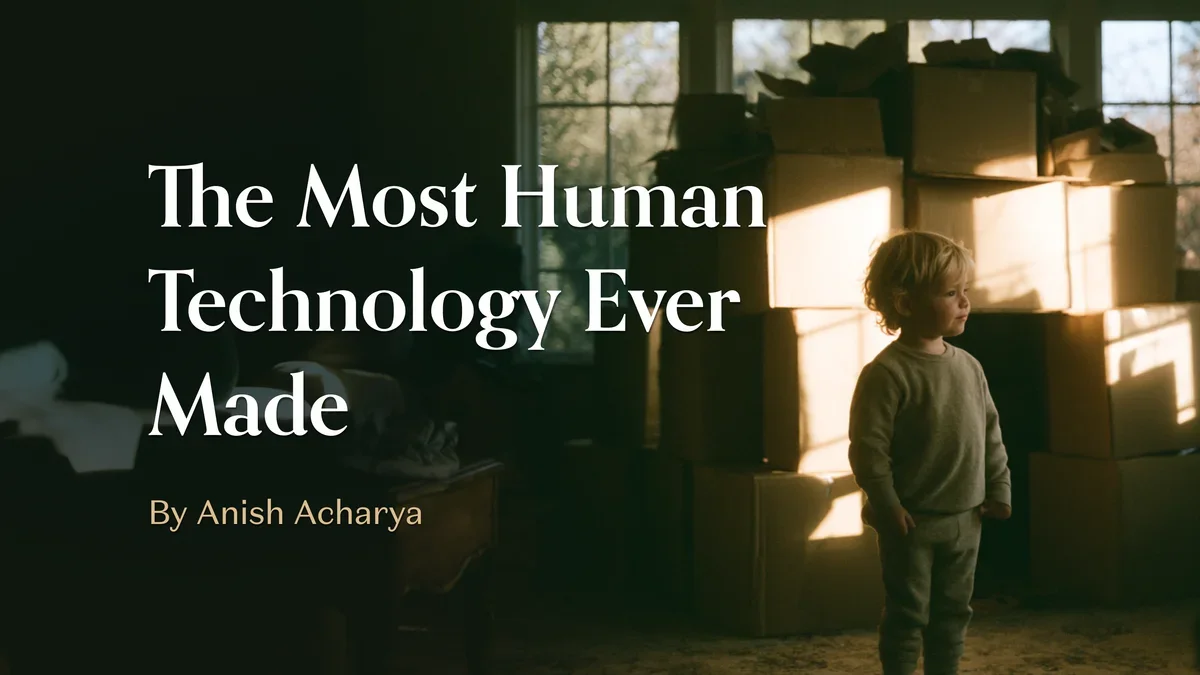
AI: The Most Human Tech?

AI is evolving beyond efficiency tools, becoming a powerful enabler of human creativity and personal expression.

5 min read
Abstract digital art with glowing lines, representing AI and creativity.
AI is emerging as a powerful tool for creative expression.· a16z Blog
Visual TL;DR
Past Tech FocusDriver
focused on doing more with less effort, saving time on tasks
From the articleWhile much of the past century’s tech focused on doing more with less effort, new AI tools offer a different paradigm: enabling creation and expression.
People Spend TimeContext
From the articleMost people aren’t trying to save time; they’re trying to spend it.
AI: Human EnablerCore
From the article 2 mentionsThis is the core idea behind the assertion that AI, far from being purely utilitarian, is becoming the most human technology ever made.
Digital PaintbrushEffect
From the articleInstead, AI can serve as a digital paintbrush, akin to language or the printing press, tools that simultaneously saved labor and expanded human potential.
Beyond ProductivityContext
From the article 3 mentionsThis perspective challenges the dominant narrative around AI’s impact on jobs and productivity, shifting focus to its role in creative expression.
Value of MakingOutcome
From the article 4 mentionsThe value of making things, as opposed to mere consumption, is profound.
Creative ImmersionOutcome
From the article 3 mentionsOliver Sacks observed that truly alive individuals are immersed in past, present, and future, a state facilitated by creative endeavors.

Most people aren’t trying to save time; they’re trying to spend it. This is the core idea behind the assertion that AI, far from being purely utilitarian, is becoming the most human technology ever made. While much of the past century’s tech focused on doing more with less effort, new AI tools offer a different paradigm: enabling creation and expression.

Eugenia Kuyda, a veteran of AI consumer products, notes that the drive isn't just about shaving minutes off tasks. Instead, AI can serve as a digital paintbrush, akin to language or the printing press, tools that simultaneously saved labor and expanded human potential. This perspective challenges the dominant narrative around AI’s impact on jobs and productivity, shifting focus to its role in creative expression.

The value of making things, as opposed to mere consumption, is profound. Oliver Sacks observed that truly alive individuals are immersed in past, present, and future, a state facilitated by creative endeavors. This "making" stretches one across time, fueled by memory, planning, and dreaming.

Social media, initially a space for connection, devolved into a performance for attention, eventually yielding to algorithmically amplified "slop." However, the author argues that the cure for this consumption-driven content is a return to creation, a process AI is uniquely positioned to enable. An interactive AI companion, for instance, offers a more engaging experience than a passive celebrity.

This democratizes creation beyond those with coding skills. A Kentucky electrician used AI to build a lucrative calculation tool, and a plumber significantly advanced a project with OpenClaw, a system also discussed in relation to minimum viable AI agent servers. The barrier to entry for building software has collapsed, opening doors for individuals previously limited to consuming others' ideas.

The promise of AI extends beyond mere efficiency gains, suggesting a future where individuals discover new passions and dedicate free time to them. This echoes the origins of great consumer companies, which often started as "toys."

Work is also being reshaped. AI is beginning to automate the tedious "tax" of jobs, politics, status meetings, allowing individuals to focus on their core strengths and creative play. This shift aligns with the evolution of individuality into an economic engine, where distinctiveness and personal projects drive innovation.

The fear of AI concentrating power in a few hands overlooks its potential to empower individuals. The true impact will be felt in the everyday texture of our lives, in what we can create and who we can become, long before it appears on economic charts.

When execution becomes cheaper, the bottleneck shifts from resources to the intrinsic desire to express something. This facilitates what the author calls AI for making things, where individuality becomes the primary driver of creation, not a luxury earned after success.

The future likely involves people making strange, beautiful, and perhaps purposeless things, sharing them, and seeing what emerges. As the source material from a16z Blog suggests, the toys were fine, but we always wanted to play with the boxes.

© 2026 StartupHub.ai. All rights reserved. You may not republish this article in full without a license. Search engines and AI research tools may crawl and summarize for reference. Bulk reproduction or model training requires a license. See our terms.

