

Data Center Congestion Meets Rising GPU Rates

Data center power constraints and supply backlogs clash with surging GPU demand as 12-month H100 rental contracts jump nearly 40 percent.

8 min read
Data center cooling equipment and server racks in high density compute facility
Data center power and cooling backlogs persist while hardware compute pricing climbs.· a16z Blog

Visual TL;DR. Data Center Congestion leads to Rising GPU Rates. Data Center Congestion exacerbates Hardware Backlogs. Hardware Backlogs contributes to Vertiv Revenue Miss. AI Server Thermal Loads drives Cooling Equipment Demand. Cooling Equipment Demand strains Data Center Congestion. Power Unit Imports Down causes Import Prices Up. Power Unit Imports Down adds to Data Center Congestion.

  1. Data Center Congestion: power constraints and supply backlogs clash with surging GPU demand
  2. Rising GPU Rates: 12-month H100 rental contracts jump nearly 40 percent
  3. Hardware Backlogs: physical friction in hardware delivery strains manufacturing capacity
  4. Vertiv Revenue Miss: missed internal guidance by $76 million and consensus by $120 million
  5. AI Server Thermal Loads: dense AI server clusters generate extreme thermal loads requiring infrastructure overhauls
  6. Cooling Equipment Demand: orders for data center power and cooling equipment nearly doubled
  7. Power Unit Imports Down: physical imports of power conversion units fell 23 percent
  8. Import Prices Up: unit import prices for power conversion units rose 25 percent
Visual TL;DR
Visual TL;DR, startuphub.ai Data Center Congestion leads to Rising GPU Rates. AI Server Thermal Loads drives Cooling Equipment Demand. Cooling Equipment Demand strains Data Center Congestion leads to drives strains Data Center Congestion Rising GPU Rates AI Server Thermal Loads Cooling Equipment Demand From startuphub.ai · The publishers behind this format
Visual TL;DR, startuphub.ai Data Center Congestion leads to Rising GPU Rates. AI Server Thermal Loads drives Cooling Equipment Demand. Cooling Equipment Demand strains Data Center Congestion leads to drives strains Data CenterCongestion Rising GPU Rates AI Server ThermalLoads Cooling EquipmentDemand From startuphub.ai · The publishers behind this format
Visual TL;DR, startuphub.ai Data Center Congestion leads to Rising GPU Rates. AI Server Thermal Loads drives Cooling Equipment Demand. Cooling Equipment Demand strains Data Center Congestion leads to drives strains Data Center Congestion power constraints and supply backlogsclash with surging GPU demand Rising GPU Rates 12-month H100 rental contracts jump nearly40 percent AI Server Thermal Loads dense AI server clusters generate extremethermal loads requiring infrastructureoverhauls Cooling Equipment Demand orders for data center power and coolingequipment nearly doubled From startuphub.ai · The publishers behind this format
Visual TL;DR, startuphub.ai Data Center Congestion leads to Rising GPU Rates. AI Server Thermal Loads drives Cooling Equipment Demand. Cooling Equipment Demand strains Data Center Congestion leads to drives strains Data CenterCongestion power constraintsand supply backlogsclash with surging… Rising GPU Rates 12-month H100rental contractsjump nearly 40… AI Server ThermalLoads dense AI serverclusters generateextreme thermal… Cooling EquipmentDemand orders for datacenter power andcooling equipment… From startuphub.ai · The publishers behind this format
Visual TL;DR, startuphub.ai Data Center Congestion leads to Rising GPU Rates. Data Center Congestion exacerbates Hardware Backlogs. Hardware Backlogs contributes to Vertiv Revenue Miss. AI Server Thermal Loads drives Cooling Equipment Demand. Cooling Equipment Demand strains Data Center Congestion. Power Unit Imports Down causes Import Prices Up. Power Unit Imports Down adds to Data Center Congestion leads to exacerbates contributes to drives strains causes adds to Data Center Congestion power constraints and supply backlogsclash with surging GPU demand Rising GPU Rates 12-month H100 rental contracts jump nearly40 percent Hardware Backlogs physical friction in hardware deliverystrains manufacturing capacity Vertiv Revenue Miss missed internal guidance by $76 millionand consensus by $120 million AI Server Thermal Loads dense AI server clusters generate extremethermal loads requiring infrastructureoverhauls Cooling Equipment Demand orders for data center power and coolingequipment nearly doubled Power Unit Imports Down physical imports of power conversion unitsfell 23 percent Import Prices Up unit import prices for power conversionunits rose 25 percent From startuphub.ai · The publishers behind this format
Visual TL;DR, startuphub.ai Data Center Congestion leads to Rising GPU Rates. Data Center Congestion exacerbates Hardware Backlogs. Hardware Backlogs contributes to Vertiv Revenue Miss. AI Server Thermal Loads drives Cooling Equipment Demand. Cooling Equipment Demand strains Data Center Congestion. Power Unit Imports Down causes Import Prices Up. Power Unit Imports Down adds to Data Center Congestion leads to exacerbates contributes to drives strains causes adds to Data CenterCongestion power constraintsand supply backlogsclash with surging… Rising GPU Rates 12-month H100rental contractsjump nearly 40… Hardware Backlogs physical frictionin hardwaredelivery strains… Vertiv RevenueMiss missed internalguidance by $76million and… AI Server ThermalLoads dense AI serverclusters generateextreme thermal… Cooling EquipmentDemand orders for datacenter power andcooling equipment… Power UnitImports Down physical imports ofpower conversionunits fell 23… Import Prices Up unit import pricesfor powerconversion units… From startuphub.ai · The publishers behind this format

Vertiv added $3.27 billion in revenue for the second quarter, but missed its internal revenue guidance by roughly $76 million and fell $120 million short of consensus estimates. Company leadership blamed the shortfall on temporary supply chain congestion and project execution delays across scaled deployments. Fresh data analysis from the a16z Blog shows that while hardware delivery encounters physical friction, compute appetite continues to strain manufacturing capacity.

Orders for data center power and cooling equipment recorded by the U.S. Census Bureau have nearly doubled compared to baseline levels from the previous decade. Industrial HVAC machinery orders lead the acceleration as dense AI server clusters generate extreme thermal loads that require complete infrastructure overhauls. Simultaneously, physical imports of power conversion units fell 23 percent compared to January 2025 levels while unit import prices rose 25 percent.

StartupHub.ai data shows Vertiv Holdings Co (NYSE:VRT) holding a startup tracking score of 10/100, reflecting its scale as an industrial incumbent rather than an early-stage venture entity. Specialized thermal and hardware competitors tracked by StartupHub.ai display varied momentum in the market, including Lumentum (66/100), GridCARE (59/100), ZutaCore (55/100), Iceotope Group (53/100), and Omen AI (45/100). Alternative cooling providers are competing to catch spillover order volume as liquid cooling transitions from an advanced option to an operational requirement.

Hardware Backlogs and Inflationary GPU Pricing

Unfilled orders for computer and electronic components stepped up sharply in 2023 and inflected higher again recently. The backlog ratio sits at roughly six months of current shipment volume. The New York Fed Global Supply Chain Pressure Index reflects similar physical friction, running almost two standard deviations above historical norms. For additional perspective on how venture funds analyze these hardware demands, read how Bessemer Maps AI Data Center Future.

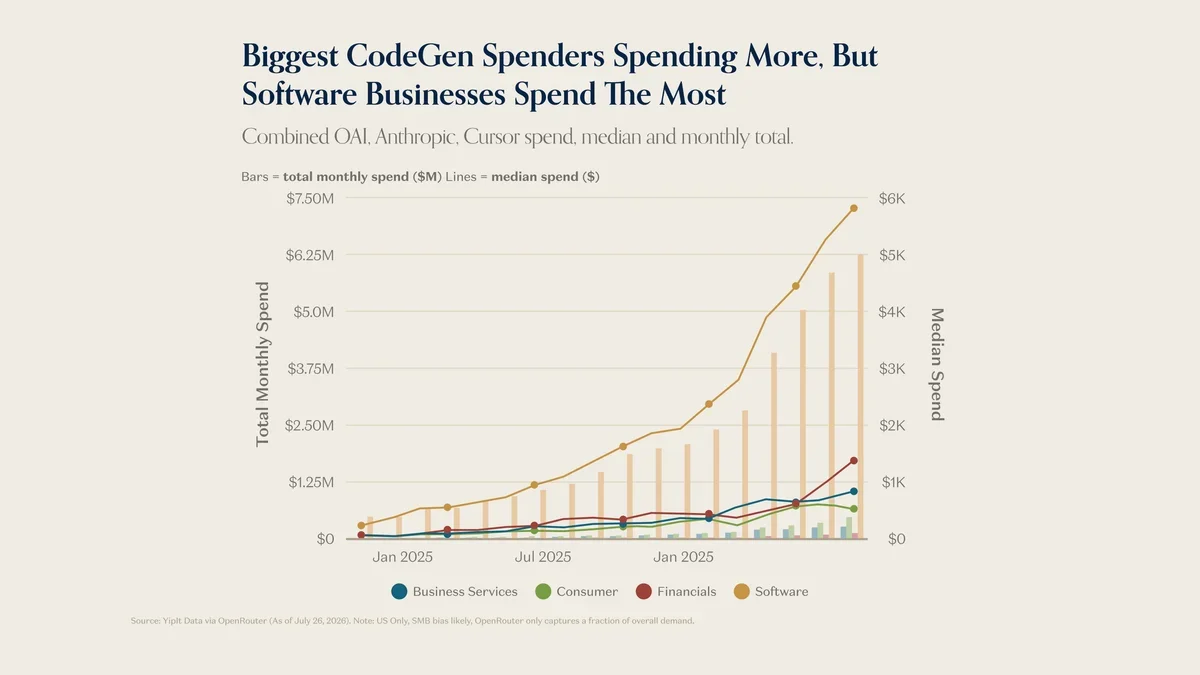
Supply friction has failed to suppress hardware utilization rates. While Silicon Data's Token Cost Index dropped from its May peak due to heavy consumption of lower-cost inference models, enterprise software spending remains strong. YipitData tracking of OpenRouter volume indicates B2B software spend across Cursor, Anthropic, and OpenAI continues to expand in financial services, consumer products, and business services.

That enterprise demand translates directly into hardware pricing strength. 12-month contract H100 GPU rental rates reached nearly $2.50 per GPU hour, representing a 40 percent increase over November 2023 levels. Short-term market expectations tracked on Kalshi prediction markets price H100 GPU rental rates even higher at approximately $2.78 per hour.

Remote Work Shifts the Tech Hiring Pie

Physical compute constraints contrast with broader changes in technical labor dynamics. Entry-level tech job postings have stayed near 5 percent of total postings since 2019, countering narratives that AI models eliminated junior engineering roles. Instead, data from ADP shows long-distance remote hiring jumped during the pandemic and settled at 26.4 percent, a 30 percent increase over pre-2020 levels.

Information and technical services lead all corporate sectors with more than 45 percent of workers in long-distance remote roles. With 12-month H100 contract prices hovering near $2.50 an hour and power equipment order backlogs stretching out to half a year, the artificial intelligence expansion remains firmly constrained by real-world manufacturing capacity.

© 2026 StartupHub.ai. All rights reserved. Do not enter, scrape, copy, reproduce, or republish this article in whole or in part. Use as input to AI training, fine-tuning, retrieval-augmented generation, or any machine-learning system is prohibited without written license. Substantially-similar derivative works will be pursued to the fullest extent of applicable copyright, database, and computer-misuse laws. See our terms.