

WordPress for Startups: The Stack Founders Actually Ship

Every hosting roundup quotes the promotional rate. This one quotes what you pay in month 13, compares six hosts on both, and adds the plugin stack a startup marketing site actually needs.

Bar chart comparing how much six WordPress hosting plans multiply in price at renewal
Renewal price divided by promotional price, from each vendor pricing page on 13 August 2026.
Key Takeaways
  • 1
    The renewal multiple matters more than the headline price: SiteGround renews at roughly 5.3x its promo rate, EuroDNS at roughly 1.3x.

  • 2
    Hostinger’s $2.99 a month requires a 48 month prepay of $143.52, which is a long bet for a company measuring runway in months.

  • 3
    Over a three year horizon, the ordering on price inverts completely against the one year comparison.

  • 4
    A startup marketing site needs about six plugins, not forty. Everything on every page load costs Core Web Vitals.

  • 5
    Custom plugins can now be generated from a prompt as ordinary PHP you own outright, with no runtime dependency.
Bar chart comparing how much six WordPress hosting plans multiply in price at renewal, from SiteGround at 5.3x down to EuroDNS at 1.3x
Renewal price divided by promotional price. Checked on each vendor pricing page, 13 August 2026.

Picking WordPress for startups is a different problem from picking it for a hobby blog. The constraint is not which host has the prettiest dashboard, it is that you are signing a multi-year prepay to get the price on the sticker, at a company whose runway is measured in months. Every roundup quotes the promotional rate. Almost none of them quote what you pay in month 13, which is the number that actually shows up in your burn.

So this compares six hosts on both numbers, adds what real users say on Reddit rather than what the vendors say about themselves, and finishes with the plugin stack a startup marketing site actually needs. We track all six as company profiles, so each row also carries our own StartupHub score.

The six hosts compared

HostBest ForScoreFromRenewsGo
HostingerLowest entry pricen/a$2.99/mo$10.99/moVisit
BluehostWordPress.org default22$3.99/mo$9.99/moVisit
SiteGroundManaged updates19€2.99/mo€15.99/moTry
10WebAI site generation36$10/mo$20/moTry
NamecheapDomain plus hosting62See siteSee siteTry
EuroDNSEU data residency15€5.99/mo€7.49/moTry

Prices checked in-browser on 13 August 2026. SiteGround and EuroDNS quote EUR, the rest quote USD, so the renewal multiple below is the like-for-like comparison. Score is our own 0 to 100 StartupHub profile score and moves as we re-enrich each company.

The renewal multiple is the number that matters

Line the promotional rates up and Hostinger looks like the obvious winner at $2.99. Line the renewal rates up and the ordering changes completely. The chart below divides each renewal rate by its promotional rate, which strips out the currency difference and shows the size of the cliff you are walking toward.

SiteGround more than quintuples. Hostinger nearly quadruples, and asks for a 48 month prepay of $143.52 to give you that entry price at all. EuroDNS barely moves, because its discount is 20 percent rather than 75 percent. Over a single year the budget hosts win on price. Over three years, which is a realistic life for a startup marketing site, that ordering inverts.

None of this makes the cheap hosts a bad decision. It makes the cheap hosts a decision with a date attached. Put the renewal date in a calendar the day you sign up.

Which one to pick, by situation

Pre-seed, no designer, need a site this week. 10Web. It generates a working WordPress site from a description, and because the output is real WordPress you can move it anywhere later. You are paying for time, which is the resource you actually lack.

Bootstrapped and optimizing for cash. Hostinger or Bluehost, on the shortest term you can tolerate rather than the longest. Take the low rate, diarise the renewal, and reassess then. Prepaying 48 months to save a few dollars a month is a bet on your own survival that you do not need to make.

Selling into European enterprises. EuroDNS. EU data residency under an EU provider takes an entire line item off the security questionnaire, and the pricing does not ambush you at renewal.

You want managed updates and shell access. SiteGround, with the renewal cost budgeted from day one. The engineering is the best of the budget tier. Just do the three year arithmetic before you sign.

You are tired of DNS. Namecheap, keeping the registrar and the host in one account.

The six hosts in detail

One note on the Reddit sections below. r/webhosting is a venue people visit when something has broken, so it skews negative for every provider by construction. The useful signal is not that complaints exist, it is what they cluster around: renewal pricing for SiteGround, outages and upsells for Bluehost, support for Hostinger and 10Web.

Hostinger: The Cheapest Way In, If You Prepay Four Years

Hostinger's Premium plan is the number that headlines almost every hosting roundup, and the number is real. The condition attached to it is less widely quoted: $2.99 a month is the rate on a 48 month term, billed as $143.52 up front, and the plan renews at $10.99 a month afterwards. For a startup that is a genuine trade. You are prepaying four years of hosting before you know whether the company still exists in year two.

What you get is legitimately good for the money: three sites, 20 GB of NVMe storage, a free domain for the first year, weekly backups and a CDN. The Business tier at $3.79 a month lifts that to unlimited sites and daily backups. If you want the low price without the four year commitment, the shorter terms are priced much closer to the renewal rate, which is the honest comparison to make.

Pros

  • Lowest headline price of the six
  • Free domain for the first year
  • Daily backups from the second tier up
  • Genuinely fast NVMe and LiteSpeed stack

Cons

  • The $2.99 rate needs a 48 month prepay of $143.52
  • Renews at roughly 3.7x the promo rate
  • Support quality is the most common complaint

What r/webhosting says. A thread titled "Hostinger admitted that a System UI Error wiped my data, then their support closed the ticket" is the kind of post worth reading before you commit four years up front. r/webhosting, February 2026.

Check current Hostinger pricing, or read our full Hostinger profile and its alternatives.

Bluehost: The Official Recommendation, With Caveats

Bluehost has been recommended on WordPress.org since 2005, and that endorsement is why it appears in every beginner guide ever written. The Starter plan runs $3.99 a month on a 36 month term and renews at $9.99. Ten sites, 10 GB of NVMe storage, a free domain for the first year and Yoast SEO preinstalled.

The endorsement is doing a lot of work though. Bluehost is owned by Newfold Digital, and the recurring founder complaint is not about the launch experience, which is smooth, but about what happens at renewal and at scale. If you are picking Bluehost, pick it for the frictionless first 30 days and plan your exit before the renewal lands.

Pros

  • Officially recommended by WordPress.org since 2005
  • Smoothest first-time WordPress setup of the six
  • Free domain and Yoast SEO included
  • Phone support from the Business tier

Cons

  • Renews at 2.5x the promo rate
  • Upsells are aggressive through checkout
  • A major outage hit on 2026-08-11

What r/webhosting says. The most recent thread at the time of writing is simply titled "Major outage over at Bluehost", posted 11 August 2026. Older threads cover price rises and long-term users leaving. r/webhosting, August 2026.

Check current Bluehost pricing, or read our full Bluehost profile and its alternatives.

SiteGround: Strong Engineering, Brutal Renewal Math

SiteGround runs on Google Cloud, handles managed WordPress updates properly, ships its own Speed Optimizer and security plugins, and gives you WP-CLI and SSH on the entry plan, which most budget hosts do not. For a technical founder who wants managed updates without giving up shell access, that combination is rare at the price.

Then the renewal arrives. The StartUp plan is €2.99 a month for the first 12 months and renews at €15.99 a month, VAT excluded. That is the steepest renewal multiple in this comparison by a wide margin. The engineering is not in question. The pricing structure is the thing to plan around, and it is why so many SiteGround threads are people costing out a migration.

Pros

  • Google Cloud infrastructure
  • WP-CLI and SSH on the entry plan
  • Managed WordPress updates that rarely break
  • Free migration and daily backups

Cons

  • Steepest renewal jump here, roughly 5.3x
  • Entry plan is a single website only
  • The Site Tools UI rewrite was unpopular

What r/webhosting says. Search the subreddit and the top results are "Everyone Flee from Siteground!" and "Good alternatives to siteground?". The complaints cluster on renewal pricing and the Site Tools redesign, not on uptime. r/webhosting, April 2026.

Check current SiteGround pricing, or read our full SiteGround profile and its alternatives.

10Web: Generate The First Draft, Then Own It

10Web is the only host here that is really a builder wearing a host's clothing. You describe the site, it generates a working WordPress install with content and layout in place, and you edit from there in Elementor. For a pre-seed team that needs a credible marketing site this week and has no designer, that is a real shortcut, and the output is genuine WordPress rather than a proprietary format you cannot leave.

AI Starter is $10 a month billed annually at $120, against a $240 regular annual rate. It is the most expensive entry point in this list and the cheapest way to get from nothing to a live site in an afternoon. Which of those framings matters depends entirely on whether your bottleneck is money or time.

Pros

  • Generates a complete WordPress site from a prompt
  • Output is real WordPress, portable to any host
  • Elementor editing built in
  • Managed hosting and builder in one bill

Cons

  • Highest entry price of the six
  • Regular rate is double the promotional one
  • Support responsiveness is the common complaint

What r/webhosting says. Sentiment is thinner than for the big hosts, and the sharpest thread is bluntly titled "10web: awful support". Worth weighing if you expect to need help during a launch. r/webhosting, July 2025.

Check current 10Web pricing, or read our full 10Web profile and its alternatives.

Namecheap: One Vendor For The Domain And The Site

Namecheap's real strength is consolidation. Most founders register the domain somewhere and host somewhere else, then lose an afternoon to DNS every time something changes. Keeping the registrar and the WordPress host in one account removes a whole category of small recurring problems, and Namecheap's registrar side is genuinely well regarded, with free WhoisGuard privacy on domains.

Its managed WordPress product, EasyWP, installs any plugin on every plan, with the notable exception of caching plugins, because EasyWP runs its own caching layer. One thing to keep on your radar rather than to panic about: a majority stake in Namecheap was reported as being sold to CVC Capital, and private equity ownership has historically been a leading indicator of price rises across this industry.

Pros

  • Registrar and host in one account
  • Free domain privacy, which several rivals charge for
  • EasyWP allows plugins on every tier
  • Strong reputation on the domain side

Cons

  • Caching plugins are blocked on EasyWP
  • Majority stake reported sold to CVC Capital
  • Pricing page was unavailable when this was written

What r/webhosting says. The registrar side draws steady recommendations in "best value registrar" threads. The thread founders should actually read is the one on the CVC Capital majority stake. r/webhosting, September 2025.

Check current Namecheap pricing, or read our full Namecheap profile and its alternatives.

EuroDNS: The One Without A Renewal Cliff

EuroDNS is a Luxembourg company, which is the entire point of putting it on this list. If you are selling to European enterprises, or your investors care about where customer data physically sits, hosting the marketing site inside the EU under an EU provider removes a question from every security review you will sit through.

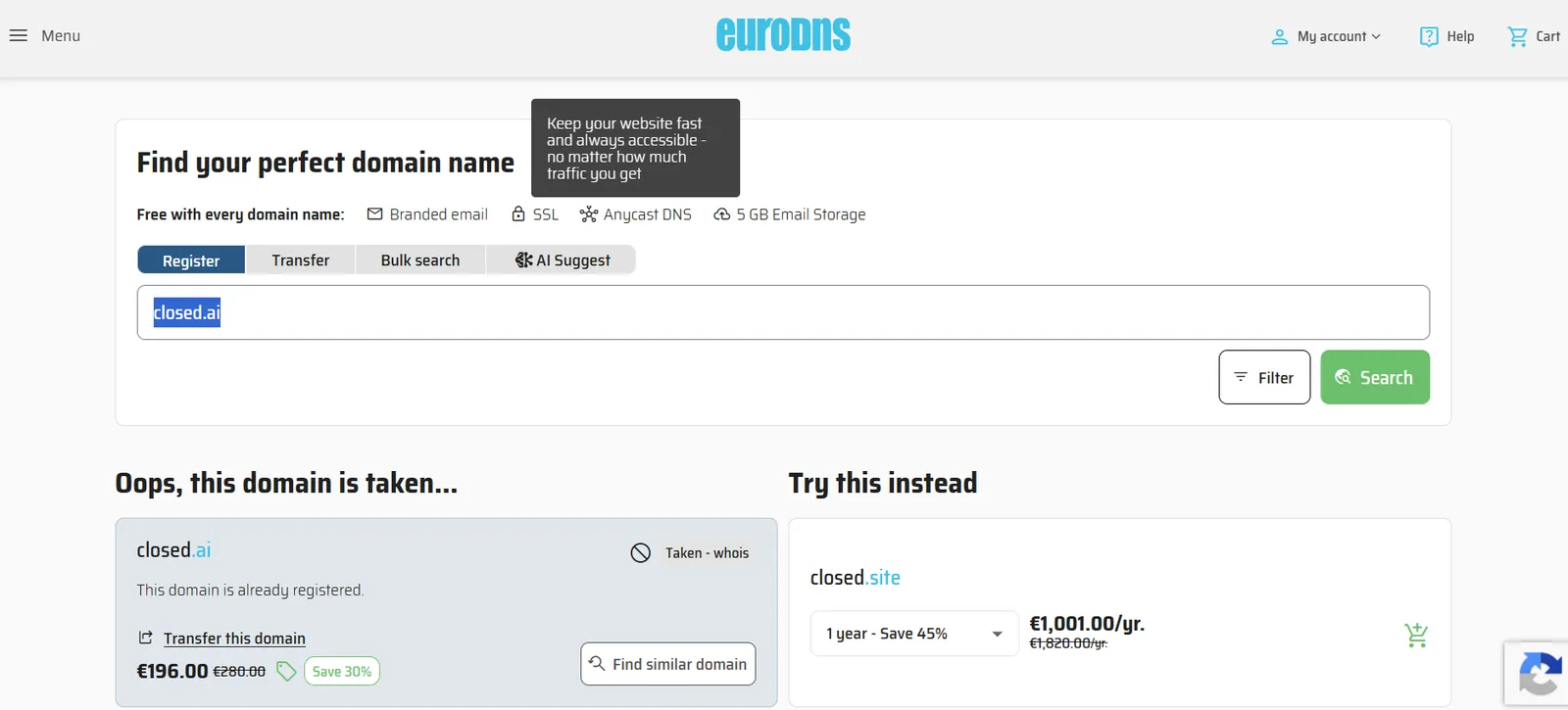
The pricing is the other reason it earns a place. Basic is €5.99 a month against a €7.49 standard rate, billed annually at €71.90. That is a 20 percent discount, not a 75 percent one, which means the price you sign up at is close to the price you keep paying. Every plan bundles a Jetpack licence for backups, security and CDN. It is the highest entry price after 10Web and, over three years, comfortably the cheapest option here.

Pros

  • EU company and EU data residency
  • No renewal cliff, roughly 1.3x
  • Jetpack licence bundled on every plan
  • Cheapest of the six over a three year horizon

Cons

  • Higher entry price than the budget hosts
  • One website per plan on both tiers
  • Smaller support organisation than the giants

Check current EuroDNS pricing, or read our full EuroDNS profile and its alternatives.

The plugin stack for a startup marketing site

The temptation is to install forty plugins in week one and spend the next year wondering why the site is slow. A startup marketing site needs roughly six things, and every plugin past that should have to justify its weight.

  • WooCommerce Profile (Payments and storefront). If you are selling anything directly, this is still the default. It is free, it is owned by Automattic, and it does not take a cut of your revenue the way a hosted storefront does.
  • Jetpack Profile (Backups, security, CDN). Covers downtime monitoring, malware scanning and an image CDN in one plugin. Already bundled if you go with EuroDNS, so check before paying for it twice.
  • Yoast SEO (On-page SEO). Handles titles, meta descriptions, canonical tags and schema. Preinstalled free on Bluehost plans. Rank Math is the usual alternative and the choice between them is preference, not capability.
  • WP Rocket (Caching and Core Web Vitals). The one paid plugin most worth its price on a marketing site, because page speed feeds directly into rankings. Skip it if your host already caches at the server level, which SiteGround and EasyWP both do.
  • Wordfence (Firewall and malware scanning). A WordPress site with a login page is a target within days of going live. Wordfence plus enforced two factor on every admin account handles the overwhelming majority of that risk.
  • Fluent Forms (Lead capture). Lighter than the older form plugins and it will not slow every page down to render one contact form. Pipe submissions straight into your CRM rather than letting them sit in the WordPress database.

Two rules that matter more than the specific picks. Anything that runs on every page load costs you Core Web Vitals, which costs you rankings. And every plugin is third-party code with database access on a site that carries your customer data, so fewer, better-maintained plugins is a security position as much as a performance one.

Bonus: generate the plugin you cannot find

The gap in the list above is the plugin that does the one specific thing your business needs. The usual options are installing a heavyweight plugin and using four percent of it, or paying a developer for a week. Steem is a third route: describe the plugin in plain English and it writes the PHP, then boots it in a real WordPress instance in your browser so you can click through it before it touches your site.

What makes it interesting for a startup rather than a novelty is the ownership model. The output is ordinary PHP with a plugin header, proper file structure and translation-ready strings. No licence key, no runtime dependency, nothing calling home. You can modify it, ship it, or sell it. It writes capability checks, nonce verification, sanitised input and escaped output from the start, which is precisely where hand-rolled WordPress code usually fails a security review.

It is free to start, with 75 credits on signup and no card required, which covers one complete plugin including refinements. The honest limits: it is built for plugins of ordinary scope, a form, a shortcode, a custom post type, an admin screen. It is not going to reproduce WooCommerce, and generated code should still be read before it goes live on a site that matters. Our full Steem profile has more.

Frequently asked questions

Which WordPress host is cheapest for a startup?

Over one year, Hostinger at $2.99 a month, provided you prepay 48 months. Over three years, EuroDNS, because it renews at roughly 1.3x its promotional rate while the budget hosts renew at 2.5x to 5.3x. The answer genuinely depends on the time horizon you are pricing.

Do I need managed WordPress hosting?

If nobody on the team wants to own WordPress core and plugin updates, yes. Managed hosting is buying back the hour a month that patching costs you, plus the much larger cost of the one time an unpatched plugin gets exploited.

Can I move my WordPress site between these hosts later?

Yes, and all six offer migration tooling, several of them free. This is the strongest argument for WordPress over a proprietary builder: the site is yours, in a portable format. Even 10Web's AI-generated output is standard WordPress.

Is WordPress still a good choice for a startup in 2026?

For a marketing site, yes. Pages arrive as HTML so search engines and answer engines read them without executing JavaScript first, you own the domain and the database, and MCP servers now exist for WordPress so Claude or ChatGPT can publish to it directly.

© 2026 StartupHub.ai. All rights reserved. Do not enter, scrape, copy, reproduce, or republish this article in whole or in part. Use as input to AI training, fine-tuning, retrieval-augmented generation, or any machine-learning system is prohibited without written license. Substantially-similar derivative works will be pursued to the fullest extent of applicable copyright, database, and computer-misuse laws. See our terms.