

8 Best Ways to Pay International Contractors, Compared

Paying international contractors is three separate problems: compliance, moving the money, and accounts payable. We compare Deel, Wise Business, Airwallex, Melio and their alternatives on funding, headcount and our 0-100 StartupHub Score, with a recommendation for each stage of company.

Deel homepage advertising hiring, managing and paying workers anywhere
The Deel homepage, captured 5 August 2026.

Most founders discover too late that paying international contractors is three separate problems wearing one coat. Getting the contract and compliance right. Moving the money without losing a chunk to exchange rates. And keeping the whole thing reconciled in your books. Pick a tool that solves one of those and you will feel the other two later.

StartupHub.ai tracks every company below as a company, so this comparison runs on funding, headcount and our 0-100 StartupHub Score rather than on whoever bid highest for the keyword. Screenshots were captured on 5 August 2026.

The Three Jobs, and Which Tool Does Which

Before any comparison, work out which problem you actually have. It is usually not the one you think.

  • Compliance and contracts. Is this person a contractor or, in the eyes of their local labour authority, an employee? Getting this wrong is the expensive failure mode, and it is a legal question rather than a payments one. This is what Deel and its peers exist for.
  • Moving the money. Once the relationship is legitimate, you need funds to land in their currency without a bank taking a cut in the exchange rate. This is Wise.
  • Treasury and accounts payable. Holding balances in several currencies, paying vendors on terms, reconciling to your accounting stack. This is Airwallex and Melio territory.

A five-person startup with three contractors needs the second job solved and can handle the first with a decent template. A thirty-person company hiring in six countries needs the first solved properly and will not care about a 0.4% rate difference.

1. Deel: Best for Contractor Compliance and Global Hiring
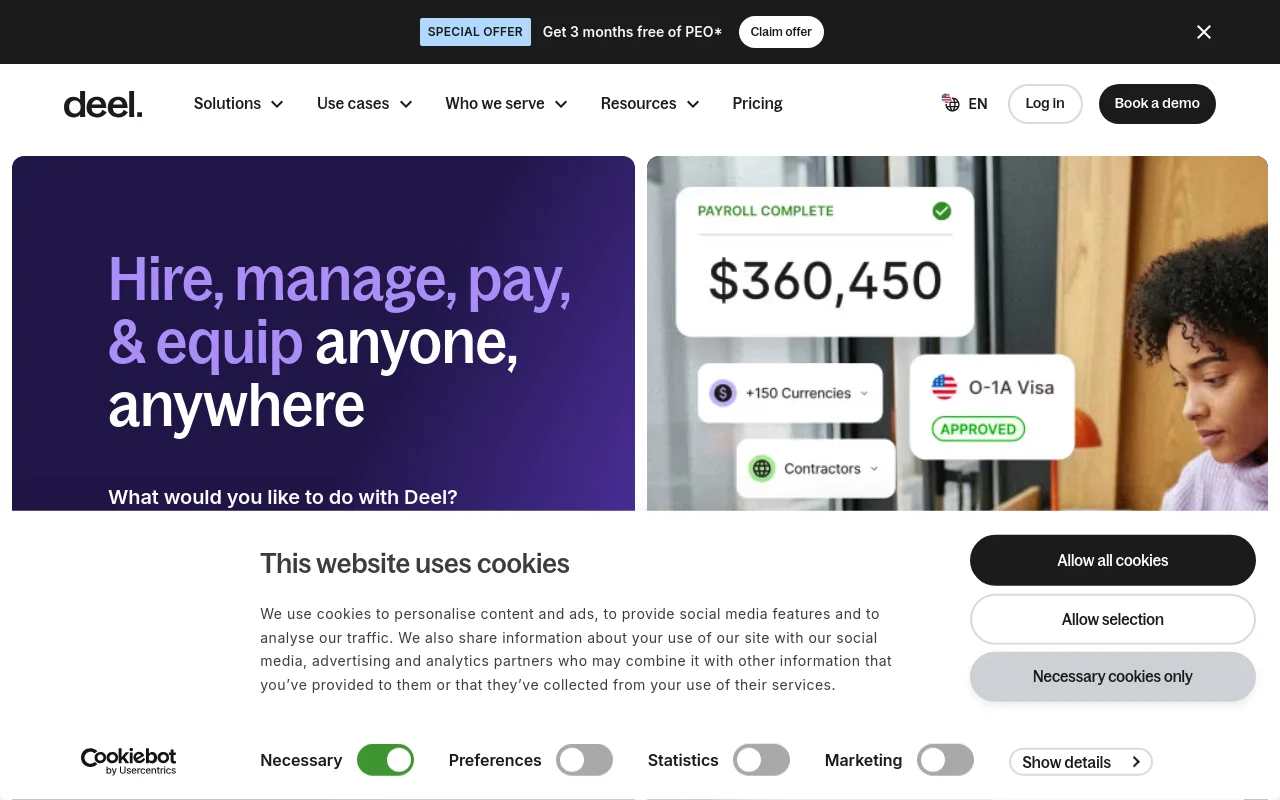
Deel homepage advertising hiring, managing and paying workers anywhere
The Deel homepage on 5 August 2026.

Deel scores 76 and is the giant of this category by some distance: founded 2019 in San Francisco, roughly 9,578 employees, and about $18.3 billion raised, the largest funding total of any company in this comparison. Its current positioning is "hire, manage, pay and equip anyone, anywhere", and the homepage leads on 150-plus currencies, contractor management and immigration support including O-1A visas.

What you are actually buying is the compliance layer: locally compliant contracts, classification guidance, invoicing, and an Employer of Record option when a contractor really should be an employee. The payment rail is bundled, which is convenient and is not where Deel competes hardest on price.

Best for: teams hiring across borders who need the contract and classification to be defensible, and who would rather pay for that than assemble it themselves.

See Deel's contractor and EOR plans

2. Wise Business: Best for Cheap Cross-Border Payment

Wise homepage advertising fast international transfers to over 140 countries
The Wise homepage on 5 August 2026.

Wise scores 70. Founded 2011 in London, around 10,813 employees, about $1.1 billion raised before listing publicly. It is the cheapest credible way to actually move the money, because it quotes the mid-market rate and charges a stated fee rather than folding a margin into the rate.

Wise Business specifically is built for this use case. Per its own pages: receive in 22 currencies, batch transfers to up to 1,000 contacts in a single click, physical and digital cards for team spend across 231 countries, accounting software integrations, API access, and returns on GBP, EUR and USD balances. There is a one-off £50 account setup fee, and volume discounts once monthly transfers pass roughly £20,000.

The batch payment feature is the one founders underrate. If you are paying fifteen contractors monthly and doing it as fifteen manual transfers, that is the thing to fix first.

Best for: startups paying a known set of contractors who already have compliant contracts, and who want the money movement itself to cost as little as possible.

Check Wise Business pricing

3. Airwallex: Best for Multi-Currency Treasury and Developers

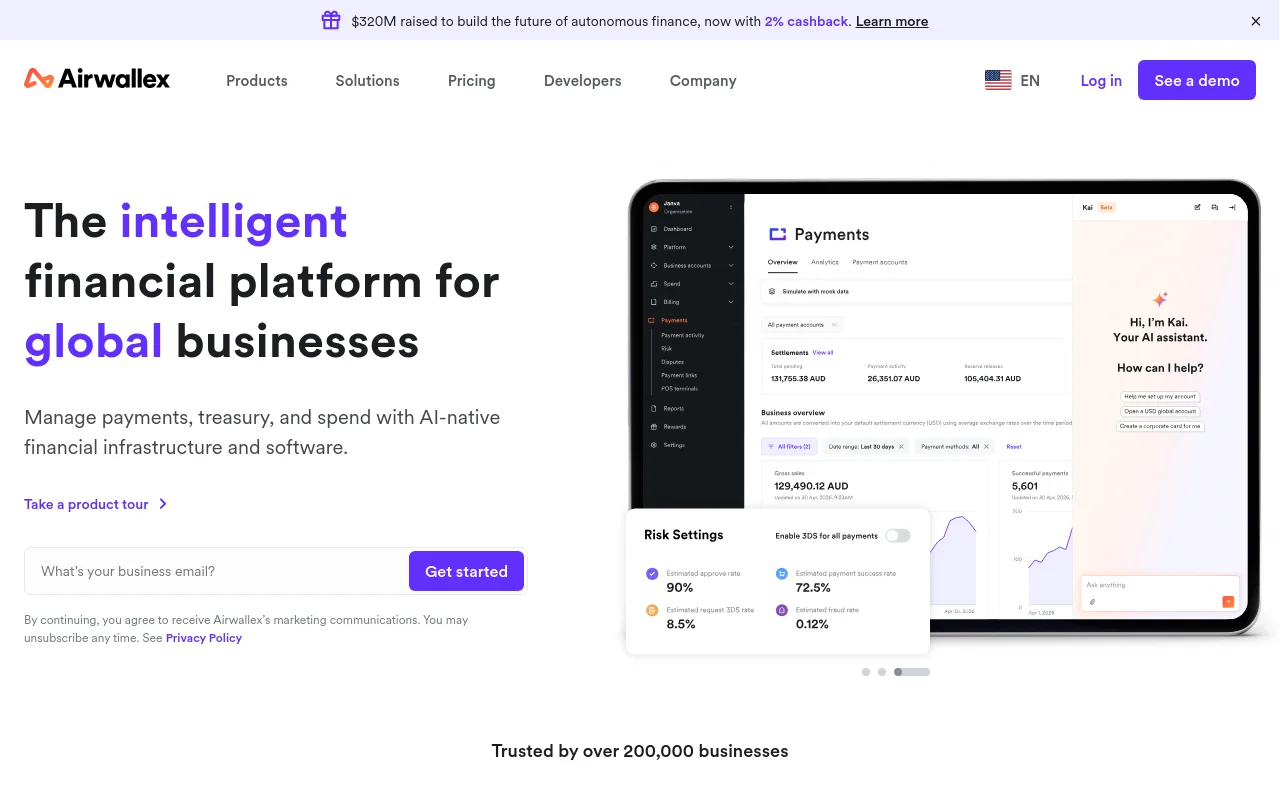
Airwallex homepage describing an intelligent financial platform for global businesses
The Airwallex homepage on 5 August 2026.

Airwallex scores 66, founded 2015 in London with roughly 2,507 employees. Its site states it is trusted by more than 200,000 businesses, and it recently announced a $320 million raise.

It sits closest to Stripe in shape of anything here: payments, treasury and spend delivered as financial infrastructure with a first-class Developers section, rather than as a self-serve app you log into once a month. If you are building a product that itself needs to hold balances or pay people out, this is the one to look at.

Best for: companies operating in several currencies who want business accounts, treasury and spend management in one place, and engineering teams who want an API rather than a dashboard.

Explore Airwallex for business

4. Melio: Best for Accounts Payable

Melio scores 69, founded 2018 in New York with about 697 employees and roughly $654 million raised. It solves the third job: paying vendors and bills on terms, with the workflow and reconciliation that implies, rather than one-off international transfers.

Include it if your problem is really accounts payable wearing a contractor costume: recurring vendor bills, approval steps and clean books. Note its centre of gravity is US business payments, so check coverage for your corridors.

See how Melio handles vendor payments

5. Papaya Global: Best for Enterprise Payroll

Papaya Global scores 83, the highest of any company on this page, on roughly $438 million raised and around 806 employees, founded 2016 in Tel Aviv. We have no commercial relationship with them and it still tops our table, because the score measures company strength rather than fit for your use case. Papaya skews toward enterprise global payroll rather than the handful-of-contractors problem most startups have, which is why it is not our pick here. At payroll scale it deserves a serious look.

6. Remote.com: Deel's Closest Competitor

Remote.com scores 68, founded 2019 in San Francisco with about $496 million raised. It goes head to head with Deel on contractor management and Employer of Record, and is worth pricing against it directly rather than assuming the market leader wins. Shortlist both and compare quotes for your specific countries.

7. Oyster: Best for Distributed-First Teams

Oyster scores 61, founded 2020 in San Francisco with around 600 employees. It was built for companies that are remote by default rather than a head office with satellites, and its positioning reflects that.

8. Rippling: Best if You Also Need HR and IT

Rippling scores 58, founded 2016 with about 5,200 employees and roughly $500 million raised. It comes at the problem from workforce management rather than payments: hiring, devices, app access and payroll in one system. Pick it when contractor payment is one requirement among several rather than the whole job.

Comparison Table

PlatformStartupHub ScoreSolvesBest ForFounded
Papaya Global83 / 100ComplianceEnterprise global payroll2016
Deel76 / 100ComplianceContractor classification and EOR2019
Wise70 / 100Money movementCheapest cross-border payment, batch pay2011
Melio69 / 100Accounts payableVendor bills and reconciliation2018
Remote.com68 / 100ComplianceDeel's closest competitor2019
Airwallex66 / 100TreasuryMulti-currency accounts and APIs2015
Oyster61 / 100ComplianceDistributed-first hiring2020
Rippling58 / 100ComplianceHR and IT alongside payroll2016

StartupHub Scores and company data as tracked in the StartupHub.ai directory. The score rates company strength, not fit for your specific use case, which is what the "solves" column is for.

What to Use at Each Stage

One to five contractors, all clearly independent. Wise Business alone. Use a solid contractor template, pay in batch monthly, keep the money-movement cost near zero. Adding an EOR platform here buys you compliance you do not yet need.

Five to twenty people, several countries, some full-time in practice. This is where classification risk becomes real, and where Deel earns its fee. If someone works for you full time, on your schedule, with your equipment, a "contractor" agreement may not survive contact with their local authority.

Twenty-plus, multiple currencies, real treasury. Add Airwallex for balances and accounts, keep the compliance layer, and use the API rather than logging into three dashboards.

A note on stacking: Deel and Wise are not mutually exclusive. Plenty of companies run compliance through an EOR platform and still hold and move their own money through Wise or Airwallex, because the bundled FX in a payroll product is rarely the cheapest available.

Frequently Asked Questions

What is the cheapest way to pay international contractors?

For straightforward contractor relationships, Wise Business is generally the cheapest credible option, because it uses the mid-market exchange rate with a stated fee rather than a margin hidden in the rate, and it supports batch payments to many recipients at once. Cheapest is only the right target once compliance is settled: a misclassification penalty dwarfs any FX saving.

Do I need Deel if I only have a few contractors?

Probably not. If your contractors are genuinely independent, work for other clients and control their own hours, a good contract template plus Wise Business covers it. Deel becomes worth its cost when you have people who look like employees in their home country, when you are hiring in several jurisdictions at once, or when a customer or investor starts asking about your classification exposure.

What is the difference between Deel and Wise?

They solve different problems and are often used together. Deel is a compliance and hiring platform: contracts, worker classification, Employer of Record and payroll, with payments bundled in. Wise is a money-movement service: the cheapest way to get funds into someone else's currency. Deel answers "am I allowed to pay this person this way", Wise answers "how do I lose the least on the exchange rate".

Is Airwallex like Stripe?

They overlap. Both are API-first financial infrastructure aimed at businesses, and both have strong developer tooling. Stripe's centre of gravity is accepting payments from your customers, while Airwallex leans toward business accounts, treasury, spend management and cross-border payouts. Companies frequently run both rather than choosing.

Can I just use my bank?

You can, and for a single occasional payment it is fine. The problems appear at volume: banks typically build their margin into the exchange rate rather than charging a visible fee, they rarely support batch payouts to many recipients, and reconciliation is manual. That combination is what the platforms above are selling against.

Final Verdict

Work out which of the three jobs you actually have before you shop. If it is money movement, Wise Business is the answer and the batch payment feature alone justifies the setup. If it is compliance, Deel is the strongest fit for the startup-scale version of that problem, with Papaya Global the better choice at enterprise payroll scale despite scoring higher overall in our directory. If it is treasury and you have engineers, Airwallex.

The expensive mistake is not picking the wrong platform. It is assuming that because the money arrived, the relationship is compliant.

© 2026 StartupHub.ai. All rights reserved. Do not enter, scrape, copy, reproduce, or republish this article in whole or in part. Use as input to AI training, fine-tuning, retrieval-augmented generation, or any machine-learning system is prohibited without written license. Substantially-similar derivative works will be pursued to the fullest extent of applicable copyright, database, and computer-misuse laws. See our terms.