

Wise Business Review: What It Costs and Who It Actually Suits

An honest review of Wise Business for startups: what it actually costs, the batch-payment feature founders underrate, and the Wise Platform detail that reframes the company. Monzo and N26 both run their cross-border transfers on Wise's rails.

Wise Business homepage: the business account for going global
The Wise Business homepage, captured 5 August 2026.

Verdict up front: if your startup pays or gets paid across borders and you are not yet at the scale where a treasury team exists, Wise Business is the default answer. It is the cheapest credible way to move money, the batch-payment feature alone justifies the setup for anyone paying more than about five contractors, and it is a publicly listed company rather than a startup holding your float. Where it loses is breadth: it is a money-movement account, not a full financial stack, and if you need card acquiring or treasury automation you will end up pairing it with something else.

StartupHub.ai tracks Wise as a company, so this review carries data most reviews do not: it scores 70 in our directory, has raised about $1.1 billion, employs roughly 10,813 people, and was founded in 2011 in London. Screenshots captured 5 August 2026.
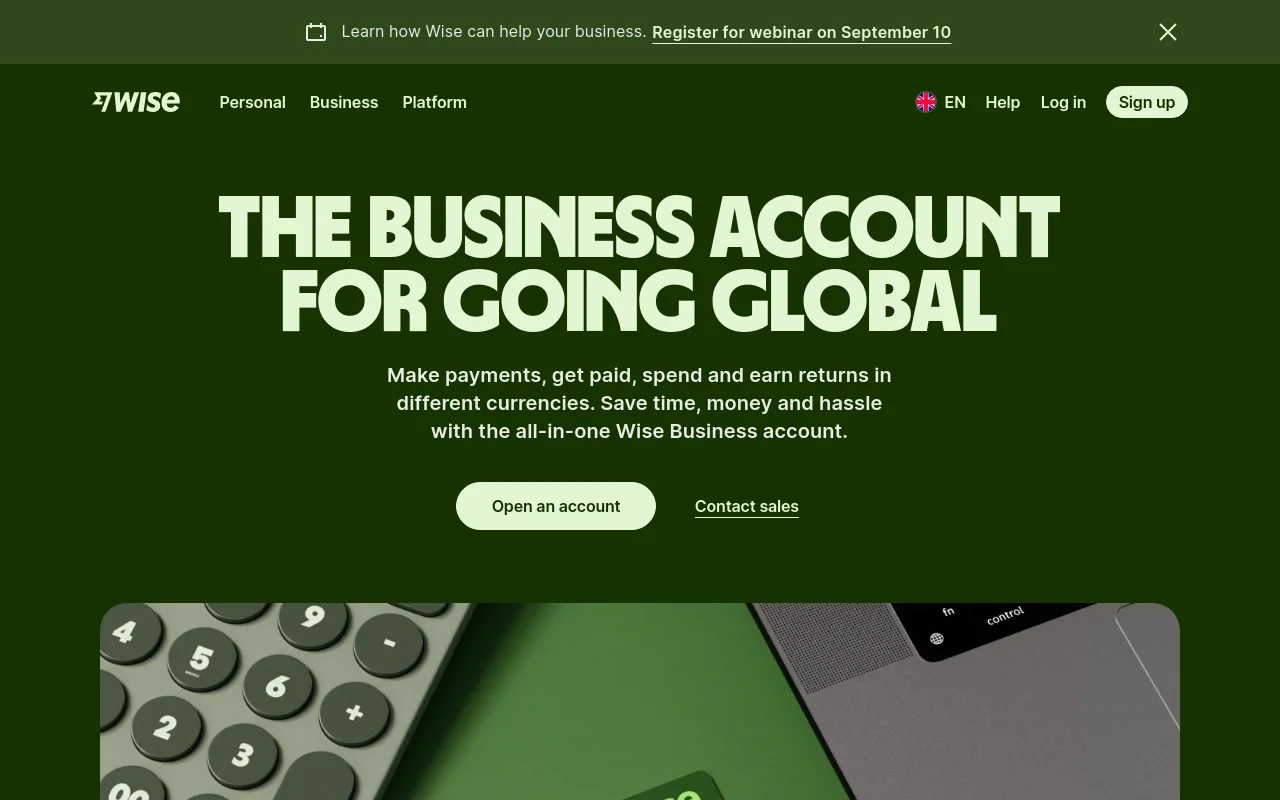
Wise Business homepage: the business account for going global
The Wise Business homepage on 5 August 2026.

What Wise Business Actually Is

It is a multi-currency account with local receiving details, a debit card, and outbound payments at the mid-market exchange rate. It is not a bank account, and it is not a payment processor: you cannot take card payments from customers with it. Think of it as the pipe your money moves through, not the till.

Per Wise's own pages as of today, the account covers:

  • Receiving in 22 currencies with local account details, so a US client can pay you by domestic ACH rather than an international wire.
  • Batch payments to up to 1,000 recipients in a single click. This is the feature founders consistently underrate. If you pay fifteen contractors monthly as fifteen manual transfers, this is the thing to fix first.
  • Cards for the team, physical and virtual, usable across 231 countries and territories.
  • Returns on idle balances in GBP, EUR and USD, added every working day with no lock-up. Treat it as an investment product rather than a savings account: Wise states rates track central bank rates and capital is at risk, with GBP holdings described as eligible for FSCS protection up to £85,000.
  • Accounting integrations and an API, plus invoicing and payment links.

What It Costs

Wise publishes its pricing, which is itself worth noting in a category built on hiding the margin inside the exchange rate. As listed on 5 August 2026:

  • £50 one-off to open the business account. There is no monthly subscription.
  • From 0.33% on transfers and conversions, varying by currency, always on top of the real mid-market rate rather than baked into it.
  • Volume discounts once monthly transfers pass roughly £20,000.
  • Free: holding money, receiving domestic payments in a set of currencies including USD, EUR, GBP, AUD, CAD, NZD, SGD and PHP, and Wise-to-Wise transfers in matching currencies.

Those are published list prices, not a quote for your corridor. Rates move constantly and vary by amount and funding method, so pull a live quote for the route you actually use before committing.

The Part Nobody Mentions: Wise Platform

Wise Platform homepage: infrastructure to power the world's money
Wise Platform on 5 August 2026, the infrastructure arm behind the consumer brand.

Wise runs a third product line alongside Personal and Business: Wise Platform, which it describes as "infrastructure to power the world's money". Banks and enterprises plug into the Wise network and deliver cross-border payments from inside their own products. It exposes an API, Swift connectivity, customisable onboarding and KYC, and covers 160-plus countries and 40-plus currencies with domestic payment-scheme access in eight markets.

Here is the detail that reframes the whole company. Wise Platform's named partners include Morgan Stanley, Nubank, Standard Chartered, Bank Mandiri, Google Pay, Bolt, and, tellingly, Monzo and N26. Two of the neobanks in our neobank comparison run their cross-border transfers on Wise's rails.

So when you compare "Wise vs my neobank" for an international transfer, there is a reasonable chance you are comparing Wise against a wrapper around Wise, with the wrapper's margin on top. That is the strongest argument for using it directly that exists, and Wise does not make it loudly.

Where Wise Business Loses

An honest review needs the losses, so:

It cannot take payments from customers. No card acquiring, no checkout. If revenue arrives by card, you need Stripe or similar alongside it. Wise moves money you already have.

Treasury and spend management are thin. Airwallex (StartupHub Score 66) is built around business accounts, treasury and spend controls with a heavier developer surface, and states it serves more than 200,000 businesses. If you want approval workflows and programmatic account creation, that is the closer fit.

Marketplace payouts are somebody else's speciality. If your money arrives from Amazon, Upwork or Fiverr rather than from named clients, Payoneer (69) is the accepted rail on those platforms, and acceptance beats price when the alternative is not getting paid at all.

It is not a bank. Wise is an e-money institution in most markets. Your money is safeguarded rather than deposit-insured in the way a bank account is. That is a normal and regulated arrangement, but it is not the same thing, and it is worth knowing which protection applies where you live.

Wise Business vs the Alternatives

PlatformStartupHub ScoreBest ForTakes Card Payments
Stripe74 / 100Getting paid by customersYes
Wise Business70 / 100Cheapest cross-border movement, batch payNo
Payoneer69 / 100Marketplace and platform payoutsVia Checkout
Airwallex66 / 100Treasury, spend controls, APIsYes

StartupHub Scores as tracked in the StartupHub.ai directory. The score rates company strength, not fit for your use case.

Who Should Actually Use It

Use Wise Business if: you pay contractors or suppliers abroad, you invoice clients in currencies you do not bank in, you want the exchange cost visible before you confirm, or you are paying enough people that batch payments save you a real afternoon each month.

Do not make it your only tool if: your revenue arrives by card, you need spend approvals and treasury automation, or your money comes from marketplaces that pay out to their own accepted rails.

The common setup at startup scale is Stripe for money in, Wise for money out, and a compliance layer such as Deel on top once contractors start looking like employees. We cover that split in how startups pay international contractors.

Open a Wise Business account

Frequently Asked Questions

How much does Wise Business cost?

There is a one-off £50 account opening fee and no monthly subscription. Transfers and conversions start from 0.33% depending on the currency, charged on top of the mid-market exchange rate rather than hidden inside it, with volume discounts once monthly transfers pass roughly £20,000. Holding money and receiving domestic payments in the supported currencies are free. Those are published list prices as of 5 August 2026, so check a live quote for your route.

Is Wise Business a bank account?

No. Wise operates as an electronic money institution in most markets, so your funds are safeguarded rather than covered by deposit insurance in the way a bank account is. It is a regulated and normal structure for this kind of service, but the protection is different, and which regime applies depends on your country.

Can Wise Business accept card payments from customers?

No. Wise moves money you already have and lets you receive bank transfers in 22 currencies, but it does not do card acquiring. For customers paying by card you need a processor such as Stripe alongside it. Most startups run both.

Wise Business or Airwallex?

Wise if the job is moving money cheaply across borders and paying a lot of people at once. Airwallex if you want business accounts, treasury and spend management with a deeper API, and especially if you need to take card payments too. Wise scores 70 in our directory against Airwallex's 66, but that measures company strength rather than fit: they solve overlapping but different problems.

Does Wise pay interest on business balances?

It offers returns on GBP, EUR and USD balances, added every working day with no lock-up period. Wise states the rates track central bank rates and that capital is at risk, so it behaves like an investment product rather than a savings account. GBP holdings are described as eligible for FSCS protection up to £85,000. Check the current terms before moving working capital into it.

The Bottom Line

Wise Business is the right default for a startup moving money across borders, and the batch-payment feature is the single strongest reason to set it up before you think you need it. It is deliberately narrow: it will not take your customers' card payments and it will not run your treasury.

The most interesting thing about it is the part Wise markets least. When Morgan Stanley, Standard Chartered, Monzo and N26 all run cross-border payments on Wise Platform, the question stops being whether Wise is good enough for your startup and becomes why you would pay someone else's margin to use it second-hand.

© 2026 StartupHub.ai. All rights reserved. Do not enter, scrape, copy, reproduce, or republish this article in whole or in part. Use as input to AI training, fine-tuning, retrieval-augmented generation, or any machine-learning system is prohibited without written license. Substantially-similar derivative works will be pursued to the fullest extent of applicable copyright, database, and computer-misuse laws. See our terms.