6 Best Money Transfer Apps: Wise, Revolut, Remitly and More

Most money transfer comparisons are a fee table that expired the week it was published. We rate Wise, Payoneer, Remitly, Revolut, Western Union and Xoom on the company data behind them: funding raised, headcount and the 0-100 StartupHub Score. Wise leads the group at 70.

Wise homepage advertising fast international money transfers to over 140 countries
The Wise homepage, captured 5 August 2026.

Picking the best money transfer app usually means reading a fee table that expired the week it was published. We took a different angle. StartupHub.ai tracks Wise, Revolut, Remitly, Payoneer and their peers as companies, so alongside the product comparison you get numbers most review sites never show: capital raised, headcount, and the 0-100 StartupHub Score we assign across the directory. Wise leads this group at 70.

That matters more than it sounds. A transfer provider holds your cash in transit. Scale, funding and staffing are the closest public proxies for whether a company can absorb a bad quarter, and they do not change every time a corridor reprices.

On fees and rates: pricing in this category changes constantly and varies by corridor, amount and payment method. We deliberately do not quote a percentage or a rate below, because any number written today is wrong by the time you read it. Every provider links to its live pricing. Pull a quote for your specific route before you send. Screenshots were captured on 5 August 2026 and show each provider's live homepage on that date, including any promotion running at the time.

How We Scored These Apps

The StartupHub Score is a 0-100 rating computed across every company in our directory from funding, team size, traction and data completeness. It measures company strength, not how cheap a given transfer is. Read it as "how solid is the business behind this app", then compare live quotes for the corridor you need.

1. Wise: Best Overall for Transparent Pricing
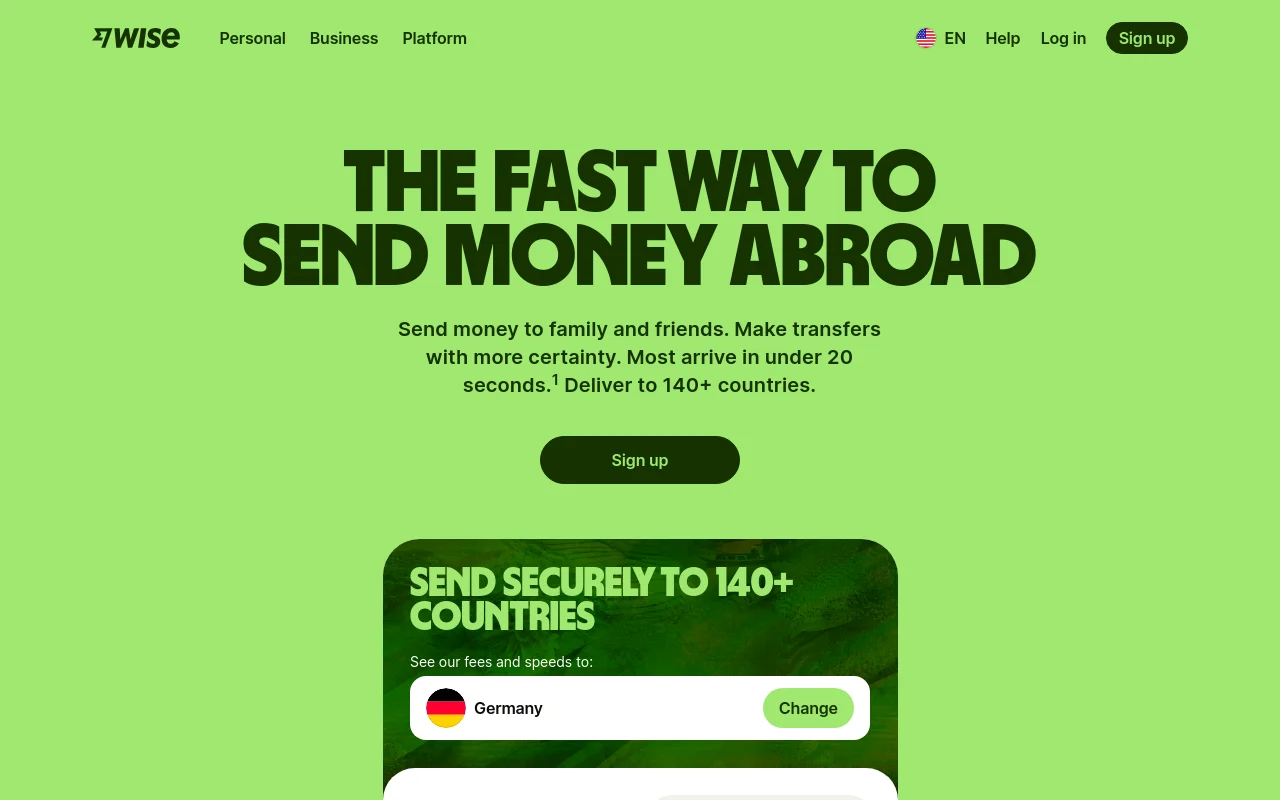
Wise homepage advertising fast international money transfers to over 140 countries
The Wise homepage on 5 August 2026. Click through for live rates.

Wise (formerly TransferWise) is the reference point for the category. It was built on one idea: show the real mid-market exchange rate, then charge a visible fee on top, rather than burying a margin inside a "zero fee" rate. That model is why nearly every competitor now advertises rate transparency.


As of today its homepage states delivery to more than 140 countries, with most transfers arriving in under 20 seconds. Founded in 2011 in London, Wise employs roughly 10,800 people and raised about $1.1 billion before listing publicly. It holds the highest StartupHub Score here at 70.

What changed recently. Two updates matter if you already use Wise:

  • Returns on held balances. Wise now offers an interest-style product on GBP, USD and EUR balances, with returns added every working day and funds not locked away. Wise states rates track central bank rates and that capital is at risk, so treat it as an investment product rather than a savings account. GBP holdings are described as eligible for FSCS protection up to £85,000.
  • More local account details. Wise expanded local account details to 14 currencies during 2026, adding Brazilian real, Hong Kong dollar, Malaysian ringgit, Philippine peso and Romanian leu. That is directly useful if you invoice clients in those markets.

How the pricing is structured. Wise's own pricing page states it uses only the mid-market rate, with no subscription or plan: you pay per service. Transfers and conversions start from 0.33%, varying by currency. Holding money, registering an account, receiving domestic payments in a set of currencies including USD, EUR, GBP, AUD, CAD, NZD, SGD and PHP, and Wise-to-Wise transfers in matching currencies are listed as free. The debit card is a one-time £7, ATM withdrawals are free up to £250 per month and 2.69% above that, and receiving via SWIFT carries a small fixed fee. Those are published list prices as of 5 August 2026, not a quote for your corridor.

One warning if you are in Thailand. Wise is rolling out new limits on Thailand-registered accounts, with changes landing through 2026 and existing Wise cards linked to Thai accounts being cancelled. If that is you, check the Wise help centre for your account's date rather than relying on any comparison article.

Best for: anyone who wants to see exactly what a transfer costs before confirming it, plus freelancers and remote workers holding several currencies in one account.

Check live Wise rates for your corridor

2. Payoneer: Best for Freelancers and Marketplace Payouts

Payoneer homepage promoting its multi-currency account for global payments
The Payoneer homepage on 5 August 2026.

Payoneer solves a narrower problem than Wise and solves it well: getting paid by international clients, marketplaces and platforms. Founded in 2005 in New York, it employs around 3,200 people and raised roughly $544 million. StartupHub Score: 69, essentially level with Wise.

Payoneer's own site states 70 supported currencies, coverage across more than 190 countries and territories, support in 17 languages, and 5 million customers. Beyond receiving payments it now runs Payoneer Checkout for your own storefront, commercial Mastercard cards with team spend limits, business funding, and workforce management covering hiring, onboarding and payroll across 160-plus countries. You can also pay UK and EU VAT authorities directly from GBP and EUR balances.

The 2026 addition worth noting: Payoneer has launched a stablecoin wallet in beta, powered by Bridge, positioning stablecoin rails alongside fiat on the same platform. That is the clearest sign yet that mainstream cross-border payment companies now treat stablecoins as a settlement rail rather than a crypto side product, and it is the kind of move we track across the StartupHub directory.

Best for: freelancers, agencies and sellers receiving money from overseas platforms such as Amazon, Upwork or Fiverr.

3. Remitly: Best for Recurring Remittances

Remitly homepage with the tagline Built for lives across borders and app store ratings
The Remitly homepage on 5 August 2026.

Remitly was built specifically for remittances: money sent home regularly, often where the recipient wants cash or a mobile wallet rather than a bank deposit. Founded in 2011 in Seattle, it employs around 3,300 people and holds a StartupHub Score of 66.

The product is organised around corridors and delivery methods rather than a multi-currency account. It offers roughly 490,000 cash pickup locations worldwide alongside bank and mobile wallet delivery, a guaranteed delivery time with fees refunded if a transfer lands late, and 24/7 support in 18 languages. Its homepage today advertises 4.8 stars on Google Play from over 1.4 million ratings and 4.9 on the App Store from over 4.2 million, which is the largest consumer review base in this comparison by a wide margin.

It has also broadened past pure remittance: there is now a Remitly Card and a Remitly Business product alongside the core send-money flow. On the regulatory side, Remitly discloses licensing as a Money Transmitter with the New York State Department of Financial Services under NMLS number 1028236, plus separate registrations in Massachusetts, Rhode Island and Puerto Rico. That is the kind of detail worth checking for any provider you hand money to.

Best for: regular remittances, especially where the recipient wants cash pickup or mobile money.

4. Revolut: Best All-in-One Money App

Revolut homepage with the tagline Change the way you money and a Standard account with no monthly fees
The Revolut homepage on 5 August 2026.

Revolut is not primarily a transfer service. It is a neobank that happens to do currency exchange well, and that distinction decides whether it suits you. Founded in 2015 in London, it employs roughly 8,000 people and has raised about $5.9 billion, by far the most capital in this group. StartupHub Score: 62.

The lower score relative to Wise reflects our directory weighting, not a verdict on the product. Taking Revolut's published US plan page as of 5 August 2026, the structure is:

  • Standard is $0 per month, Premium $9.99 and Metal $16.99.
  • Currency exchange is capped by plan: $1,000 per month on Standard, $10,000 on Premium, unlimited on Metal, with fair usage fees above the limit.
  • The weekend markup is real and specific. Standard pays an extra 1% on exchanges outside foreign-exchange market hours, which Revolut defines as 5:00pm Friday to 6:00pm Sunday Eastern Time. Premium and Metal pay no out-of-hours fee. This is the single most missed cost in the category: the same exchange can cost 1% more purely because you did it on a Saturday.
  • ATM withdrawals carry 2% on out-of-network machines on Standard, with monthly free allowances on the paid tiers.
  • Paid plans discount international transfer fees by 20% on Premium and 40% on Metal.

Two things worth knowing beyond price. Revolut states plainly on its US pages that it is not a bank: US savings services are provided through Cross River Bank, a Member FDIC institution. And plan structures differ by region, with more tiers in the UK and EU than the US, so check your local page rather than this one. There are also Kids and Teens accounts for ages 6 to 17 and a separate Revolut Business offering.

Best for: people who want one app for spending, holding and exchanging currency rather than a dedicated transfer tool. If you send large amounts at a weekend on the free plan, price it against Wise first.

5. Western Union: Best for Cash Pickup Reach

Western Union homepage with a live send money quote and Trustpilot rating
The Western Union homepage on 5 August 2026. The quote shown is a live example from that date, including a promotional first-transfer offer, and is not the rate you will be quoted today.

Western Union has been moving money since 1851, and its advantage is physical: an agent network reaching places a purely digital provider cannot serve. If your recipient has no bank account, or lives somewhere digital delivery is unreliable, reach beats price.

Its site currently shows a Trustpilot score of 4.3 from more than 166,000 reviews, and runs a promotional zero fee on a first online transfer. Credit where due: the homepage states plainly that Western Union makes money from currency exchange, which is the disclosure the whole category was once criticised for hiding.

Best for: cash pickup, and corridors where digital-only providers do not operate.

6. Xoom: Best if You Already Live in PayPal

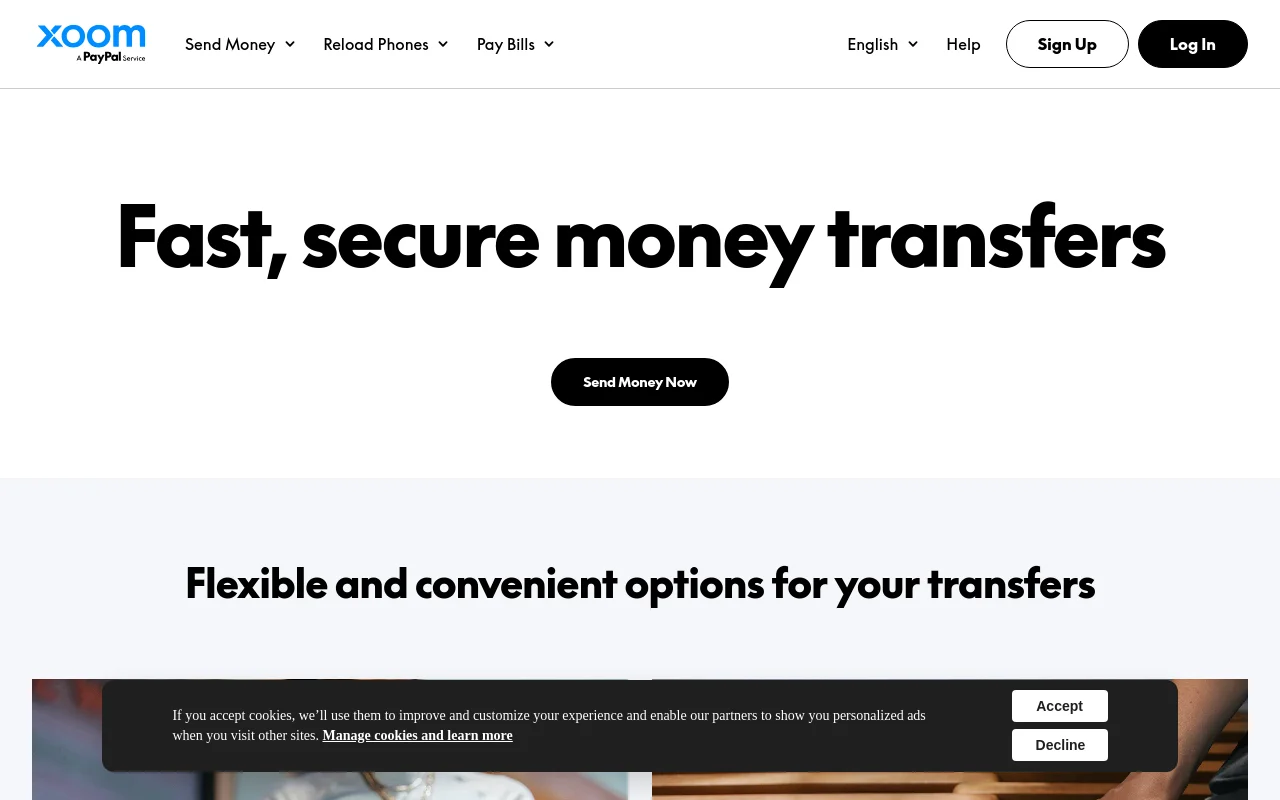
Xoom homepage, a PayPal service, advertising fast secure money transfers
The Xoom homepage on 5 August 2026.

Xoom is PayPal's international transfer arm, and its case is convenience: if your money already sits in PayPal and your recipient is in a supported country, it removes a step. Beyond transfers it also handles phone top-ups and bill payments in some markets, which is genuinely useful if you support family abroad. Compare it against a dedicated provider before assuming the convenience is free.

Best for: existing PayPal balances, occasional transfers, and paying bills or topping up phones overseas.

Neobanks That Also Send Money Abroad

A digital bank is not the same product as a transfer service, and the difference costs people money. A transfer app is built to move one amount to one recipient at the best rate it can. A neobank is built to be your everyday account, and international transfers are a feature bolted onto that.

Several are worth knowing if you want both jobs done in one app. From our directory: Monzo (StartupHub Score 71) and Starling Bank (66) in the UK, N26 (66) and bunq (54) in the EU, and Revolut (62) covered above. Each handles international payments to some degree, and for modest occasional amounts the convenience often outweighs a small rate difference.

Two big names do not belong on this list, and it is worth saying so plainly because they turn up in a lot of "money transfer" roundups that should know better. Chime (our highest score in the whole digital banking set at 77) and Varo (70) are US domestic accounts. They are strong products, but they are not built to send money to another country, so choosing one for that job means solving the wrong problem well.

We compare the digital banks properly, on their own terms, in our guide to the best neobanks and digital banks.

Sending Money for a Business, Not Yourself?

Everything above is the personal account. If you are paying contractors, invoicing clients abroad or running payroll across currencies, the product you actually want is Wise Business: it adds local receiving details in 22 currencies, batch payments to up to 1,000 recipients in one click, team cards, an API and accounting integrations, for a one-off setup fee rather than a subscription. The batch payment feature alone is worth it if you currently pay a handful of people one transfer at a time.

We reviewed it separately in our Wise Business review, including what it costs and where it loses to Airwallex and Payoneer. If your question is which rail your own product should run on rather than which account to open, see Wise Platform vs Stripe.

Comparison Table

AppStartupHub ScoreBest ForEmployeesFounded
Wise70 / 100Transparent pricing, multi-currency~10,8002011
Payoneer69 / 100Freelancer and marketplace payouts~3,2002005
Remitly66 / 100Recurring remittances, cash and wallet payout~3,3002011
Revolut62 / 100All-in-one money app~8,0002015
Western UnionNot yet scoredCash pickup reachNot disclosed1851
XoomNot yet scoredExisting PayPal users, bill payNot disclosedNot disclosed

StartupHub Scores and company data as tracked in the StartupHub.ai directory. Employee counts are approximate and move quarter to quarter.

What the Company Numbers Tell You That a Fee Table Does Not

Two things stand out once you line these companies up side by side.

First, funding does not track product focus. Revolut has raised roughly $5.9 billion, more than five times Wise's $1.1 billion, yet Wise is the stronger dedicated transfer product and scores higher in our directory. Revolut raised to build a bank, not a transfer rail. Pick on brand size alone and you end up with the wrong tool.

Second, headcount tracks the shape of the problem each company solves. Wise runs about 10,800 people against Remitly's 3,300, because multi-currency accounts, local bank details and regulatory permissions across many markets are far heavier to operate than a focused set of remittance corridors. Neither is better. They are answers to different questions.

Frequently Asked Questions

What is the best money transfer app overall?

For most people sending money internationally, Wise is the strongest all-round pick. It holds the highest StartupHub Score in this comparison at 70, it is publicly listed, and it quotes the mid-market rate with the fee stated separately rather than folded into the exchange rate. If your need is narrower, a specialist may beat it: Payoneer for marketplace payouts, Remitly for regular remittances home.

Is Wise cheaper than a bank?

Usually, though it depends on the corridor, the amount and how you fund the transfer. The structural difference is that a typical bank builds its margin into the exchange rate it offers you, while Wise quotes the mid-market rate and charges a stated fee. That makes the cost visible, which is not the same as always being lowest. Compare a live quote for your specific route.

What is the difference between Wise and Revolut?

Wise is a dedicated cross-border money service built around transparent transfers and multi-currency accounts. Revolut is a neobank where currency exchange sits alongside spending, budgeting and investing, with a monthly exchange allowance on the free plan and an extra markup at weekends. Choose Wise if transfers are the job. Choose Revolut if you want one app for your everyday money.

Can you earn interest on a Wise balance?

Wise offers a returns product on GBP, USD and EUR balances, with returns added every working day and no lock-up period. It is an investment product rather than a savings account: Wise states that rates track central bank rates and that capital is at risk. GBP holdings are described as eligible for FSCS protection up to £85,000. Check the current rate and terms on the Wise site before moving money into it.

Why does Revolut cost more at the weekend?

Because currency markets close. Revolut defines foreign-exchange market hours as every hour except 5:00pm Friday to 6:00pm Sunday Eastern Time, and on the free Standard plan it adds an extra 1% on exchanges made in that window. Premium and Metal do not pay it. If you are moving a meaningful amount and it can wait until Monday, waiting is the cheapest optimisation available to you.

Can I use Chime or Varo to send money abroad?

No. Chime and Varo are US domestic accounts and are not built for international transfers, despite often appearing in money transfer roundups. Use a dedicated cross-border provider such as Wise or Remitly for that job. Chime and Varo are covered in our neobank comparison instead, where they compete on the thing they are actually good at.

Are money transfer apps safe?

The established providers here are regulated in the markets they serve, and several are publicly listed. Safety in practice comes down to using a regulated provider, confirming recipient details before sending, and never moving money on behalf of someone you met online. Regulatory protection differs by country, so check what applies where you live.

How is the StartupHub Score different from a review rating?

It rates the company, not the transaction. The score is computed from funding, team size, traction and data completeness across every company in our directory, so it answers "how solid is this business" rather than "was my transfer cheap". Use it alongside a live fee quote, not instead of one.

Final Verdict

Wise is the pick for most people sending money internationally: the highest StartupHub Score here at 70, a publicly listed parent, delivery to 140-plus countries with most transfers arriving in seconds, and a pricing model that shows the real rate before you commit. Payoneer is the better tool if your money arrives from platforms and marketplaces rather than from a person. Remitly is the better tool if you send the same amount home every month and your recipient wants cash or a mobile wallet. Revolut wins only if you want one app for everything and transfers are secondary.

Whichever you choose, pull a live quote for your exact corridor and amount first. In this category the ranking changes by route, and no comparison article, including this one, can tell you what your specific transfer will cost today.

© 2026 StartupHub.ai. All rights reserved. Do not enter, scrape, copy, reproduce, or republish this article in whole or in part. Use as input to AI training, fine-tuning, retrieval-augmented generation, or any machine-learning system is prohibited without written license. Substantially-similar derivative works will be pursued to the fullest extent of applicable copyright, database, and computer-misuse laws. See our terms.