Healthcare

Amgen CTO: Codex AI Empowers Scientists, Not Replaces Them

Amgen's CTO, Sean Bruich, discusses how Codex AI empowers scientists, shifting focus from coding to patient impact and accelerating drug discovery.

StartupHub.ai Staff

By StartupHub.ai Staff, reviewed by Daniel Singer, Editor

3 min read

Visual TL;DR
Amgen's Scientific ChallengesDriver
complex data analysis and coding tasks hindering progress
From the article 3 mentionsIn a discussion hosted by OpenAI, Amgen's Senior Vice President and Chief Technology Officer, Sean Bruich, elaborated on how the company is leveraging Codex AI to enhance its scientific endeavors.
Codex AI IntroductionCore
Amgen's CTO Sean Bruich discusses Codex AI
From the article 8 mentionsBruich articulated a vision where AI tools like Codex move beyond mere code generation.
Empowering ScientistsEffect
AI augments human expertise, not replaces it
From the article 4 mentionsThis democratizes access to advanced data analysis, empowering a broader range of scientific professionals within Amgen.
OpenAI DiscussionContext
From the article 2 mentionsThe full discussion can be found on OpenAI Youtube's YouTube channel.
Focus on Critical ThinkingEffect
scientists spend less time coding, more time thinking
From the articleBruich emphasized that the goal is not to replace human expertise but to augment it, allowing Amgen's diverse scientific talent, from statisticians to software engineers, to dedicate more time to critical thinking and patient impact.
Streamlining R&DEffect
abstracting data analysis complexities for faster insights
Patient Impact FocusOutcome
accelerating creation of life-changing medicines
From the article 2 mentionsUltimately, the adoption of Codex AI is framed within Amgen's broader mission: to focus on patients.
Contents(3)

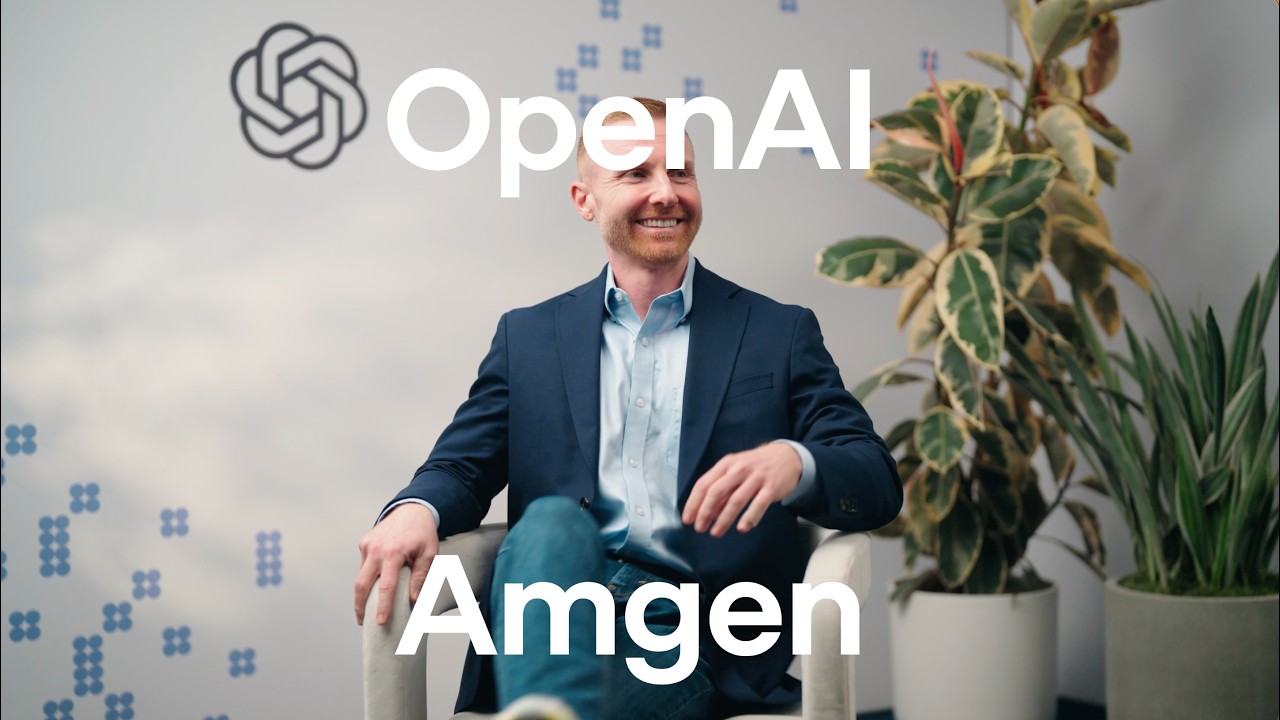
In a discussion hosted by OpenAI, Amgen's Senior Vice President and Chief Technology Officer, Sean Bruich, elaborated on how the company is leveraging Codex AI to enhance its scientific endeavors. Bruich emphasized that the goal is not to replace human expertise but to augment it, allowing Amgen's diverse scientific talent, from statisticians to software engineers, to dedicate more time to critical thinking and patient impact.

Bruich articulated a vision where AI tools like Codex move beyond mere code generation. Instead, they are designed to abstract away the complexities of data analysis, enabling researchers to focus on the underlying scientific questions and the ultimate goal of creating life-changing medicines. He stated, "Everything about Codex is about spending less time writing code and more time thinking about how to make an impact."

The full discussion can be found on OpenAI Youtube's YouTube channel.

Codex Helps Amgen Focus on Patients - OpenAI Youtube
Codex Helps Amgen Focus on Patients, from OpenAI Youtube

Empowering Scientific Discovery with AI

The core of Bruich's message centered on how Codex AI facilitates a shift in how scientific work is conducted. Rather than getting bogged down in the intricacies of programming and data wrangling, scientists can utilize Codex to process and understand vast datasets more efficiently. This allows them to focus on higher-level tasks such as hypothesis generation, experimental design, and the interpretation of results.

Bruich explained, "The data analysis capabilities inside Codex are incredible." He further detailed how the AI can interpret complex data structures from prompts, allowing scientists to retrieve insights without needing to be expert coders themselves. This democratizes access to advanced data analysis, empowering a broader range of scientific professionals within Amgen.

Streamlining Research and Development

The application of Codex AI at Amgen is seen as a strategic move to accelerate the entire research and development pipeline. By automating or simplifying time-consuming coding tasks, the company can expedite stages such as data analysis, experimental planning, and even the early stages of drug discovery. This efficiency gain is crucial in the highly competitive pharmaceutical industry.

Bruich highlighted that the impact of AI is not about one large, singular advancement but rather a series of incremental improvements across various scientific workflows. "It's a series of bets spread across lots of little places that then build together to make a really big impact overall," he noted. This suggests a comprehensive integration of AI tools across different departments and research areas within Amgen.

Focusing on Patients

Ultimately, the adoption of Codex AI is framed within Amgen's broader mission: to focus on patients. By freeing up valuable scientist time, reducing the burden of repetitive tasks, and accelerating discovery, the company aims to bring novel therapies to patients more quickly and effectively. The ability to interpret data and generate actionable insights faster translates directly into improved patient outcomes.

Mentioned in this story

TopicsArtificial IntelligenceHealthcareAmgenOpenAI

StartupHub.ai StaffDaniel SingerWritten by StartupHub.ai Staff, Editorial teamReviewed by Daniel Singer, EditorAbout

StartupHub.ai Staff, Editorial team

The staff writers of StartupHub.ai, ranging from investment analysts to avid AI tool users, early adopters and critical enthusiasts. Backgrounds span engineering, business and the arts. We hold every piece to rigorous standards of research and review.

Daniel Singer, Editor

Daniel Singer is an AI expert who has been writing about, covering and building AI technology since 2018.

More from Daniel Singer

Get the free daily brief every morning

Every morning the day's AI news, new AI startups and new funding rounds. Free and takes a few minutes to read, unsubscribe at any time.

Join 64,000 other subscribers.

Test your Agent Readiness now

Paste your website. How well ChatGPT, Claude and the other agents can read and use a site, in about a minute.

The videos behind the news, one flip at a time

The feed mixes the videos from our articles with startup demos and you flip through them like TV channels for free with no signup.