

Gemma 4 Good Challenge Winners Showcase Edge AI Innovation

6 min read
Gemma 4 Good Challenge Winners Showcase Edge AI Innovation
Google Blog
Visual TL;DR
Gemma 4 Good ChallengeCore
From the article 2 mentionsGoogle has announced the winners of its Gemma 4 Good Challenge, a competition that spurred developers to create AI solutions for global challenges.
Edge AI InnovationContext
deploying AI models on resource-constrained hardware is increasingly important
From the article 4 mentionsThe event underscored the growing importance of deploying AI models on resource-constrained hardware, often referred to as edge AI.
GEM-4: Robotic AssistantOutcome
From the articleFirst place went to GEM-4, a robotic assistant for the elderly and disabled that uses a Gemma 4 31B model for visual labeling and a fine-tuned controller for physical actions.
Trido: Digital WhiteboardOutcome
second place winner, voice-controlled for educators, uses locally hosted Gemma 4 E2B
From the articleSecond place was awarded to Trido, a voice-controlled digital whiteboard aimed at educators.
Gemma 4 Good ChallengeCore
From the article 2 mentionsGoogle has announced the winners of its Gemma 4 Good Challenge, a competition that spurred developers to create AI solutions for global challenges.
Edge AI InnovationContext
deploying AI models on resource-constrained hardware is increasingly important
From the article 4 mentionsThe event underscored the growing importance of deploying AI models on resource-constrained hardware, often referred to as edge AI.
GEM-4: Robotic AssistantOutcome
From the articleFirst place went to GEM-4, a robotic assistant for the elderly and disabled that uses a Gemma 4 31B model for visual labeling and a fine-tuned controller for physical actions.
Trido: Digital WhiteboardOutcome
second place winner, voice-controlled for educators, uses locally hosted Gemma 4 E2B
From the articleSecond place was awarded to Trido, a voice-controlled digital whiteboard aimed at educators.
Efficient AI HardwareDriver
companies focusing on efficient AI inference chips and optimized software stacks gain relevance
From the article 4 mentionsStartupHub.ai data indicates a growing demand for AI hardware solutions capable of efficient on-device processing, with specialized accelerators and optimized inference engines becoming key differentiators.
Embodied AIContext
From the articleThis project exemplifies embodied AI, moving AI reasoning into tangible physical assistance.
Broad Application RangeEffect
winning entries demonstrate diverse practical uses of edge AI solutions
From the articleThe winning entries demonstrate a broad range of applications.

Gemma 4 Good Challenge Winners Showcase Edge AI Innovation

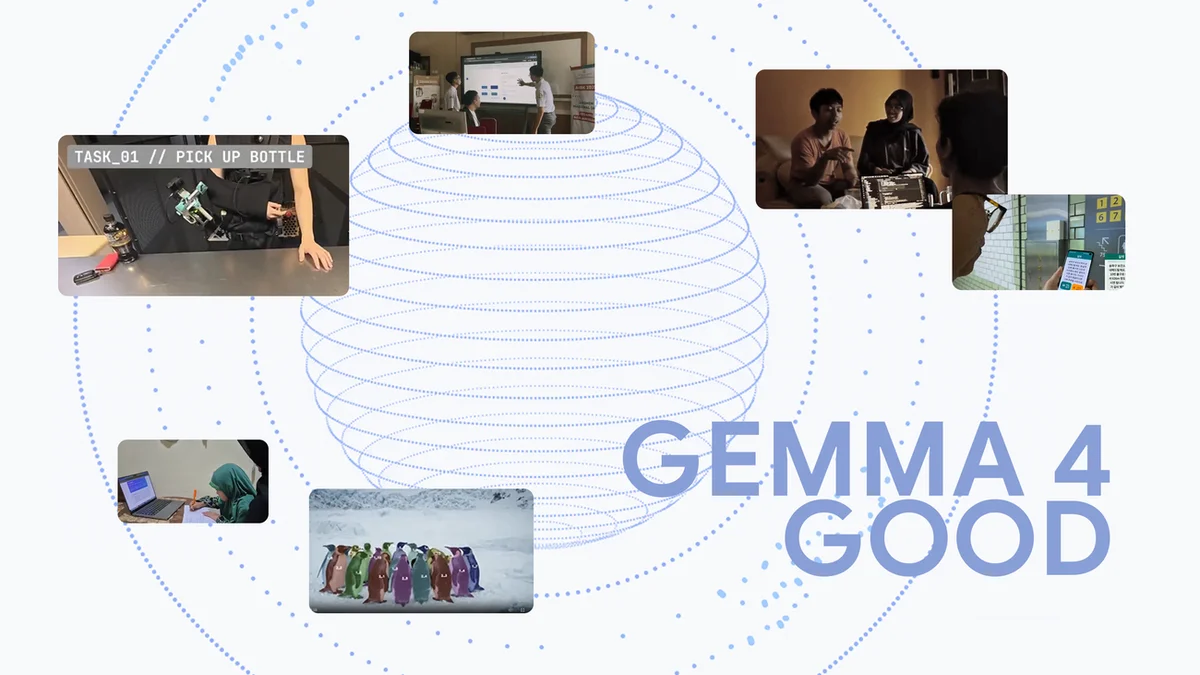
Google has announced the winners of its Gemma 4 Good Challenge, a competition that spurred developers to create AI solutions for global challenges. The event underscored the growing importance of deploying AI models on resource-constrained hardware, often referred to as edge AI.

This competition highlights a critical trend in the AI hardware sector. Companies focusing on efficient AI inference chips and optimized software stacks are seeing increased relevance.

The winning entries demonstrate a broad range of applications. First place went to GEM-4, a robotic assistant for the elderly and disabled that uses a Gemma 4 31B model for visual labeling and a fine-tuned controller for physical actions. This project exemplifies embodied AI, moving AI reasoning into tangible physical assistance.

Second place was awarded to Trido, a voice-controlled digital whiteboard aimed at educators. It utilizes a locally hosted Gemma 4 E2B model for dynamic content generation, praised for its user empathy and offline capabilities, making it suitable for budget laptops.

PenguinAgent secured third place with an offline-first research application for wildlife ecologists. This tool uses Gemma 4 26B to analyze video frames and telemetry data for ecological studies, emphasizing data privacy at the edge.

The fourth-place winner, DEMENTOR, is an ambient edge companion and sensor network designed for individuals with dementia. It leverages Gemma 4 E2B for behavioral monitoring and memory assistance, prioritizing user safety and data privacy.

Additional prizes recognized specific areas. The Global Resilience Prize went to Acuífero·Vigía, an offline flood early warning system in South America. The AI Trust & Safety Prize was awarded to TrueVoice, a solution combating voice-cloning fraud by analyzing vocal anomalies on edge devices.

The Digital Equity & Inclusion Prize celebrated Gem-Care, which fine-tuned Gemma 4 E2B to improve Automatic Speech Recognition for individuals with speech disabilities. The Future of Education Prize recognized CodeBuddy, an offline Socratic programming tutor for Indonesian students.

The Health & Sciences Prize was claimed by Project Rosie, an AI agent for canine oncology vaccine development. The LiteRT Prize highlighted Gilbeot (길벗), an on-device walking navigation assistant for the elderly. The llama.cpp Prize went to PreVillage, a voice-first WhatsApp navigator for accessing government services in Nepal.

The Ollama Prize was awarded to PathOS, an offline histopathology screening assistant for cancer detection. Unsloth Prize winner MindBridge developed a mental health screening tool for regional Hindi dialects. Finally, the Cactus Prize recognized KawanIsyarat, an offline communication assistant for deaf and hard-of-hearing BISINDO users.

These projects showcase a significant shift towards practical, privacy-focused AI deployments. StartupHub.ai data indicates a growing demand for AI hardware solutions capable of efficient on-device processing, with specialized accelerators and optimized inference engines becoming key differentiators. The success of these Gemma 4 Good Challenge winners underscores the market's readiness for AI that operates effectively without constant cloud connectivity.

© 2026 StartupHub.ai. All rights reserved. Do not enter, scrape, copy, reproduce, or republish this article in whole or in part. Use as input to AI training, fine-tuning, retrieval-augmented generation, or any machine-learning system is prohibited without written license. Substantially-similar derivative works will be pursued to the fullest extent of applicable copyright, database, and computer-misuse laws. See our terms.