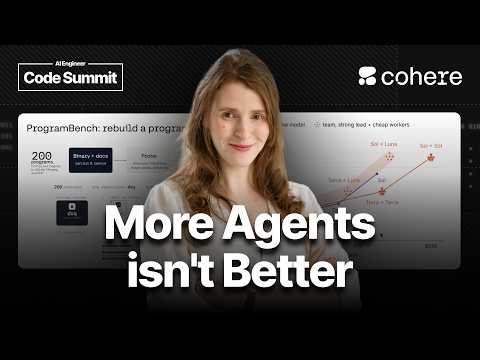
A Sol lead paired with Luna planners matched an all-Sol team at 60% lower cost, Nouha Dziri told AI Engineer, according to her Cohere tests.
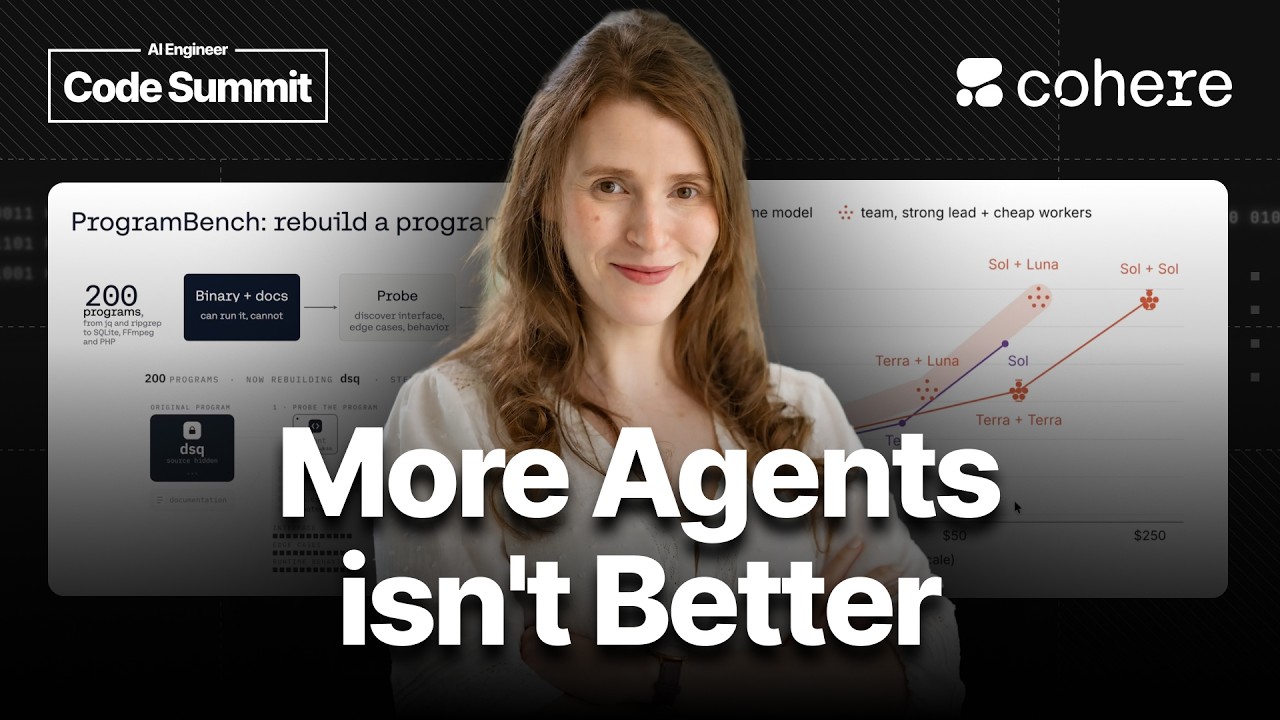
Dziri, a senior researcher at Cohere, described a minimal hierarchical harness where a lead delegates by tool to workers in one shared workspace and then consolidates compact reports. With minimal prompting, she said a blocking lead beat a solo agent by almost 10 points but cost four to seven times as much, while an async lead that kept working instead of waiting often ignored late reports or submitted early and wasted worker effort.
Planning was where extra agents paid. Dziri said allocating workers only to exploration matched full-team prompting at half the cost, with each planning dollar buying 1.6 times more reward than implementation or verification, according to her efficiency metric. The full-team run kept delegating through implementation and verification for another 830 calls and about $500 in spend, she said, for the same reward and 2.4 times less reward per delegation than one early planning burst.
That result reflects the benchmark. ProgramBench asks a model to rebuild a program from its binary and specification so the copy compiles and passes tests, a framing maintained by GPT-5.6 task data where Dziri tested Luna, Terra and Sol in rising capability and cost, while Vals AI lists tasks including the PHP interpreter and FFmpeg where she said the best frontier model passes only 10% of tests. Against that bottleneck, a strong lead set the ceiling and workers set the price, she said, with Sol plus Luna matching Sol plus Sol and Terra plus Luna reaching 51% versus 57% for Sol alone, a controller effect also claimed by DeepSeek-V4.1-Flash-1017 with gains across reasoning, coding and agentic tasks.
Implementation workers failed for concrete reasons, Dziri said, with 84% of messages going straight to the lead, workers stepping outside narrow slices and a weak plan forcing the lead into costly stitching and delay. The numbers do not show pricing beyond this setup or whether the planning edge holds outside black-box discovery, since she said Commit Zero reversed the result and rewarded implementation help because docs and tests were given. The read would change with public costs per run and a second benchmark family. Can a team stay cheap if discovery is not the bottleneck?