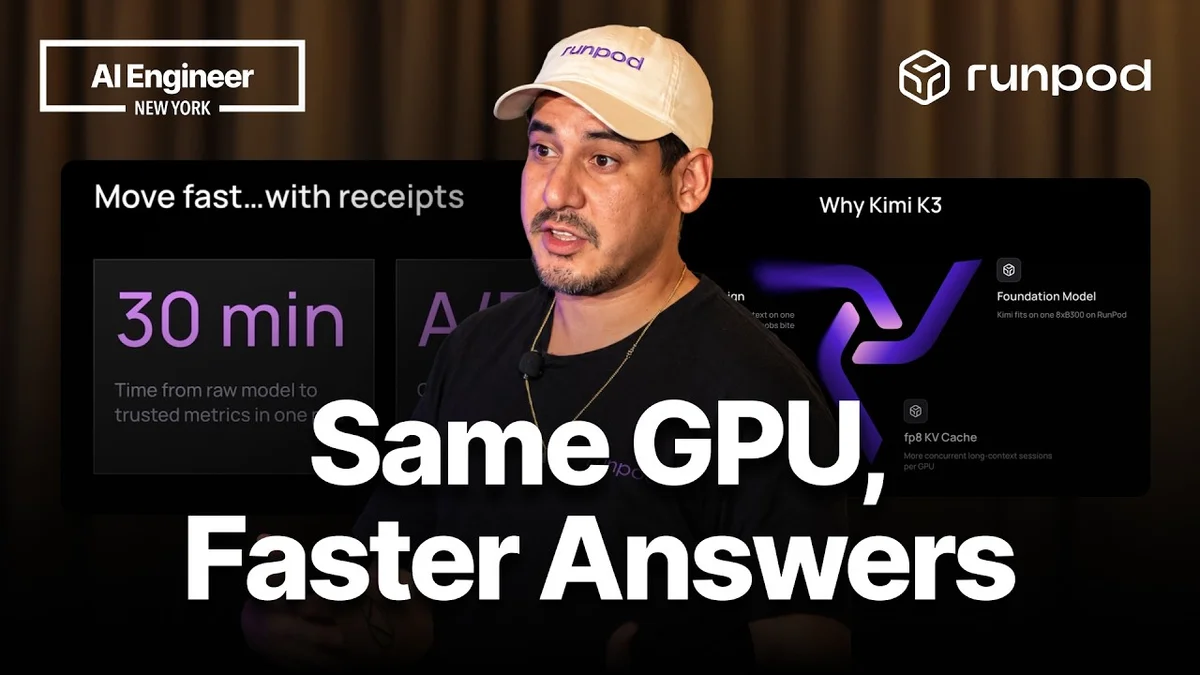
Forward deploy engineer Chris Vela came to AI Engineer with a dashboard, not a recipe, to show how vLLM configs actually behave on Runpod.
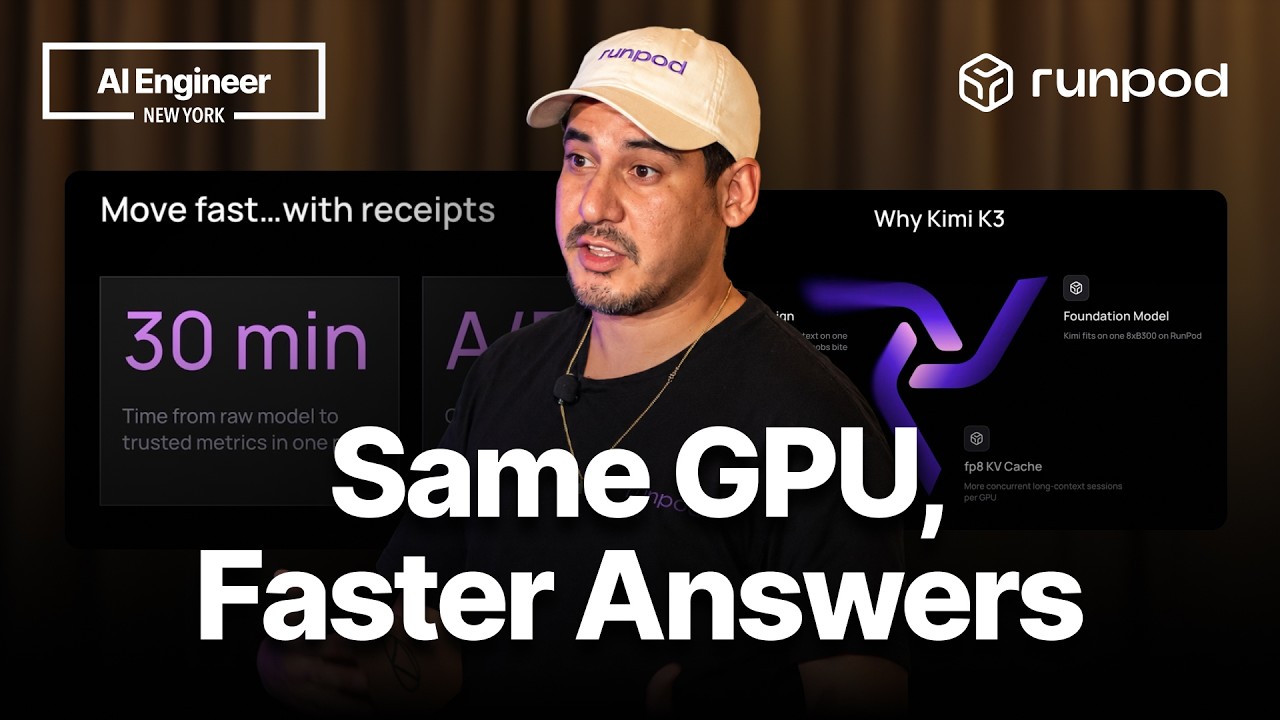
The tool is BenchPod, a template Vela said is not yet public but expected by the end of the month. It is a Docker image wrapping the vLLM OpenAI-compatible server with a FastAPI application on top, a watchdog that self-heals failed nodes, and live metrics that persist to storage so agents can query them directly. Vela ran it on a B300 pod to test Kimi K3, showing a UI that surfaces GPU type, CUDA version and config YAML in one place. He said Kimi K3 fails on CUDA 12.8 and needs 13.0, and fails on older vLLM builds like 0.27, which is why version pinning and one-click config swaps matter more than copy-pasted recipes.
Everyone is guessing, Vela argued.
He said teams grab the newest model without asking what they need it for, whether it is a coding agent or simple summarization, how long the context window must be, or how many concurrent users will hit it. That leads to the wrong vLLM nightly, the wrong KV cache sizing, and cold starts that waste 30 minutes just downloading and loading 83 billion parameter weights, Vela said. His demo fixed one knob, max number of batch tokens, and compared runs at concurrency 1, 8, 64 and 192. Raising batch tokens barely moved time to first token but cut inter-token latency noticeably on long jobs, Vela said, and the in-house Kimi K3 pod recovered automatically after a GPU failure Sunday across four nodes with about a nine minute cold start.
The bench is not free of tradeoffs. Vela said a single B300 cannot reach Kimi K3's advertised one million token context, you get about half, and even with Runpod's pitch as the AI Developer Cloud for teams building, training and scaling AI applications, supply is tight and he had only one B300 live for the demo. He pegged a B300 node at roughly 40,000 dollars a month as of his talk and warned against putting Kimi K3 in production the day it drops, citing hallucinations and unfinished layers in nightly code. He also said a four H200 setup running DeepSeek is often enough and cheaper if you do not need very long, detailed tasks.
Vela declined to crown a single winner config. He told viewers to pick a pod, compare configs against their own metric, whether it is time to first token or inter-token latency, then ship that winner to serverless or multi-node. He did not answer how BenchPod will choose for you when traffic mixes short and long prompts, or how his planned smart router and AI governance layer will decide when to keep a frontier model versus routing to a smaller one. That is the question his dashboard surfaces but still leaves to the team.