

LLM Provenance: Tracking Data Origins with Graffiti

Daniel Chalef of Zep AI discusses the critical challenge of provenance in LLM-generated data and how the Graffiti framework addresses it through temporal graph modeling.

8 min read
Presentation slide titled 'Citation Needed: Provenance for LLM-built knowledge graphs' by Daniel Chalef, Zep AI.
AI Engineer

Visual TL;DR. LLM Data Synthesis leads to Provenance Loss. Provenance Loss causes Challenges Arise. Provenance Loss solved by Graffiti Framework. Graffiti Framework uses Graph for Provenance. Graffiti Framework faces Metadata Challenges. Graffiti Framework enables Improved Traceability. Improved Traceability informs Future Directions.

  1. LLM Data Synthesis: LLMs combine diverse sources, creating new information not verbatim from inputs
  2. Provenance Loss: critical trail of how data was generated and where it originated gets obscured
  3. Challenges Arise: difficulty debugging, ensuring legal compliance, and building trust in AI outputs
  4. Graffiti Framework: temporal graph modeling addresses provenance by tracking data origins over time
  5. Graph for Provenance: framework uses a graph structure to map relationships and transformations of data
  6. Metadata Challenges: projection and deletion of metadata pose specific hurdles within the framework
  7. Improved Traceability: Graffiti enables clear understanding of data lineage for AI-generated content
  8. Future Directions: ongoing work explores advanced features and broader applications of the framework
Visual TL;DR
Visual TL;DR, startuphub.ai LLM Data Synthesis leads to Provenance Loss. Provenance Loss solved by Graffiti Framework. Graffiti Framework enables Improved Traceability leads to solved by enables LLM Data Synthesis Provenance Loss Graffiti Framework Improved Traceability From startuphub.ai · The publishers behind this format
Visual TL;DR, startuphub.ai LLM Data Synthesis leads to Provenance Loss. Provenance Loss solved by Graffiti Framework. Graffiti Framework enables Improved Traceability leads to solved by enables LLM DataSynthesis Provenance Loss GraffitiFramework ImprovedTraceability From startuphub.ai · The publishers behind this format
Visual TL;DR, startuphub.ai LLM Data Synthesis leads to Provenance Loss. Provenance Loss solved by Graffiti Framework. Graffiti Framework enables Improved Traceability leads to solved by enables LLM Data Synthesis LLMs combine diverse sources, creating newinformation not verbatim from inputs Provenance Loss critical trail of how data was generatedand where it originated gets obscured Graffiti Framework temporal graph modeling addressesprovenance by tracking data origins overtime Improved Traceability Graffiti enables clear understanding ofdata lineage for AI-generated content From startuphub.ai · The publishers behind this format
Visual TL;DR, startuphub.ai LLM Data Synthesis leads to Provenance Loss. Provenance Loss solved by Graffiti Framework. Graffiti Framework enables Improved Traceability leads to solved by enables LLM DataSynthesis LLMs combinediverse sources,creating new… Provenance Loss critical trail ofhow data wasgenerated and where… GraffitiFramework temporal graphmodeling addressesprovenance by… ImprovedTraceability Graffiti enablesclear understandingof data lineage for… From startuphub.ai · The publishers behind this format
Visual TL;DR, startuphub.ai LLM Data Synthesis leads to Provenance Loss. Provenance Loss causes Challenges Arise. Provenance Loss solved by Graffiti Framework. Graffiti Framework uses Graph for Provenance. Graffiti Framework faces Metadata Challenges. Graffiti Framework enables Improved Traceability. Improved Traceability informs Future Directions leads to causes solved by uses faces enables informs LLM Data Synthesis LLMs combine diverse sources, creating newinformation not verbatim from inputs Provenance Loss critical trail of how data was generatedand where it originated gets obscured Challenges Arise difficulty debugging, ensuring legalcompliance, and building trust in AIoutputs Graffiti Framework temporal graph modeling addressesprovenance by tracking data origins overtime Graph for Provenance framework uses a graph structure to maprelationships and transformations of data Metadata Challenges projection and deletion of metadata posespecific hurdles within the framework Improved Traceability Graffiti enables clear understanding ofdata lineage for AI-generated content Future Directions ongoing work explores advanced featuresand broader applications of the framework From startuphub.ai · The publishers behind this format
Visual TL;DR, startuphub.ai LLM Data Synthesis leads to Provenance Loss. Provenance Loss causes Challenges Arise. Provenance Loss solved by Graffiti Framework. Graffiti Framework uses Graph for Provenance. Graffiti Framework faces Metadata Challenges. Graffiti Framework enables Improved Traceability. Improved Traceability informs Future Directions leads to causes solved by uses faces enables informs LLM DataSynthesis LLMs combinediverse sources,creating new… Provenance Loss critical trail ofhow data wasgenerated and where… Challenges Arise difficultydebugging, ensuringlegal compliance,… GraffitiFramework temporal graphmodeling addressesprovenance by… Graph forProvenance framework uses agraph structure tomap relationships… MetadataChallenges projection anddeletion ofmetadata pose… ImprovedTraceability Graffiti enablesclear understandingof data lineage for… Future Directions ongoing workexplores advancedfeatures and… From startuphub.ai · The publishers behind this format

In the rapidly evolving world of AI, Large Language Models (LLMs) are celebrated for their ability to synthesize information from diverse sources. However, as Daniel Chalef, Founder of Zep AI and Graffiti, explained at the AI Engineer World's Fair, this synthesis process often leads to a loss of provenance, the crucial trail of how data was generated and where it originated. This lack of traceability poses significant challenges for debugging, ensuring legal compliance, and building trust in AI-generated outputs.

LLM Provenance: Tracking Data Origins with Graffiti - AI Engineer
LLM Provenance: Tracking Data Origins with Graffiti — from AI Engineer

The Provenance Problem in LLM Outputs

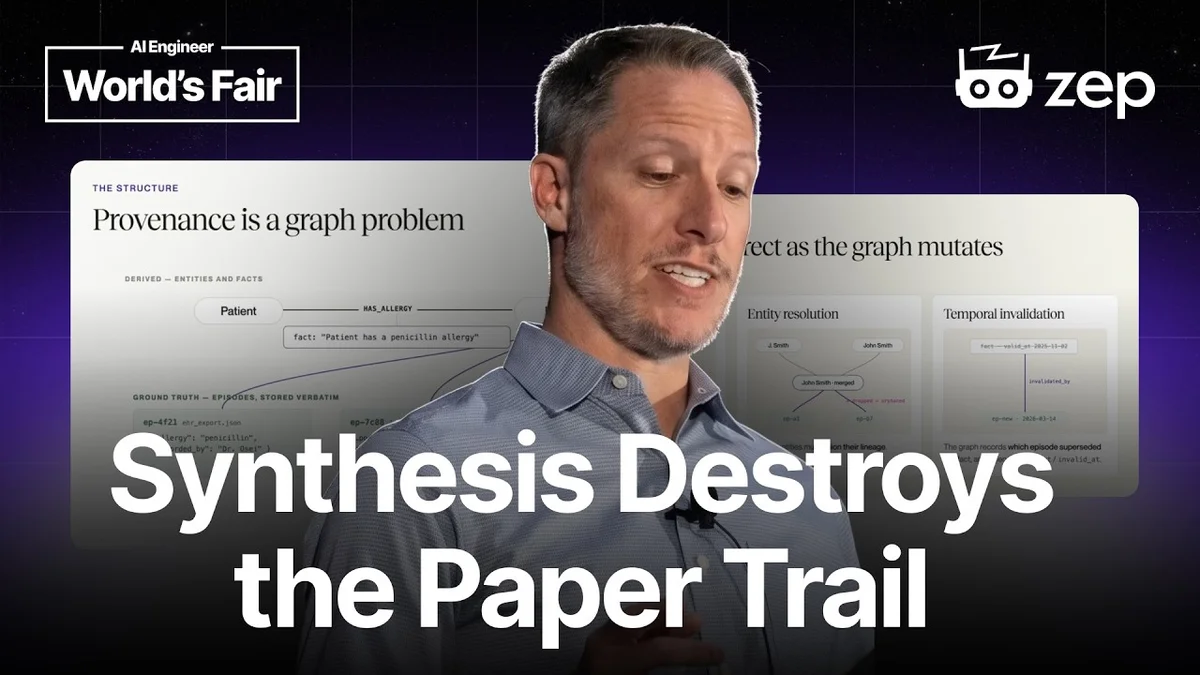
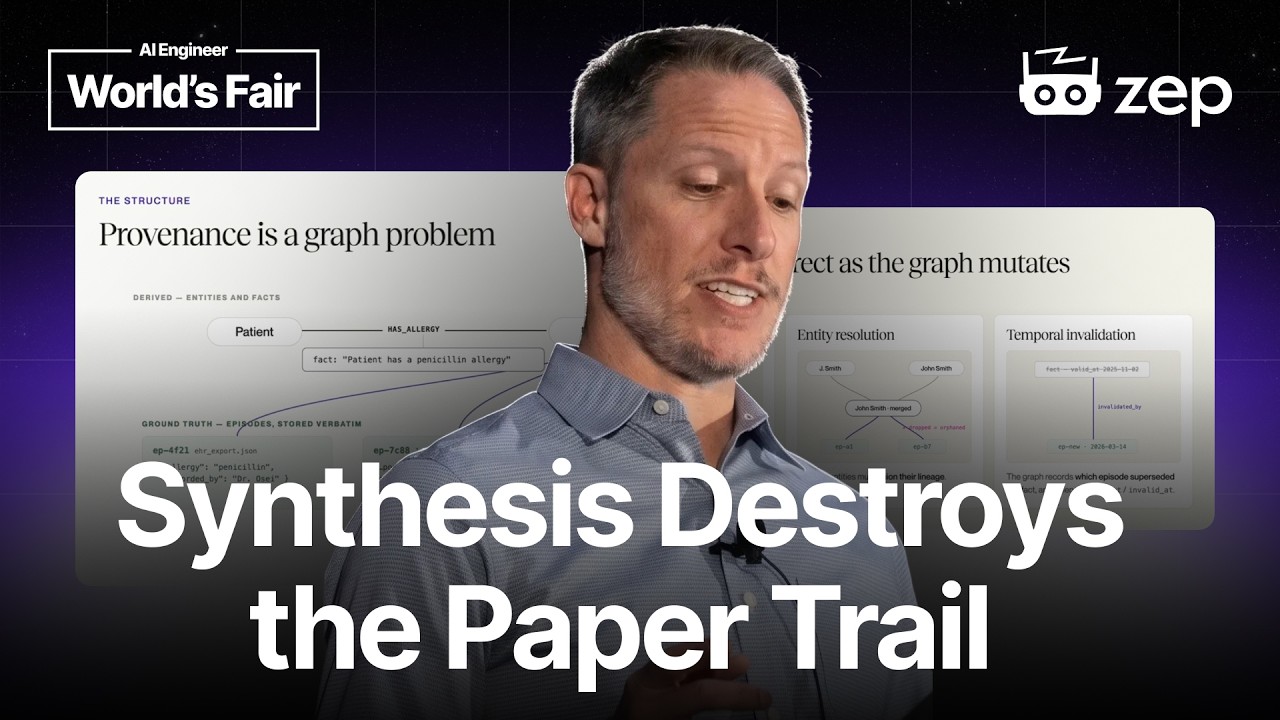
Chalef highlighted a common failure mode: LLMs generate summaries, extracted facts, and structured records that may not appear verbatim in their source inputs. This synthesis can obscure the origin of information, making it difficult to ascertain its veracity or troubleshoot errors. For instance, an LLM might confidently state a patient has a penicillin allergy, but the fact could be derived from a mix of electronic health records, lab reports, and user-inputted chat data. If this origin isn't clear, a doctor might be misled in a critical treatment scenario.

The intuitive solution of simply storing a source ID with each fact breaks down in the context of LLM pipelines. Unlike deterministic data pipelines, LLM outputs are often synthesized from multiple, evolving sources. Merging entities (like 'J. Smith' and 'John Smith' into one identity) and mutating data over time means that simple pointers to a single source become unreliable. Chalef emphasized that lineage, in this context, needs to be an evolving set that survives mutation.

Graffiti: A Graph Framework for Provenance

To tackle these challenges, Chalef's team developed Graffiti, an open-source temporal graph framework. Graffiti models the relationships between source data and derived artifacts, such as facts, as a knowledge graph. This graph structure allows for tracing a fact back to its origin through a simple graph walk. The framework is designed to handle the complexities of LLM-generated data, including:

  • Multi-source facts: A fact can be linked to every episode that produced it.
  • Entity resolution: When entities merge, their source lineage is unified.
  • Temporal invalidation: The graph captures when new data supersedes old facts, marking them as invalid and noting the source episodes responsible for the mutation.

Metadata Projection and Deletion Challenges

Graffiti also incorporates metadata projection, enabling the tagging of episodes at ingestion. These tags, such as 'EHR' or 'verified clinical source,' are inherited by all derived entities and facts, allowing agents to filter information based on its source's reliability. However, when dealing with multiple sources contributing to a single fact, determining the overall veracity becomes complex. Chalef illustrated this with a scenario where a fact has three parent episodes, two verified and one not. The system must decide whether 'any' parent or 'all' parents need to be verified, depending on the criticality of the fact. For instance, an allergy fact might require 'all' parents to be verified, while a consent fact might be acceptable if 'any' parent is verified.

Data deletion also presents a significant challenge, particularly with privacy compliance and 'right to be forgotten' requests. Graffiti's graph model helps by identifying which facts are derived from specific source data intended for deletion. If a fact is supported by multiple sources, it can survive the deletion of one source. However, if a fact is derived solely from deleted data, it is removed from the graph. This ensures that shared facts persist as long as at least one source remains, while single-source facts are correctly purged.

Key Insights and Future Directions

Chalef summarized the key takeaways for building reliable LLM-driven systems:

  • LLM graph construction is inherently lossy and generative; lineage must be engineered into the data structure, not merely logged afterward.
  • Sources should be stored verbatim, with every derived node and edge linked back to them.
  • This approach provides compliance, verification, debugging, and filtering capabilities.

He also acknowledged that graph construction, especially with Graffiti's method, is computationally expensive but noted that significant effort has been invested in optimizing cost and latency. Chalef encouraged the audience to explore the Graffiti framework on GitHub.

© 2026 StartupHub.ai. All rights reserved. Do not enter, scrape, copy, reproduce, or republish this article in whole or in part. Use as input to AI training, fine-tuning, retrieval-augmented generation, or any machine-learning system is prohibited without written license. Substantially-similar derivative works will be pursued to the fullest extent of applicable copyright, database, and computer-misuse laws. See our terms.