

AI Assistants Need Graph Memory, Not Just More Tokens

Stephen Chin of Neo4j discusses how graph databases offer superior memory solutions for AI assistants compared to traditional file storage or vector databases.

8 min read
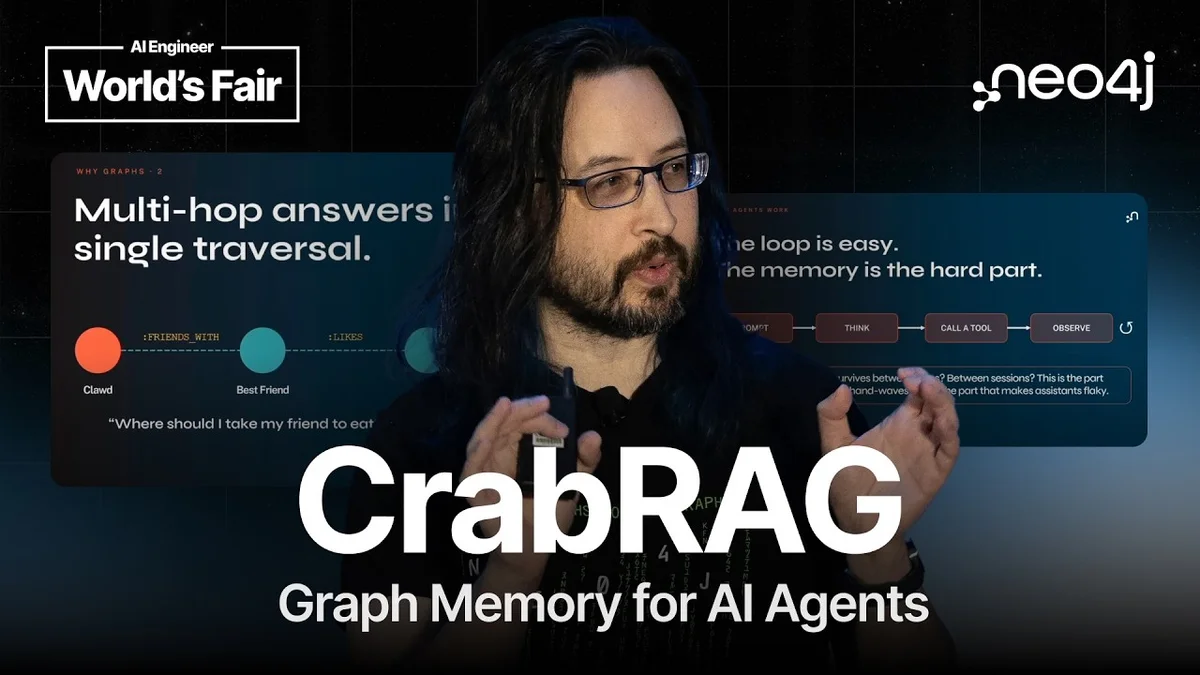
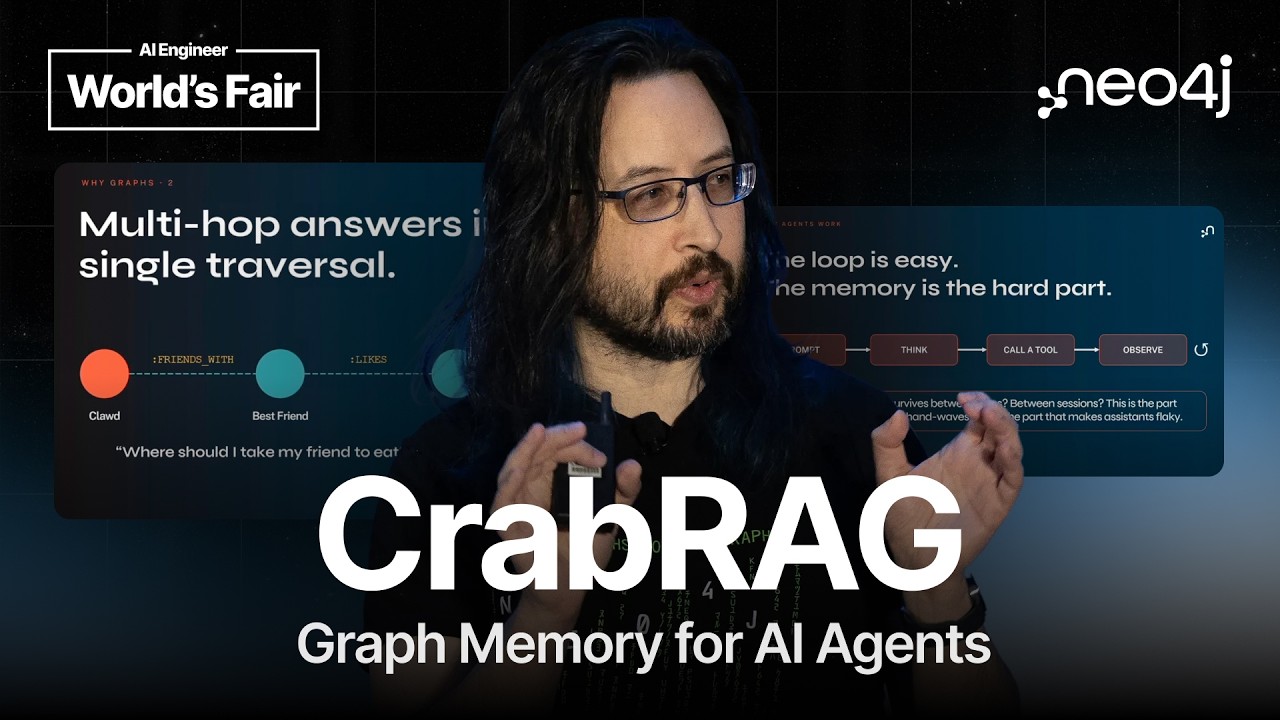
Stephen Chin presenting on AI assistants and graph memory at AI Engineer World's Fair.
Stephen Chin, VP of Developer Relations at Neo4j, presenting "CrabRAG: Why Automated Assistants Need Graph Memory, Not More Tokens."· AI Engineer

Visual TL;DR. AI Memory Deficit leads to Token Waste. AI Memory Deficit solved by Graph Databases. Token Waste addressed by CrabRAG Solution. Graph Databases provides Structured Memory. Graph Databases powers CrabRAG Solution. Structured Memory enables Reduced Repetition. CrabRAG Solution achieves Autonomous AI. Reduced Repetition contributes to Autonomous AI.

  1. AI Memory Deficit: AI assistants like 'CrabD' suffer from severe memory loss, resetting context every session
  2. Token Waste: traditional file storage (Markdown) and vector databases lead to inefficient token usage
  3. Graph Databases: Neo4j's Stephen Chin proposes graph memory as a superior solution for AI assistants
  4. Structured Memory: graphs provide persistent, structured memory, unlike amnesiac current AI agents
  5. CrabRAG Solution: a graph-powered approach to give AI assistants effective, long-term memory management
  6. Autonomous AI: enables more helpful and autonomous AI assistants by overcoming memory limitations
  7. Reduced Repetition: users won't need to repeat tasks or re-establish context for AI agents
Visual TL;DR
Visual TL;DR, startuphub.ai AI Memory Deficit solved by Graph Databases. Graph Databases powers CrabRAG Solution. CrabRAG Solution achieves Autonomous AI solved by powers achieves AI Memory Deficit Graph Databases CrabRAG Solution Autonomous AI From startuphub.ai · The publishers behind this format
Visual TL;DR, startuphub.ai AI Memory Deficit solved by Graph Databases. Graph Databases powers CrabRAG Solution. CrabRAG Solution achieves Autonomous AI solved by powers achieves AI Memory Deficit AI assistants like 'CrabD' suffer fromsevere memory loss, resetting contextevery session Graph Databases Neo4j's Stephen Chin proposes graph memoryas a superior solution for AI assistants CrabRAG Solution a graph-powered approach to give AIassistants effective, long-term memorymanagement Autonomous AI enables more helpful and autonomous AIassistants by overcoming memorylimitations From startuphub.ai · The publishers behind this format
Visual TL;DR, startuphub.ai AI Memory Deficit solved by Graph Databases. Graph Databases powers CrabRAG Solution. CrabRAG Solution achieves Autonomous AI solved by powers achieves AI Memory Deficit AI assistants like'CrabD' suffer fromsevere memory loss,… Graph Databases Neo4j's StephenChin proposes graphmemory as a… CrabRAG Solution a graph-poweredapproach to give AIassistants… Autonomous AI enables morehelpful andautonomous AI… From startuphub.ai · The publishers behind this format
Visual TL;DR, startuphub.ai AI Memory Deficit leads to Token Waste. AI Memory Deficit solved by Graph Databases. Token Waste addressed by CrabRAG Solution. Graph Databases provides Structured Memory. Graph Databases powers CrabRAG Solution. Structured Memory enables Reduced Repetition. CrabRAG Solution achieves Autonomous AI. Reduced Repetition contributes to Autonomous AI leads to solved by addressed by provides powers enables achieves contributes to AI Memory Deficit AI assistants like 'CrabD' suffer fromsevere memory loss, resetting contextevery session Token Waste traditional file storage (Markdown) andvector databases lead to inefficient tokenusage Graph Databases Neo4j's Stephen Chin proposes graph memoryas a superior solution for AI assistants Structured Memory graphs provide persistent, structuredmemory, unlike amnesiac current AI agents CrabRAG Solution a graph-powered approach to give AIassistants effective, long-term memorymanagement Autonomous AI enables more helpful and autonomous AIassistants by overcoming memorylimitations Reduced Repetition users won't need to repeat tasks orre-establish context for AI agents From startuphub.ai · The publishers behind this format
Visual TL;DR, startuphub.ai AI Memory Deficit leads to Token Waste. AI Memory Deficit solved by Graph Databases. Token Waste addressed by CrabRAG Solution. Graph Databases provides Structured Memory. Graph Databases powers CrabRAG Solution. Structured Memory enables Reduced Repetition. CrabRAG Solution achieves Autonomous AI. Reduced Repetition contributes to Autonomous AI leads to solved by addressed by provides powers enables achieves contributes to AI Memory Deficit AI assistants like'CrabD' suffer fromsevere memory loss,… Token Waste traditional filestorage (Markdown)and vector… Graph Databases Neo4j's StephenChin proposes graphmemory as a… Structured Memory graphs providepersistent,structured memory,… CrabRAG Solution a graph-poweredapproach to give AIassistants… Autonomous AI enables morehelpful andautonomous AI… ReducedRepetition users won't need torepeat tasks orre-establish… From startuphub.ai · The publishers behind this format

In the pursuit of more autonomous and helpful AI assistants, a persistent challenge has been their ability to effectively manage memory. Traditional approaches, often relying on simple file storage like Markdown, quickly become inefficient and lead to significant token waste. This is the core problem that Stephen Chin, VP of Developer Relations at Neo4j, tackled in his presentation "CrabRAG: Why Automated Assistants Need Graph Memory, Not More Tokens." Chin introduced the concept of an AI assistant named "CrabD," a characterization of the limitations faced by current AI agents.
AI Assistants Need Graph Memory, Not Just More Tokens - AI Engineer
AI Assistants Need Graph Memory, Not Just More Tokens — from AI Engineer

The Forgetful Crab: Limitations of Current AI Memory

Chin began by illustrating the shortcomings of existing AI assistants, personified by CrabD, a character who suffers from a severe memory deficit. "Every session, he wakes up an amnesiac," Chin explained, highlighting how agents often reset their memory, forcing users to repeat tasks and re-establish context. This lack of persistent, structured memory means that even with a plethora of tools at their disposal, these agents can struggle to perform effectively, often picking the wrong tool for the job or failing to connect disparate pieces of information.

The presentation delved into the common methods for storing agent memory, primarily focusing on the widespread use of Markdown files. While these files are human-readable and easy to manage at a small scale, they present significant drawbacks for larger, more complex AI applications. Chin pointed out that loading hundreds of thousands of tokens for each interaction, as is often the case with these flat file structures, is inefficient and leads to repetitive processing, hoping that the necessary information is present in the context window.

Vector Databases vs. Graph Databases for AI Memory

The discussion then moved to potential solutions, starting with vector databases. Chin acknowledged their utility in storing information and performing similarity searches, noting that Neo4j itself integrates with vector databases like PGVector and LanceDB. However, he emphasized a critical limitation: "What vectors give you, which is similarity in vector space, is not the same as actual relationships." This distinction leads to issues like hallucinations and an inability to perform complex, multi-hop reasoning, which are crucial for more sophisticated AI tasks. The challenge is that similarity alone does not guarantee relevance or the correct causal link between data points.

Chin proposed graph databases as the superior alternative for managing AI memory. "Graphs are a great way of finding the relationships, finding those identities, mapping out the paths, getting that full chain," he stated. Graphs, with their first-class nodes and edges, are inherently built for connected data. This structure allows for precise, explainable, and auditable retrieval of information. Chin highlighted how Claude, a large language model, can even assist in generating Cypher queries, making graph database interaction more accessible.

CrabRAG: A Graph-Powered Solution

The presentation culminated in a live demonstration of "CrabRAG," a system that leverages Neo4j's graph capabilities to address the memory limitations of AI assistants. Chin showcased how a graph-based approach can provide accurate and actionable insights, contrasting it with the less effective results from a purely vector-based approach. In a practical demo involving a home lab network, the graph-powered agent successfully identified security vulnerabilities, demonstrating its ability to traverse relationships and extract precise information, a task that the vector-based agent struggled with.

Chin concluded by emphasizing the broader implications of graph memory for AI development. "If you have a big enterprise which has a huge data center, if you're doing things in financial services where you have like a huge set of companies and customer records you're trying to do, if you're doing anything at large scale where it doesn't fit into the 1 million context window of the modern models, you really need a better memory system than just throwing things in markdown files." He also promoted Neo4j's "Graph Academy" as a valuable resource for developers looking to implement these advanced graph solutions.

© 2026 StartupHub.ai. All rights reserved. Do not enter, scrape, copy, reproduce, or republish this article in whole or in part. Use as input to AI training, fine-tuning, retrieval-augmented generation, or any machine-learning system is prohibited without written license. Substantially-similar derivative works will be pursued to the fullest extent of applicable copyright, database, and computer-misuse laws. See our terms.