


Google AI Edge: Tiny LMs Powering Robotics & Devices

Google's Cormac Brick discusses the state-of-the-art in tiny AI models, their applications in robotics and edge devices, and the importance of fine-tuning for broad accessibility.

7 min read
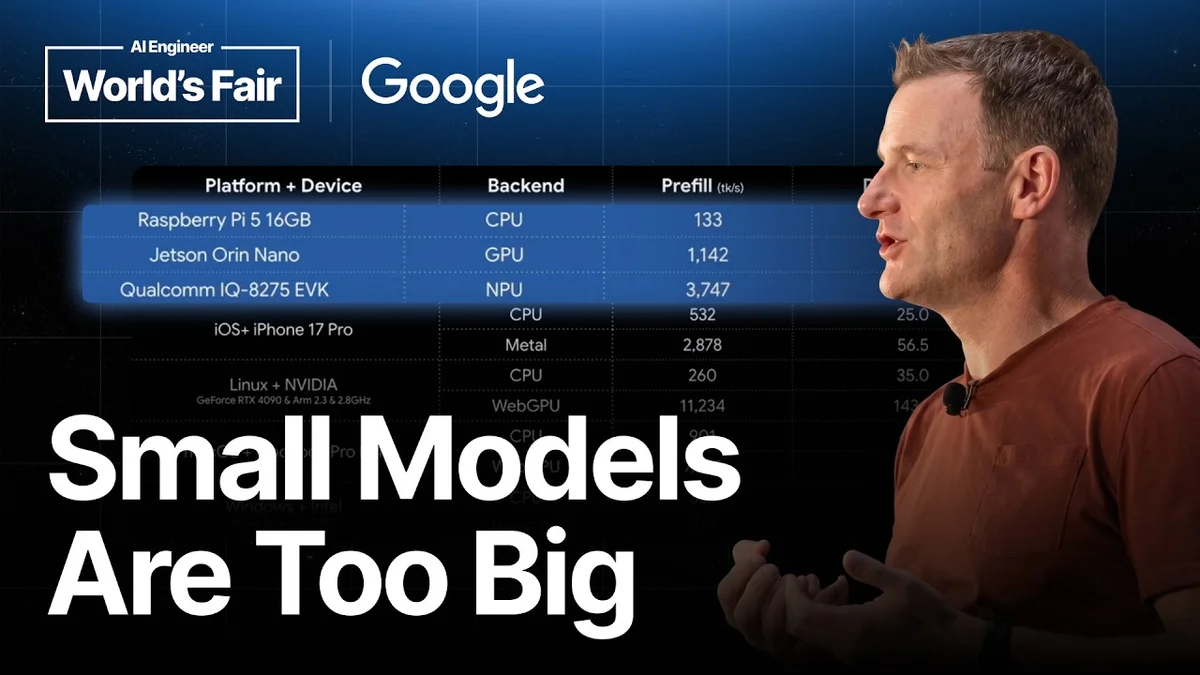
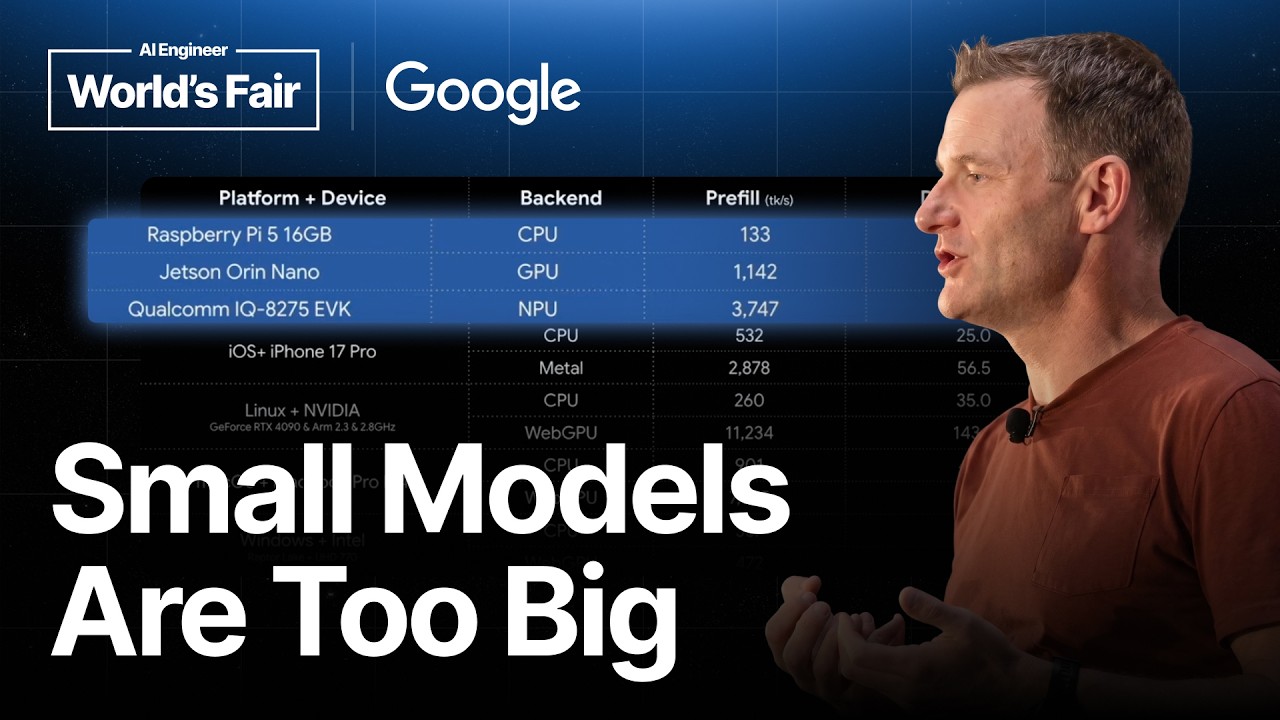
Cormac Brick from Google presenting on Tiny LMs and Agents for Edge and Robotics
AI Engineer

Visual TL;DR. Edge AI Benefits but face Deployment Challenges. Deployment Challenges solved by Tiny AI Models. Tiny AI Models enhanced via Fine-Tuning Power. Fine-Tuning Power powers Robotics & Devices. Robotics & Devices leading to Developer Takeaways. Tiny AI Models understanding Small vs. Tiny.

  1. Edge AI Benefits: reduced latency, enhanced privacy, offline functionality, and significant cost savings
  2. Deployment Challenges: DRAM cost and hardware price increases constrain AI on edge devices
  3. Tiny AI Models: Google's Cormac Brick discusses state-of-the-art tiny LMs for robotics
  4. Fine-Tuning Power: fine-tuning and community models crucial for broad accessibility and applications
  5. Robotics & Devices: enabling intelligence directly on smartphones, IoT gadgets, and various devices
  6. Developer Takeaways: focus on efficient models and leveraging community for edge AI success
  7. Small vs. Tiny: distinguishing model sizes for optimal performance on constrained edge hardware
Visual TL;DR
Visual TL;DR, startuphub.ai Tiny AI Models enhanced via Fine-Tuning Power. Fine-Tuning Power powers Robotics & Devices enhanced via powers Edge AI Benefits Tiny AI Models Fine-Tuning Power Robotics & Devices From startuphub.ai · The publishers behind this format
Visual TL;DR, startuphub.ai Tiny AI Models enhanced via Fine-Tuning Power. Fine-Tuning Power powers Robotics & Devices enhanced via powers Edge AI Benefits Tiny AI Models Fine-Tuning Power Robotics &Devices From startuphub.ai · The publishers behind this format
Visual TL;DR, startuphub.ai Tiny AI Models enhanced via Fine-Tuning Power. Fine-Tuning Power powers Robotics & Devices enhanced via powers Edge AI Benefits reduced latency, enhanced privacy, offlinefunctionality, and significant costsavings Tiny AI Models Google's Cormac Brick discussesstate-of-the-art tiny LMs for robotics Fine-Tuning Power fine-tuning and community models crucialfor broad accessibility and applications Robotics & Devices enabling intelligence directly onsmartphones, IoT gadgets, and variousdevices From startuphub.ai · The publishers behind this format
Visual TL;DR, startuphub.ai Tiny AI Models enhanced via Fine-Tuning Power. Fine-Tuning Power powers Robotics & Devices enhanced via powers Edge AI Benefits reduced latency,enhanced privacy,offline… Tiny AI Models Google's CormacBrick discussesstate-of-the-art… Fine-Tuning Power fine-tuning andcommunity modelscrucial for broad… Robotics &Devices enablingintelligencedirectly on… From startuphub.ai · The publishers behind this format
Visual TL;DR, startuphub.ai Edge AI Benefits but face Deployment Challenges. Deployment Challenges solved by Tiny AI Models. Tiny AI Models enhanced via Fine-Tuning Power. Fine-Tuning Power powers Robotics & Devices. Robotics & Devices leading to Developer Takeaways. Tiny AI Models understanding Small vs. Tiny but face solved by enhanced via powers leading to understanding Edge AI Benefits reduced latency, enhanced privacy, offlinefunctionality, and significant costsavings Deployment Challenges DRAM cost and hardware price increasesconstrain AI on edge devices Tiny AI Models Google's Cormac Brick discussesstate-of-the-art tiny LMs for robotics Fine-Tuning Power fine-tuning and community models crucialfor broad accessibility and applications Robotics & Devices enabling intelligence directly onsmartphones, IoT gadgets, and variousdevices Developer Takeaways focus on efficient models and leveragingcommunity for edge AI success Small vs. Tiny distinguishing model sizes for optimalperformance on constrained edge hardware From startuphub.ai · The publishers behind this format
Visual TL;DR, startuphub.ai Edge AI Benefits but face Deployment Challenges. Deployment Challenges solved by Tiny AI Models. Tiny AI Models enhanced via Fine-Tuning Power. Fine-Tuning Power powers Robotics & Devices. Robotics & Devices leading to Developer Takeaways. Tiny AI Models understanding Small vs. Tiny but face solved by enhanced via powers leading to understanding Edge AI Benefits reduced latency,enhanced privacy,offline… DeploymentChallenges DRAM cost andhardware priceincreases constrain… Tiny AI Models Google's CormacBrick discussesstate-of-the-art… Fine-Tuning Power fine-tuning andcommunity modelscrucial for broad… Robotics &Devices enablingintelligencedirectly on… DeveloperTakeaways focus on efficientmodels andleveraging… Small vs. Tiny distinguishingmodel sizes foroptimal performance… From startuphub.ai · The publishers behind this format

Cormac Brick, Principal Software Engineer on the AI Edge team at Google, recently spoke at the AI Engineer World's Fair about the growing importance of "tiny" AI models for edge devices and robotics. He highlighted the shift from solely relying on cloud-based AI to enabling intelligence directly on a vast array of devices, from smartphones to IoT gadgets.

Google AI Edge: Tiny LMs Powering Robotics & Devices - AI Engineer
Google AI Edge: Tiny LMs Powering Robotics & Devices — from AI Engineer

The Case for Edge AI

Brick emphasized the core benefits of edge AI, which include reduced latency for faster, more consistent user experiences, enhanced privacy as data remains on the device, reliable offline functionality, and significant cost savings by reducing cloud compute and token usage, especially at scale. These advantages are critical for a wide range of applications.

Navigating AI Deployment Challenges

Deploying AI on edge devices, however, presents several challenges. Brick identified DRAM cost as a primary constraint, noting that even basic hardware like Raspberry Pis have seen significant price increases. This necessitates a strong focus on model optimization techniques like quantization and the use of the smallest possible models for specific tasks. Furthermore, the wide variety of target devices and the tendency for LLM research to focus on larger models mean that the lower end of the LLM spectrum is less explored.

Small vs. Tiny Models

Brick differentiated between "small" models, typically ranging from 1 to 4 billion parameters, and "tiny" models, which can be as small as 50 million parameters. Small models, requiring around 4-8GB of RAM for robotics and IoT applications, are already integrated into high-end smartphones and are suitable for devices like laptops. However, they may still be out of reach for lower-tier devices. The playbook for small models often involves prompting techniques like zero-shot or LoRA adapters, proving effective for tasks like function calling.

Tiny models, on the other hand, are designed for even greater accessibility, requiring less than 2GB of RAM and capable of running on a much wider array of consumer devices. These models are ideal when AI is a secondary feature or when system health and responsiveness are paramount. The approach for tiny models often involves leveraging off-the-shelf models for fixed tasks or fine-tuning models for specific outcomes.

The Power of Fine-Tuning and Community Models

Brick showcased how fine-tuning can significantly improve model performance and reduce resource requirements. He highlighted the "Mobile Actions" model, which, after fine-tuning with synthetically generated data, can reliably convert arbitrary text input into function calls for common mobile tasks. He also pointed to the availability of various community models on platforms like Hugging Face that are optimized for specific tasks such as Automatic Speech Recognition (ASR), vision, and embeddings.

The presentation also featured examples of Google's AI Edge tools, including LiteRT-LM and MediaPipe, which simplify the deployment of AI models across edge devices. Brick demonstrated the AI Edge Gallery app, available on iOS and Android, as a practical way for developers to experiment with small models directly on their phones.

Key Takeaways for Developers

Brick concluded with key takeaways for developers focusing on consumer devices and entry-level robotics:

  • Small LLMs are user-friendly and perform well on NPUs.
  • Tiny models expand the reach of AI to a broader range of devices, often requiring fine-tuning.
  • Visual intelligence can be effectively incorporated using tiny VLMs.
  • Robust voice-to-function calling is achievable by investing in appropriate synthetic datasets for fine-tuning.

Ultimately, the trend towards smaller, more efficient AI models is democratizing the deployment of intelligent capabilities across a vast spectrum of devices.

© 2026 StartupHub.ai. All rights reserved. Do not enter, scrape, copy, reproduce, or republish this article in whole or in part. Use as input to AI training, fine-tuning, retrieval-augmented generation, or any machine-learning system is prohibited without written license. Substantially-similar derivative works will be pursued to the fullest extent of applicable copyright, database, and computer-misuse laws. See our terms.