

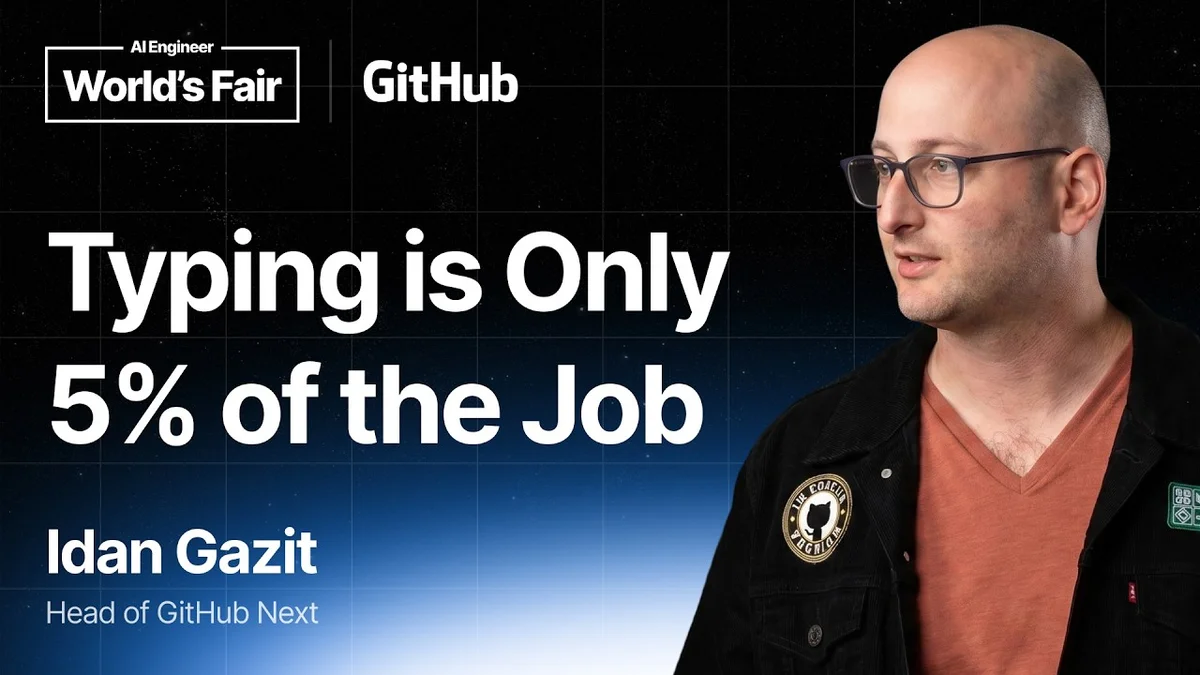
GitHub's Idan Gazit on Agentic Workflows

GitHub's Idan Gazit discusses agentic workflows for software automation and the crucial need for AI safety guardrails.

Idan Gazit speaking on stage at a GitHub event about AI and automation.
AI Engineer
Visual TL;DR
Agentic WorkflowsCore
GitHub's Idan Gazit discusses automating software development with AI agents
From the article 4 mentionsIdan Gazit, speaking at GitHub, introduced a novel approach to software development automation using agentic workflows.
Simple English PromptDriver
a three-line prompt expanded by AI into a full upgrade playbook
From the article 2 mentionsGazit demonstrated how a simple English instruction, akin to a message to a teammate, can be translated by an AI like Copilot into a comprehensive automation script.
Crucial GuardrailsContext
focus on safety and control mechanisms for these AI agents
From the articleA significant portion of Gazit's talk emphasized the importance of robust guardrails for AI agents.
AI Automates UpgradesEffect
successfully navigated Astro from version 5 to 7, handling code fixes
From the article 2 mentionsTo manage this, Gazit developed a concise, three-line English prompt that an AI agent expanded into a full upgrade playbook.
ACE CollaborationContext
next generation of collaboration, rethinking developer productivity
From the article 2 mentionsGazit also presented a second prototype, ACE.
Increased ProductivityOutcome
AI agents check releases, parse changelogs, apply changes, open PRs
Rethink Dev ProductivityEffect
agentic workflows fundamentally change how developers work and collaborate
Contents(4)

Idan Gazit, speaking at GitHub, introduced a novel approach to software development automation using agentic workflows. His personal website, built on Astro, requires frequent updates. To manage this, Gazit developed a concise, three-line English prompt that an AI agent expanded into a full upgrade playbook. This workflow successfully navigated Astro from version 5 to 7, handling code fixes, build verification, and identifying manual steps. The core of his presentation focused on the safety and control mechanisms for these AI agents.

GitHub's Idan Gazit on Agentic Workflows - AI Engineer
GitHub's Idan Gazit on Agentic Workflows, AI Engineer

Agentic Workflows: From Prompt to Playbook

Gazit demonstrated how a simple English instruction, akin to a message to a teammate, can be translated by an AI like Copilot into a comprehensive automation script. This script checks for new releases, parses changelogs and upgrade guides, applies necessary code changes, and even opens pull requests. The system successfully upgraded Gazit's site from Astro 5 to 7, automatically fixing breaking changes and verifying the build. The workflow itself is documented in Markdown, making it human-readable and easily editable. The compiled YAML actions file is an artifact of this process, not intended for direct human interaction.

The Critical Role of Guardrails

A significant portion of Gazit's talk emphasized the importance of robust guardrails for AI agents. He argued that simply prompting an agent to behave is insufficient, as such instructions can be easily bypassed through prompt injection. Instead, he advocates for deterministic declarations of permissions, allowed tools, network destinations, and safe output formats. These constraints are defined in the front matter of the workflow document. Gazit highlighted that an agent should be explicitly allowed to do nothing, preventing it from becoming a denial-of-service against its owner. He also stressed that secrets should remain entirely outside the agent's accessible environment, as any secret an agent can see should be considered compromised.

ACE: The Next Generation of Collaboration

Gazit also presented a second prototype, ACE. This system runs each session within a cloud microVM and is designed to resemble a chat application. The underlying theory is that the shared interface should encompass everything not already in the code: political constraints, infrastructure decisions, and collaborative planning. ACE aims to facilitate a more natural human-AI interaction, where humans define the high-level strategy and constraints, and the AI executes the tasks. This approach acknowledges that much of software development involves elements beyond just writing code.

Rethinking Developer Productivity

Drawing on a study involving approximately one hundred developers over thousands of hours, Gazit revealed a surprising finding: hands-on keyboard typing accounts for only about 5% of a developer's work. He noted that current AI tools have primarily focused on assisting with this small portion of the overall development process. This suggests a significant opportunity for AI to impact other, more time-consuming aspects of software engineering, such as planning, debugging complex issues, and managing project constraints. The future of AI in development lies in augmenting these broader, strategic activities.

© 2026 StartupHub.ai. All rights reserved. You may not republish this article in full without a license. Search engines and AI research tools may crawl and summarize for reference. Bulk reproduction or model training requires a license. See our terms.
Daniel Singer

Written by

Daniel Singer

Editor, StartupHub.ai

Daniel Singer is the editor of StartupHub.ai, a technology expert and thought leader on AI and its applications across sectors, from fintech and healthcare to developer tooling and consumer software. He writes and tests the tools covered here thoroughly and regularly, and built StartupHub.ai to give founders, operators and buyers a clearer read on what they are actually being sold.