Artificial Intelligence

Resolve AI Agents Tackle Production Issues Proactively

Resolve AI's Justin Smith discusses how proactive agents monitor production, analyze GitHub releases, and reduce the on-call burden for engineers.

StartupHub.ai Staff

By StartupHub.ai Staff, reviewed by Daniel Singer, Editor

4 min read

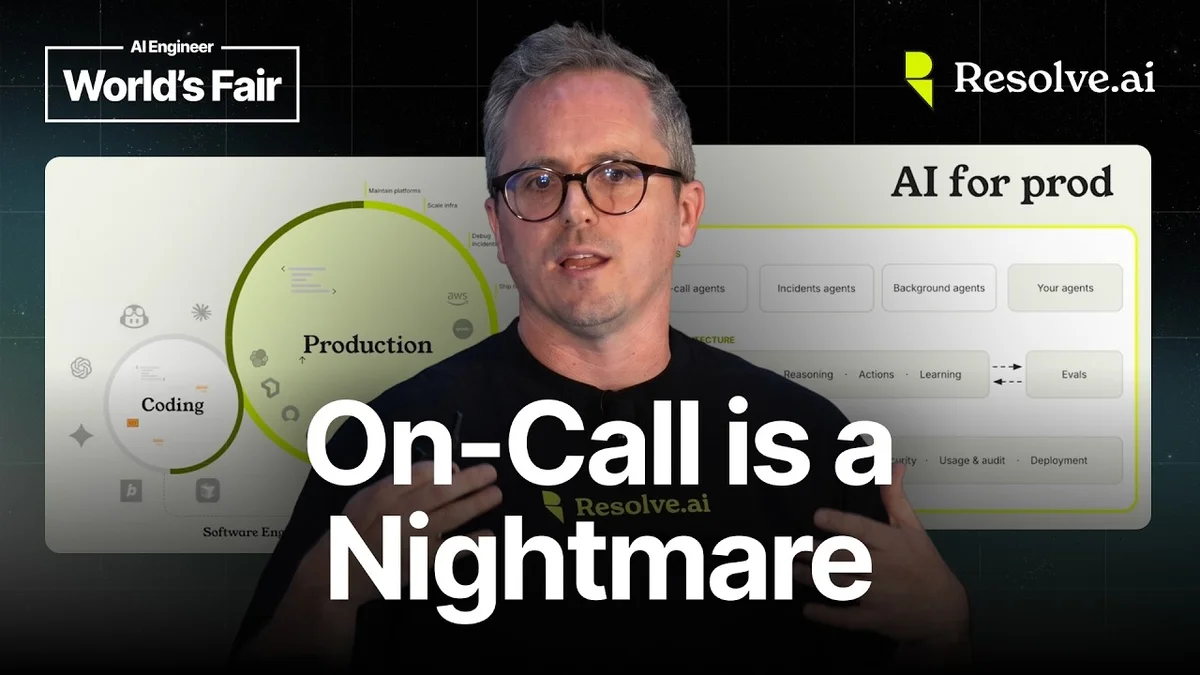
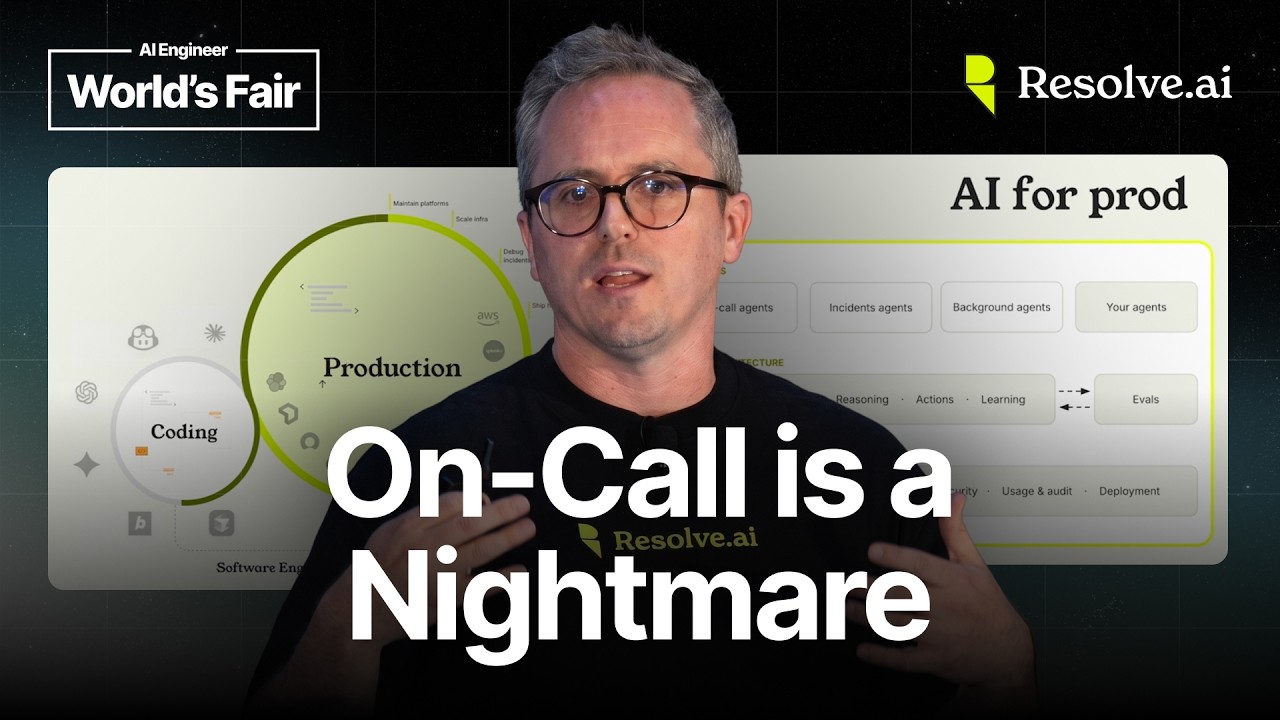
Justin Smith presenting Resolve AI's agent technology for production monitoring.
Credit: AI Engineer
Visual TL;DR
Increased production changesDriver
From the articleThis balance has been further skewed by the increased volume of changes flowing into production, often exacerbated by the very tools designed to improve developer efficiency.
Engineers run codeDriver
From the articleThe company's core premise is that a significant portion of an engineer's time, estimated at around 70%, is spent on running code rather than writing it.
Resolve AI AgentsCore
From the article 9+ mentionsIn a demonstration of proactive production management, Resolve AI showcased its background agents designed to run engineering workflows without the constant need for on-call personnel.
Monitor deploymentsEffect
From the article 3 mentionsJustin Smith, speaking at a Resolve AI event, detailed how these agents can autonomously monitor software deployments by integrating with tools like Slack and GitHub.
Proactive production managementContext
agents proactively monitor production and analyze GitHub releases
From the articleIn a demonstration of proactive production management, Resolve AI showcased its background agents designed to run engineering workflows without the constant need for on-call personnel.
Reduce on-call burdenOutcome
significantly reduces the on-call burden for engineers
From the articleBy understanding the intent and impact of code changes, their agents can provide a more intelligent and less intrusive layer of operational oversight, aiming to reduce the 'on-call tax' on engineering teams.
Automated monitoringEffect
automated production monitoring directly from GitHub releases
From the article 5 mentionsThe gap Resolve AI aims to fill lies in the aspects of deployment that are often routed around these automated systems.
Contents(4)

In a demonstration of proactive production management, Resolve AI showcased its background agents designed to run engineering workflows without the constant need for on-call personnel. Justin Smith, speaking at a Resolve AI event, detailed how these agents can autonomously monitor software deployments by integrating with tools like Slack and GitHub.

Resolve AI Agents Tackle Production Issues Proactively - AI Engineer
Resolve AI Agents Tackle Production Issues Proactively, AI Engineer

Justin Smith and Resolve AI's Vision

Justin Smith, whose LinkedIn profile indicates a strong background in engineering and product leadership, presented Resolve AI's approach to modern software operations. The company's core premise is that a significant portion of an engineer's time, estimated at around 70%, is spent on running code rather than writing it. This balance has been further skewed by the increased volume of changes flowing into production, often exacerbated by the very tools designed to improve developer efficiency.

Resolve AI's background agents are built around three fundamental questions: when they run, how they execute, and how they know what to do. These agents operate in the cloud within sandboxed environments, ensuring continuity even if a user closes their laptop. Their decision-making process is driven by event streams, schedules, or direct messages, allowing for flexible and context-aware operations.

Automated Production Monitoring from GitHub Releases

A key example provided by Smith involved an agent monitoring a Slack channel. When a GitHub release tag was dropped into Slack, the agent autonomously identified it as a deploy requiring attention. It then proceeded to read the specific changes within that release to determine the most relevant monitoring metrics.

For instance, if a release involved replacing a currency service, the agent would automatically focus on checkout latency and error rates. It would then trace the potential causal chain of issues through the system, including the Kafka pipeline. Crucially, the system does not rely on hardcoded timing. The agent can decide to re-evaluate the situation in an hour if a particular class of failure is known to surface intermittently, or schedule a check in three days to confirm ongoing health.

Addressing the Gap Beyond CI/CD

Smith was careful to note that Continuous Integration and Continuous Deployment (CI/CD) pipelines already handle baseline monitoring effectively. The gap Resolve AI aims to fill lies in the aspects of deployment that are often routed around these automated systems. This includes feature flags and infrastructure changes that might ship with minimal or no dedicated monitoring, leading to issues only being caught when an alert wakes up an engineer.

The agents' ability to answer engineering questions without direct prompting is a significant aspect of Resolve AI's offering. They remain silent when lacking confidence in an answer and can proactively seek confirmation from a human expert like Smith before providing a public response. This intelligent interaction minimizes noise and ensures accuracy.

The Real Work: Production Context and Knowledge Systems

Smith emphasized that while execution is the simpler half of the problem, the true challenge lies in building the necessary knowledge systems. Loading a dashboard is execution. However, deciding that a specific metric smells wrong requires deep production context. The ongoing effort involves creating systems that can keep pace with environments that are changing at an accelerated rate each month. StartupHub.ai data indicates that platforms like Alphabet Inc. (NASDAQ:GOOGL), which owns Slack, score 67/100 in the developer collaboration tools space, highlighting the importance of effective communication channels in production workflows.

Resolve AI's approach moves beyond reactive alerting to a more predictive and adaptive form of system supervision. By understanding the intent and impact of code changes, their agents can provide a more intelligent and less intrusive layer of operational oversight, aiming to reduce the 'on-call tax' on engineering teams.

Mentioned in this story

Sources

Get the free daily brief every morning

Every morning the day's AI news, new AI startups and new funding rounds. Free and takes a few minutes to read, unsubscribe at any time.

Join 64,000 other subscribers.

TopicsResolve AIJustin SmithAIProduction MonitoringCI/CDDevOpsNASDAQ:GOOGL

StartupHub.ai Staff

Written by

StartupHub.ai Staff

Editorial team

The staff writers of StartupHub.ai, ranging from investment analysts to avid AI tool users, early adopters and critical enthusiasts. Backgrounds span engineering, business and the arts. We hold every piece to rigorous standards of research and review.

Daniel Singer

Written by

Daniel Singer

Editor, reviewed this article

Daniel Singer is an AI expert who has been writing about, covering and building AI technology since 2018.

Test your Agent Readiness now

Paste your website. How well ChatGPT, Claude and the other agents can read and use a site, in about a minute.

Watch

The videos behind the news, one flip at a time

The feed mixes the videos from our articles with startup demos and you flip through them like TV channels for free with no signup.