

FrontierCode: AI Coding Benchmark Goes Beyond Correctness

Cognition's FrontierCode benchmark redefines AI code evaluation, measuring real-world 'mergeability' and finding current models fall short of production standards.

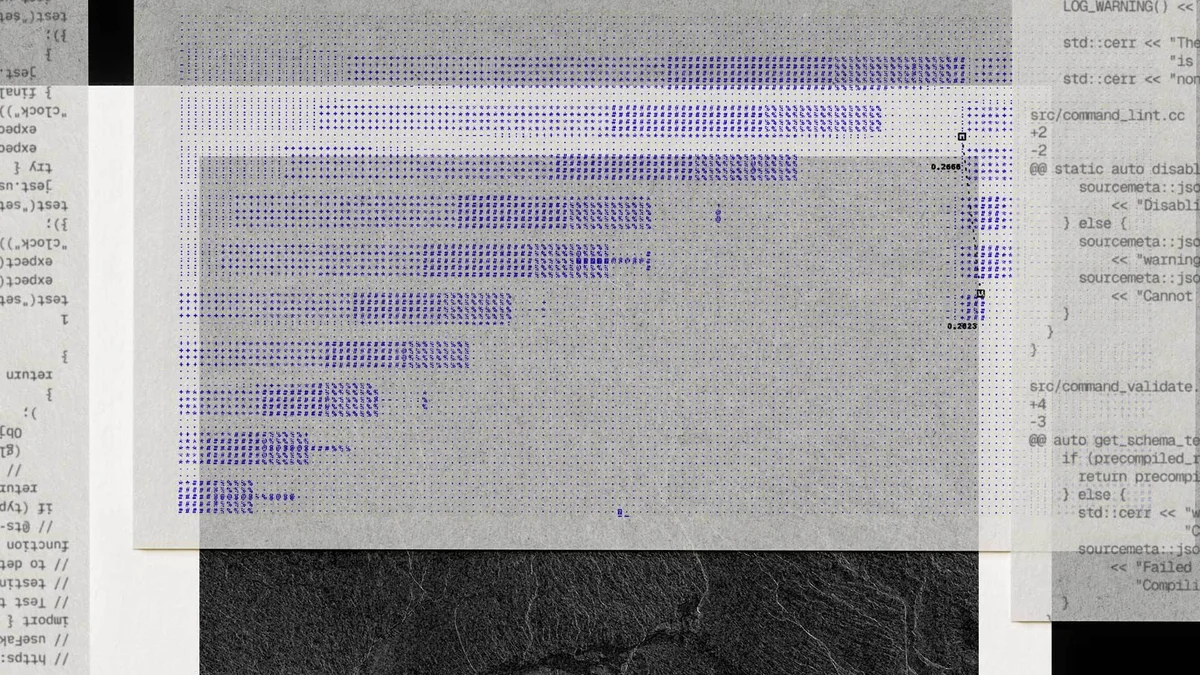
Screenshot of the FrontierCode benchmark interface showing code and evaluation results.
The FrontierCode benchmark evaluates AI-generated code quality.· cognition.ai
Visual TL;DR
AI code quality lackingDriver
current AI models fall short of production standards
From the article 3 mentionsCognition has unveiled FrontierCode, a new benchmark designed to evaluate the quality of AI-generated code, moving beyond simple correctness to assess real-world 'mergeability' into production environments.
Realistic, challenging tasksDriver
created by open-source maintainers for practical evaluation
From the articleThese developers, who spend their careers reviewing code for their projects, established realistic and challenging tasks.
Traditional benchmarks insufficientDriver
focus only on functional correctness, not real-world use
From the articleTraditional coding benchmarks focus on whether AI can produce functionally correct code.
FrontierCode benchmarkCore
new AI code evaluation benchmark by Cognition
From the article 9+ mentionsFrontierCode was built to address the shortcomings of earlier benchmarks, which often focused narrowly on functional correctness and were prone to misclassification errors.
Measures 'mergeability'Context
assesses real-world code acceptance by human maintainers
From the article 2 mentionsThe benchmark's core innovation lies in its focus on 'mergeability,' a concept defined by the open-source maintainers who contributed to its creation.
Redefines AI code evalEffect
moves beyond simple correctness to production readiness
Novel grading techniquesCore
includes test quality, scope, style, and codebase adherence
From the article 2 mentionsTo ensure rigor, FrontierCode employs a novel ensemble of grading techniques.
Contents(4)

Cognition has unveiled FrontierCode, a new benchmark designed to evaluate the quality of AI-generated code, moving beyond simple correctness to assess real-world 'mergeability' into production environments. This initiative, detailed on cognition.ai, aims to answer whether AI can write code that human maintainers would actually accept.

Traditional coding benchmarks focus on whether AI can produce functionally correct code. However, as AI-generated code increasingly becomes a pathway to production, Cognition argues that correctness is no longer sufficient. FrontierCode introduces criteria such as test quality, scope discipline, style, and adherence to specific codebase standards.

Measuring Real-World Code Quality

The benchmark's core innovation lies in its focus on 'mergeability,' a concept defined by the open-source maintainers who contributed to its creation. These developers, who spend their careers reviewing code for their projects, established realistic and challenging tasks. Each task required over 40 hours of development effort, ensuring they reflect genuine coding challenges.

To ensure rigor, FrontierCode employs a novel ensemble of grading techniques. This includes traditional unit tests, rubrics for subjective quality assessment, and new types of verifiers designed to catch subtle errors and stylistic issues.

Cognition implemented an extensive quality control pipeline, including adversarial testing and multi-stage manual reviews by researchers. This process reportedly achieves an 81% lower false positive rate compared to existing benchmarks like SWE-Bench Pro, providing a more accurate signal of a model's ability to produce high-quality, maintainable code.

Top Models Fall Short

Initial results from FrontierCode reveal that even the most advanced AI models struggle to meet these elevated standards. The benchmark's most difficult subset, 'Diamond,' remains largely unsaturated. Claude Opus 4.8, the top performer, achieved only a 13.4% score. Other leading models like GPT-5.5 (6.3%) and Gemini 3.1 Pro (4.7%) scored significantly lower.

Interestingly, GPT 5.5 demonstrated a better cost-intelligence tradeoff, using substantially fewer tokens than Claude Opus 4.8. On less challenging subsets, 'Main' and 'Extended,' Opus 4.8 maintained its lead with scores of 34.3% and 51.8%, respectively.

The performance gap between proprietary and open-source models is also stark. Kimi K2.6, the best-performing open-source model, achieved just 3.8% on Diamond and 16% on Main.

Beyond Correctness: The FrontierCode Approach

FrontierCode was built to address the shortcomings of earlier benchmarks, which often focused narrowly on functional correctness and were prone to misclassification errors. These older benchmarks could incorrectly reward solutions that wouldn't pass human review due to incomplete test coverage or overly specific tests.

The new benchmark incorporates a broader range of evaluation criteria: behavioral correctness, regression safety, mechanical cleanliness (build/lint/style checks), test correctness, scope discipline, and overall code quality. This comprehensive approach aims to mirror the multifaceted review process human developers undertake.

A key differentiator is the benchmark's prompt design. Unlike previous benchmarks that provided highly detailed instructions, FrontierCode provides concise, human-like task descriptions. This forces AI models to infer intent, similar to how human contributors operate within a codebase.

Novel Grading Techniques

To achieve its ambitious goals, FrontierCode introduces several novel grading methods. 'Reverse-Classical' testing ensures that AI-written tests fail on the original, buggy code, validating the test's effectiveness. 'Code Scope' automatically enforces constraints on which files can be modified and the extent of those changes.

'Adaptive Classical Grading,' powered by LLMs, allows for flexibility in evaluating open-ended solutions. It adapts reference tests or application code to align with the AI's specific implementation, preventing superficial differences from causing test failures.

One example task involved encapsulating warning logs into a new function. While Claude Opus 4.8 produced functionally equivalent code, its implementation differed idiomatically from human expectations, highlighting the subtle quality differences FrontierCode aims to capture. This task was personally reviewed by Andrew He, a top competitive programmer and founding engineer at Cognition.

© 2026 StartupHub.ai. All rights reserved. You may not republish this article in full without a license. Search engines and AI research tools may crawl and summarize for reference. Bulk reproduction or model training requires a license. See our terms.
Daniel Singer

Written by

Daniel Singer

Editor, StartupHub.ai

Daniel Singer is the editor of StartupHub.ai, a technology expert and thought leader on AI and its applications across sectors, from fintech and healthcare to developer tooling and consumer software. He writes and tests the tools covered here thoroughly and regularly, and built StartupHub.ai to give founders, operators and buyers a clearer read on what they are actually being sold.

More from Daniel Singer