Bloomberg Television put Mistral's 3 billion euro raise at about 21 billion euros, or roughly 24 billion dollars, against hyperscaler borrowing pegged at about 300 billion dollars in 2026, according to estimates cited by the outlet.
Update, Oct 30, 02:22 UTC · via Mistral
Mistral reported that it is releasing the weights of the improved Mistral Large 4 and said "We release the weights of Le Chonk, advancing the frontier of open models in agentic coding and cybersecurity." The company said three weeks of additional reinforcement learning drove massive improvements in coding and defensive cybersecurity with no signs of saturation.
Mistral reported that the model leads on FrontierCode 2.0 with a score of 19.7% and scores 48% on the Artificial Analysis Coding Agent Index while using 47% fewer tokens per task on average, and that it improved by 13 percentage points to 41% on Terminal-Bench 4.0. Mistral reported that it scores 51% on the Artificial Analysis Cyber Index and achieves an average refusal rate of 96.6% on malicious cyber requests, and that it now supports "three reasoning modes" described as Low, Medium and High for cost performance balance.
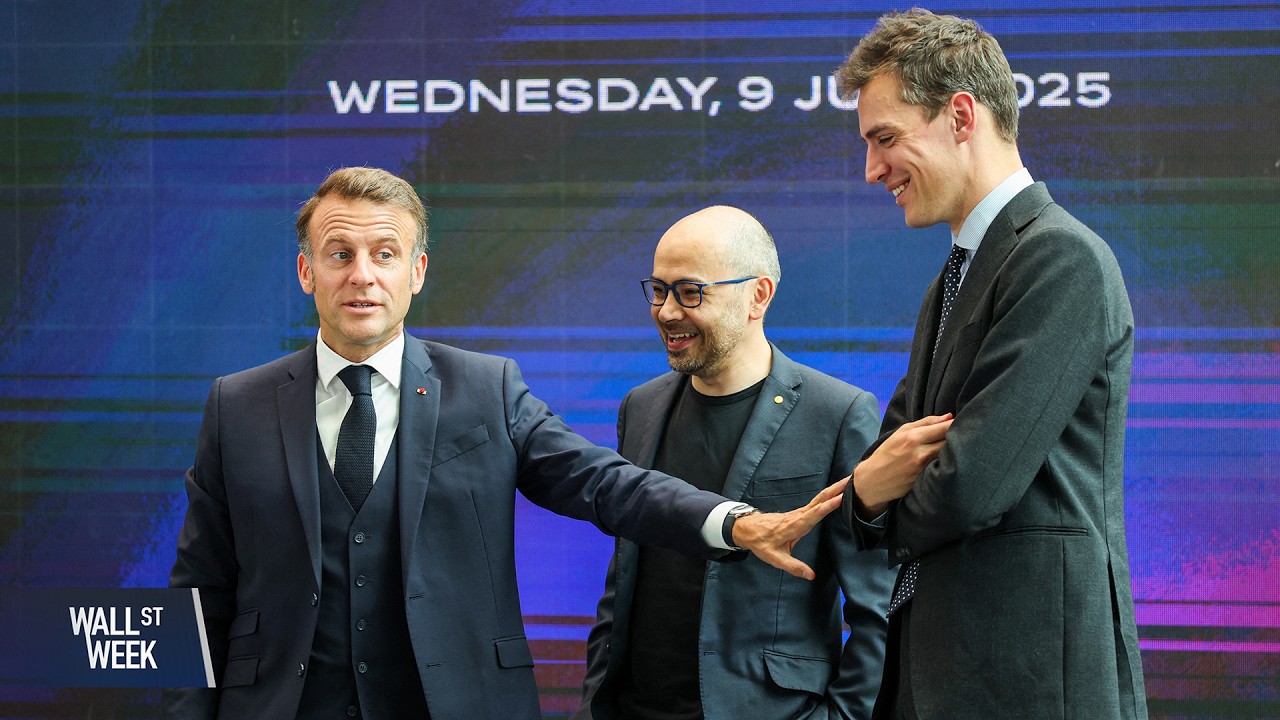
The comparison is the point. Arthur Mensch, co-founder of Mistral, told Bloomberg Television the French lab can win not by outspending closed model providers but by selling sovereign deployment on open weights, with his pitch that enterprises get business continuity by decoupling the model from infrastructure, keep sensitive data local because Mistral can deploy close to the data without seeing it, and pay less by avoiding the IP toll of centralized providers.
The segment showed the pitch without a scorecard.
Mensch said Mistral has operated under capital and compute constraints for two years yet produced what he called an extremely strong model, and said new investments will let it scale training and inference more frugally than U.S. counterparts, but the segment carried no independent benchmarks, no cost per token, and no named enterprise deployment metrics to test that claim. Bloomberg Television noted AI investment rose from 112 billion dollars a year when ChatGPT reached phones in November 2022 to 345 billion dollars by the end of 2025, according to its cited data, which underlines how far Mistral's capital base remains from the hyperscalers it cites as competition.
Roxanne Varza, director of startup campus Station F, said Europe services early stage well but still struggles with late-stage growth capital and exits, and that fragmented capital markets and a thin acquisition culture push many sellers to look to the U.S. Jacob Kirkegaard, senior fellow at Bruegel, agreed that Europe's incomplete integration hinders both model creation and diffusion, and he argued the economic payoff from AI depends less on who builds frontier models and more on who adopts them broadly, with faster uptake likely in Scandinavia, the Baltics and the Netherlands.
Kirkegaard also placed Mistral in a different box than it once claimed. He said the company was until recently near the frontier but has now shifted to providing AI services and open models rather than trying to develop closed frontier systems, and that it no longer wants to be viewed alongside Anthropic and OpenAI. That reframe matters because Mensch simultaneously said Mistral is the leader in open source for sovereign deployment, a claim the segment did not test against deployments or share.
What the segment also left out is public detail on the new system itself. Mistral's own introduction for Large 4, nicknamed Le Chonk, describes it as a 1 trillion parameter model and claims state of the art performance among open models in cyber defense, manufacturing and finance, even surpassing closed models on vision tasks in some settings, according to the company's video page.
That disclosure changes little about price or availability, and a credible read would require an audited evaluation, a published inference price, and a count of production sovereign deployments. As presented to Bloomberg Television, Mistral is asking enterprises to bet that control and lower IP cost offset integration work, and the question the numbers leave is whether frugality can buy frontier relevance when rivals are borrowing hundreds of billions to build it, a point our prior look at the same launch, Mistral says Large 4 leads Europe, proof thin, also flagged.