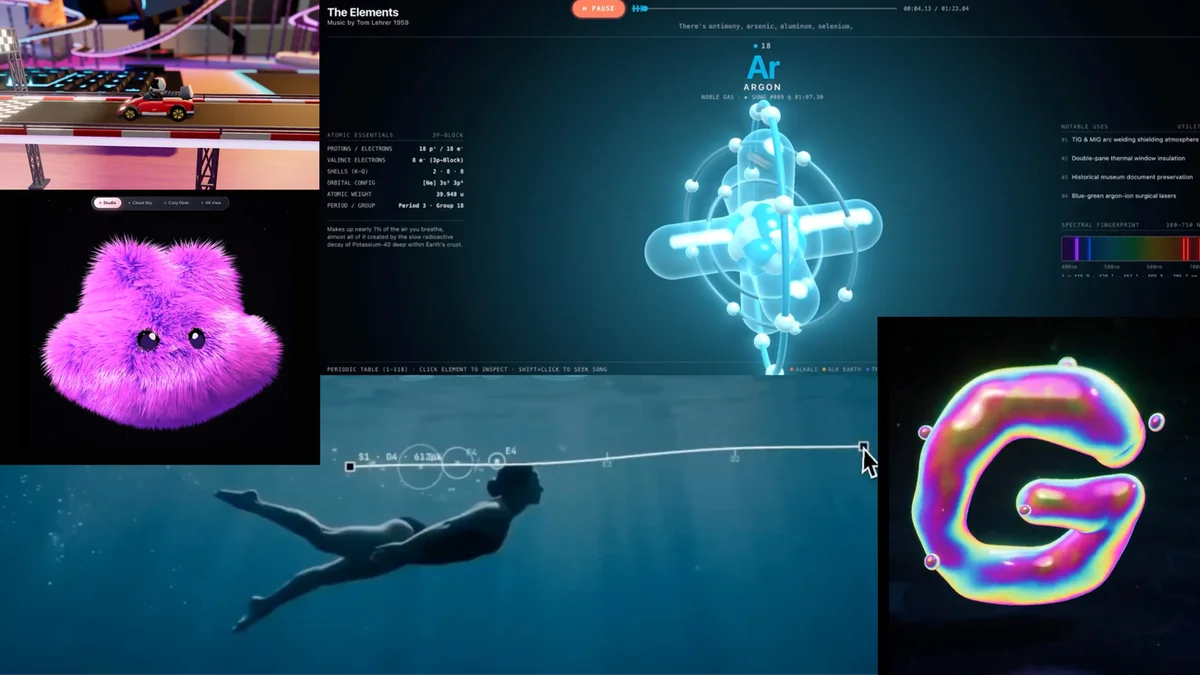
Google put Gemini 4 Argon to work on eight heavy tasks that usually take weeks, from coding a ray-traced library to turning NASA data into a deck.
Google Blog says the model can take a short prompt and produce 5,000 lines of math to render a 3D sunlit library from scratch, and it can also parse more than 80,000 raw files from 72 Mars flights into an executive deck, which frames why Gemini 4 Argon AI Studio access matters for teams that lack local render power.
The demos lean on server side synthesis. Google Blog says Argon orchestrated subagents, Blender MCP and Nano Banana to turn photos of a real desk into a playable 3D track in Antigravity, used Nano Banana and Veo to animate dense PDF science into illustrated video, and coded a custom fur engine with studio grade hair dynamics and interactive physics rather than relying on prebuilt assets or local libraries.
That shifts the bottleneck from desktop silicon to data center throughput.
For hardware, that is a cloud GPU win first. NVIDIA and AMD still power the inference behind these long horizon, multimodal runs, while Intel and Qualcomm chase the edge where prompt to tool calls stay light, and the value moves to memory, interconnect and sustained throughput for 3D, video and physics simulation. StartupHub.ai data shows inference hardware vendors tied to creative tooling see steadier pull when flagship models push rendering and simulation off device.
Access is gated. According to The Rundown, you open Argon in Google AI Studio with a project that has paid access, or use an eligible Antigravity or Gemini for business account, which limits casual testing of the heaviest examples https://www.therundown.ai/tools/gemini-4-argon.
The near term question is whether studios will rent this capacity by the minute instead of buying local workstation GPUs for the same 3D and video jobs.




