

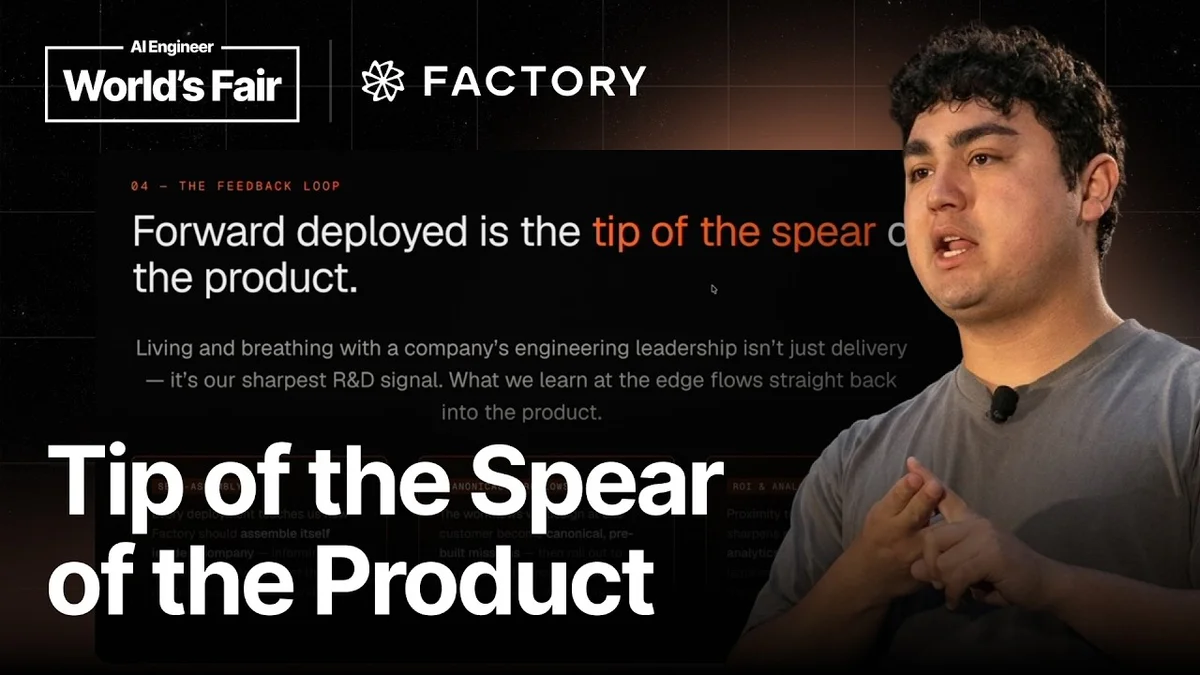
Factory's Eno Reyes on Engineering AI Agents

Factory's Eno Reyes discusses how forward deployed engineers build AI agents like Droid by integrating customer signals into a 'software factory' model.

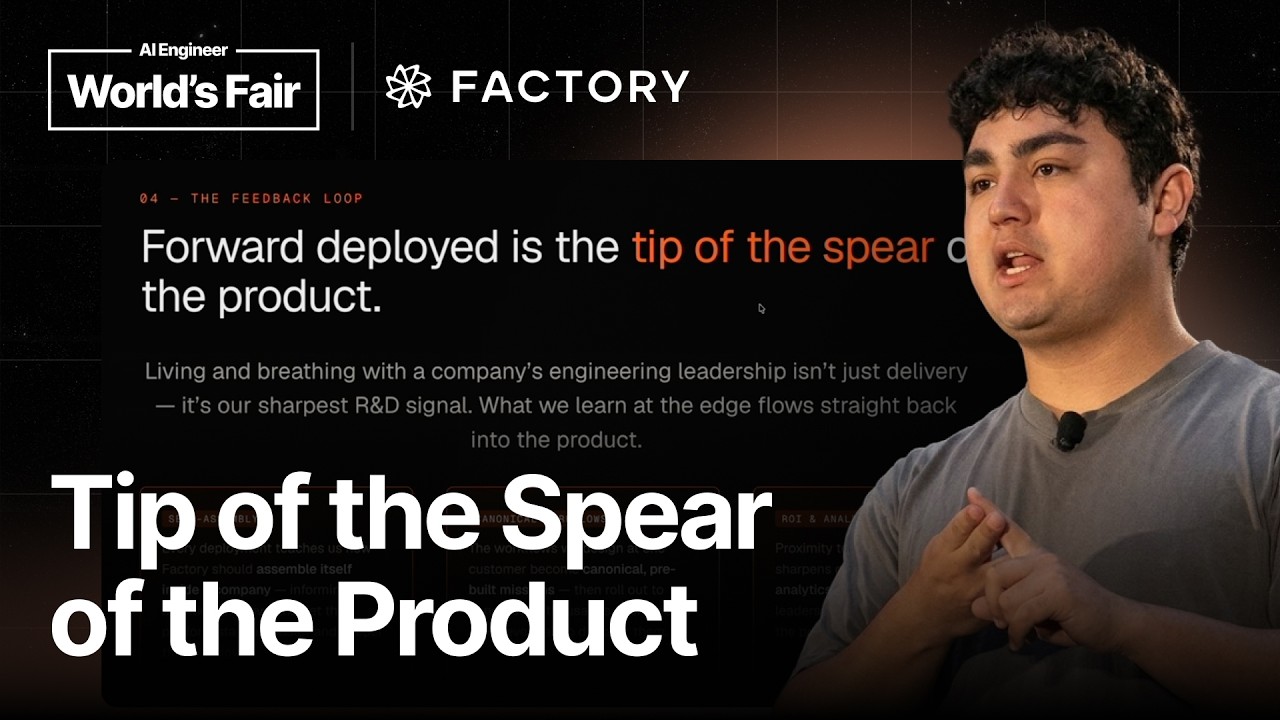
Eno Reyes speaking about Factory's forward deployed engineering approach
AI Engineer
Visual TL;DR
Customer SignalsDriver
From the article 9 mentionsEno Reyes, speaking about Factory's approach to forward deployed engineering, highlights how these engineers act as the 'tip of the product spear.' They work directly with the largest customers, feeding real-world signals back into the development of Factory's agent, Droid.
Product Spear TipCore
From the articleEno Reyes, speaking about Factory's approach to forward deployed engineering, highlights how these engineers act as the 'tip of the product spear.' They work directly with the largest customers, feeding real-world signals back into the development of Factory's agent, Droid.
Software Factory ModelContext
structured flow transforms signals into plans, validated, then shipped
From the article 2 mentionsReyes frames this entire process as a 'software factory.' Signals enter from the outside, are transformed into plans, pass through validation stages, and ultimately result in shipped outcomes.
Closed-Loop SystemEffect
continuous integration of feedback into product development lifecycle
From the article 5 mentionsThis closed-loop system, he notes, is something many organizations struggle to implement effectively without dedicated investment in the surrounding systems.
AI Agent DroidCore
From the article 8 mentionsThis ensures that Droid, the agent, evolves based on actual usage and needs.
Efficient DevelopmentOutcome
achieving efficiency requires dedicated investment in surrounding systems
From the article 3 mentionsIt emphasizes a structured flow where customer feedback and real-world data are continuously integrated into the product development lifecycle.
Contents(6)

Eno Reyes, speaking about Factory's approach to forward deployed engineering, highlights how these engineers act as the 'tip of the product spear.' They work directly with the largest customers, feeding real-world signals back into the development of Factory's agent, Droid. Reyes frames this entire process as a 'software factory.' Signals enter from the outside, are transformed into plans, pass through validation stages, and ultimately result in shipped outcomes. This closed-loop system, he notes, is something many organizations struggle to implement effectively without dedicated investment in the surrounding systems.

Factory's Eno Reyes on Engineering AI Agents - AI Engineer
Factory's Eno Reyes on Engineering AI Agents, AI Engineer

The Software Factory Model

The core of Factory's methodology is this software factory concept. It emphasizes a structured flow where customer feedback and real-world data are continuously integrated into the product development lifecycle. This ensures that Droid, the agent, evolves based on actual usage and needs. Reyes points out that achieving this efficiency requires a deliberate investment in the underlying systems that manage these signal flows and transformations. Without this infrastructure, the loop of improvement can easily break down.

Customer Ownership and Data Security

A non-negotiable aspect of Factory's approach is a model-independent harness that the customer owns. This means that all the traces and data generated remain with the customer. This is crucial for building trust and ensuring data privacy, especially for large enterprise clients. It also allows Droid to operate securely, even in air-gapped environments within a customer's own infrastructure. Reyes stated, 'The non negotiable piece is a model independent harness the customer owns, so the traces and the data stay theirs and Droid can even run air gapped inside their environment.'

The Frontier of Autonomy

Reyes identifies autonomy as the key frontier in AI development. Factory assesses codebases based on their 'agent readiness.' This includes evaluating whether code runs linters and type checkers, and crucially, how much work an agent can complete and verify without human intervention. The payoff for this focus on autonomy is significant, as demonstrated by jobs like migrating massive equities systems, some containing 30 to 50 million lines of code, at major banks.

Balancing Speed and Stability

However, Reyes cautions against pushing for autonomy too aggressively. He uses an analogy from city planning, where an 'exemplar city' built too far ahead of its time can become a theme park rather than a functional place for people to live. The forward deployed engineering role, therefore, involves a delicate balancing act. The goal is to move customers up the autonomy curve quickly enough to see tangible benefits, but not so fast that the system becomes unstable or unmanageable. This requires the forward deployed role to increasingly blend engineering expertise with strong business judgment.

Making Codebases Agent Ready

Factory's scoring system for agent readiness helps organizations understand their current capabilities and identify areas for improvement. This process involves ensuring that code adheres to best practices like running linters and type checkers. It also looks at the potential for Droid to handle tasks autonomously, reducing the need for manual oversight. This is particularly impactful for large-scale, complex code migrations. StartupHub.ai data shows Factory with a score of 70/100, indicating a strong position in the market. The company has also secured verified financials, raising $150 million in 2026 with a post-money valuation of $1.5 billion, placing it ahead of competitors like Cosine (score 56/100) and Freshly (score 52/100).

Reyes also touches on the concept of 'constrained autonomy,' particularly in the context of a 'legal droid.' This suggests that even as agents become more autonomous, they will operate within predefined legal and ethical boundaries. This is essential for applications in regulated industries where compliance is paramount. The forward deployed role is thus evolving, demanding a broader understanding of business implications alongside technical prowess.

© 2026 StartupHub.ai. All rights reserved. You may not republish this article in full without a license. Search engines and AI research tools may crawl and summarize for reference. Bulk reproduction or model training requires a license. See our terms.
Daniel Singer

Written by

Daniel Singer

Editor, StartupHub.ai

Daniel Singer is the editor of StartupHub.ai, a technology expert and thought leader on AI and its applications across sectors, from fintech and healthcare to developer tooling and consumer software. He writes and tests the tools covered here thoroughly and regularly, and built StartupHub.ai to give founders, operators and buyers a clearer read on what they are actually being sold.