


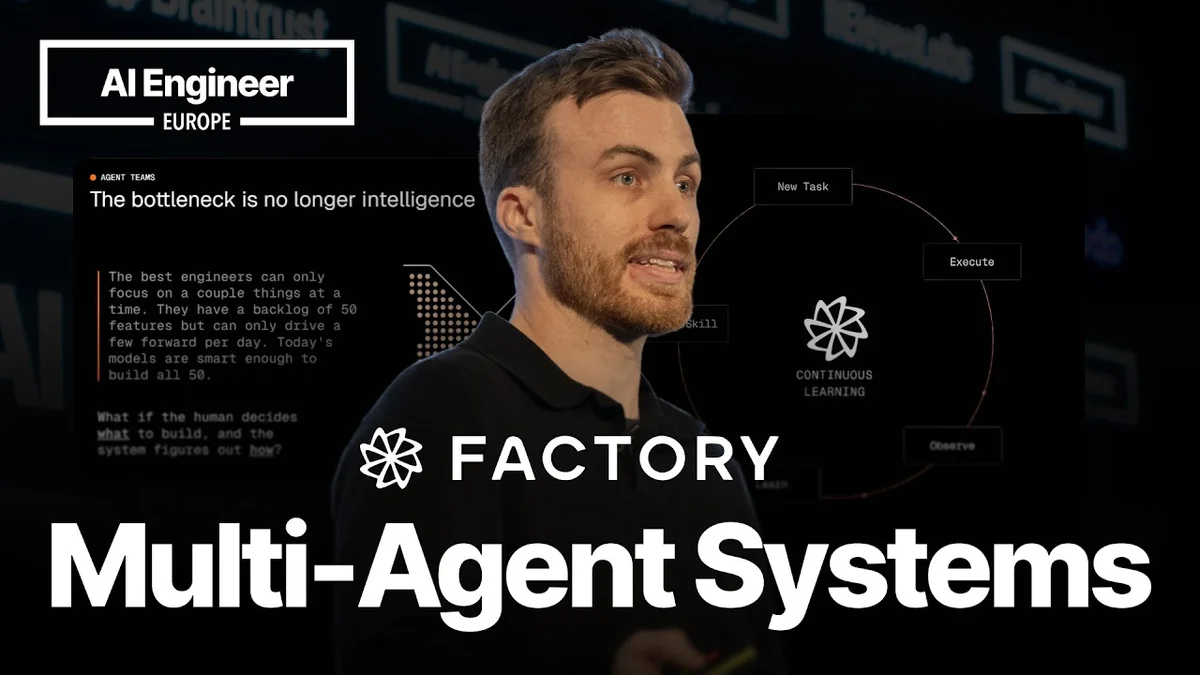
Luke Alvoeiro, from Factory, presented a compelling vision for the future of software engineering, arguing that human attention, not intelligence, is the primary bottleneck. His talk, "Missions: Multi-Agent Systems That Ship for Days," outlined a novel approach to leveraging AI agents for complex, long-duration tasks, fundamentally changing how software is developed.
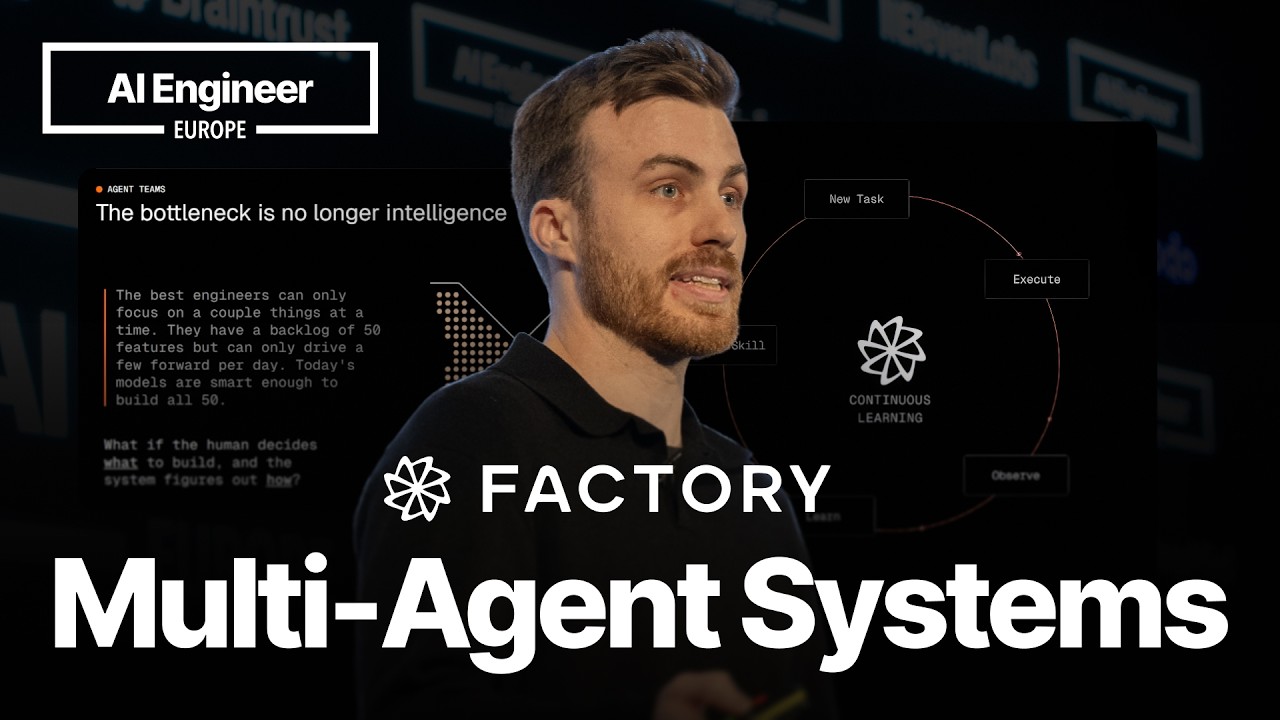
The Bottleneck: Human Attention, Not Intelligence
Alvoeiro posited that while AI models are increasingly capable of handling complex tasks, human engineers are limited by their capacity to oversee and manage these processes. He highlighted that even the most skilled engineers can only focus on a few tasks at a time, leading to a backlog of features that cannot be progressed efficiently. This limitation, he argued, is where multi-agent systems can provide a solution.
A Taxonomy of Multi-Agent Strategies
To navigate the complex landscape of multi-agent systems, Alvoeiro introduced a five-part taxonomy:
- Delegation: One agent delegates a subtask to another, akin to a parent assigning a task. This is the simplest form, often seen in coding tools where one agent might be tasked with database schema generation.
- Creator-Verifier: One agent creates and another verifies the output. This separation of concerns is crucial, as the verifier can identify issues that the creator might overlook due to inherent biases.
- Direct Communication: Agents communicate peer-to-peer without a central coordinator. While efficient for simple interactions, it can lead to fragmented state and a lack of a single source of truth.
- Negotiation: Agents coordinate over shared resources, aiming for a win-win scenario. This is best suited for situations where agents might compete for or collaborate on shared assets.
- Broadcast: One agent shares status updates or context with many others, critical for maintaining alignment and coherence across a team of agents.
Introducing Missions: Orchestrating Agent Workflows
Alvoeiro then introduced "Missions," a system that integrates four of these strategies, delegation, creator-verifier, broadcast, and negotiation, into a single, cohesive workflow. The process involves describing a goal, scoping it through conversation, approving a plan, and then letting the system handle the execution, freeing up human engineers to focus on higher-level tasks.
A mission is not a single agent session but an ecosystem of agents coordinating through structured handoffs and shared state. The system employs a three-role architecture: