

Cursor's AI Agents Get Worktree Boost

David Gomes of Cursor detailed the integration of Git worktrees into AI agents, enabling isolated task execution and reducing code complexity.

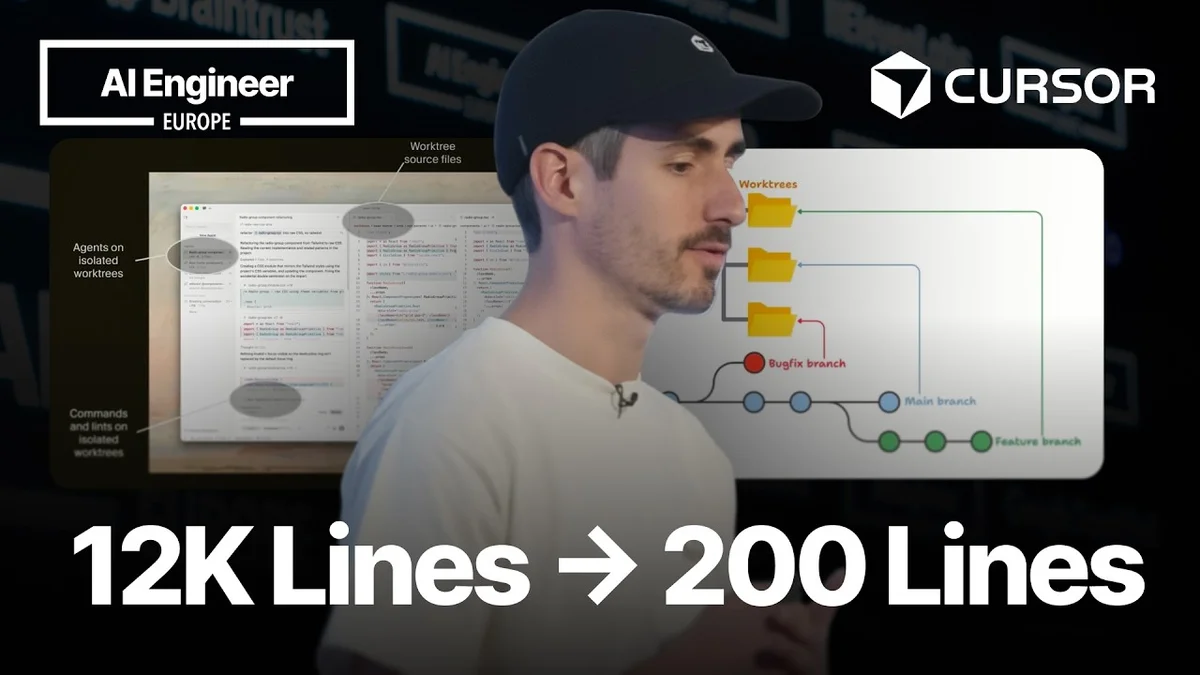
Presentation slide showing 'Replacing 12K LoC with a 200 lines Agent Skill' with David Gomes on stage.
Image credit: AI Engineer Europe· AI Engineer
Contents(4)

David Gomes, presenting at AI Engineer Europe, showcased a significant advancement in Cursor's AI agent capabilities: the integration of Git worktrees. This feature allows AI agents to operate within isolated environments, preventing interference with the main codebase and simplifying development workflows. Gomes demonstrated how the previously extensive 12,000 lines of code for a full-fledged feature could be replaced by a mere 200 lines of code using a single agent skill, highlighting a dramatic increase in efficiency and maintainability.
Cursor's AI Agents Get Worktree Boost - AI Engineer
Cursor's AI Agents Get Worktree Boost, AI Engineer

Understanding Git Worktrees and Cursor's Implementation

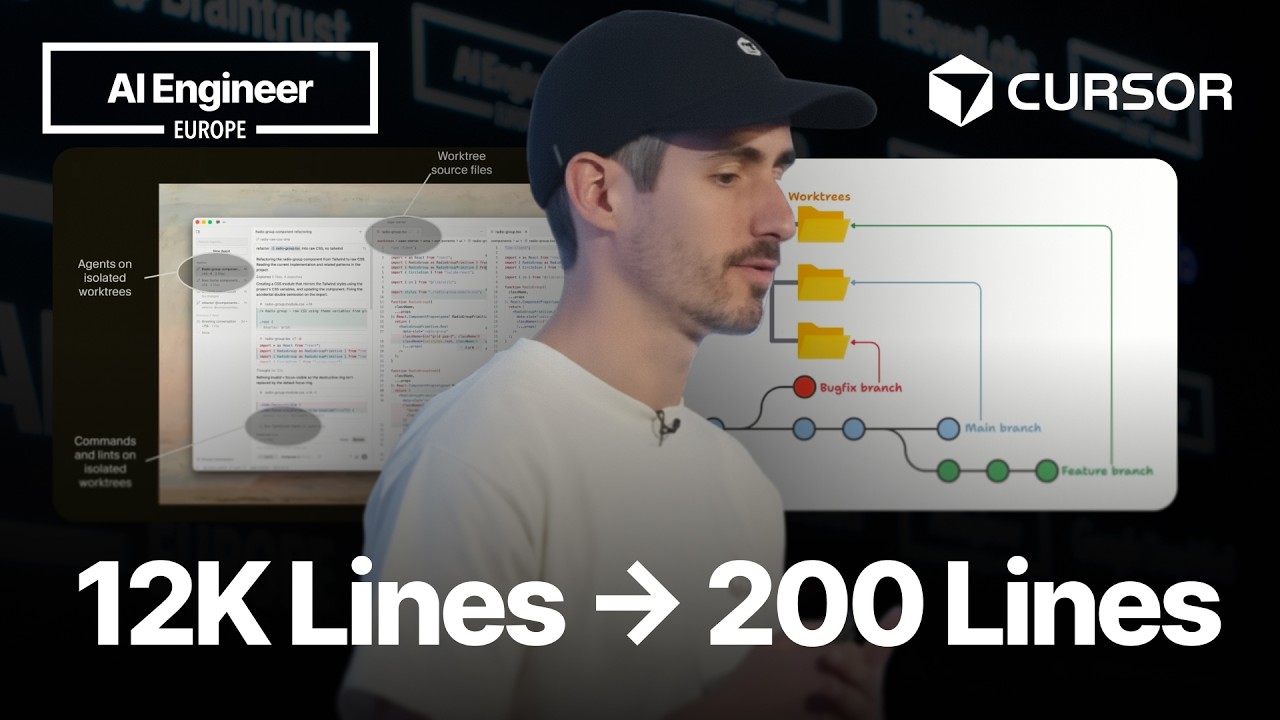
Gomes began by offering a brief recap of Git worktrees, explaining their function as separate checkouts of a repository. This allows developers, or in this case, AI agents, to work on different tasks concurrently without impacting the main branch. He illustrated this with a diagram showing a Git repository branching into multiple worktrees, each potentially dedicated to a specific task or agent.

The core of the innovation lies in how Cursor utilizes these worktrees. Agents are now scoped to these isolated worktrees, meaning any commands or changes they execute are confined to that specific environment. This isolation is crucial for maintaining code integrity and preventing unintended side effects across different development branches or tasks.

Key Benefits and Functionality

The primary advantage of this new approach is a substantial reduction in code complexity and maintenance overhead. By abstracting complex tasks into lightweight agent skills, developers can streamline their workflows. Gomes highlighted the ability for users to switch between worktrees mid-chat, allowing for seamless context switching between different tasks or models. Furthermore, the system works with multiple workspaces and repositories out of the box, offering flexibility for various development scenarios.

A notable improvement is the enhanced judging experience for 'Best of N' tasks. Agents can now be trained and evaluated more effectively within their isolated worktrees, leading to more reliable and accurate outcomes. Users can also leverage this feature to ask agents to stitch together code snippets from different sub-agent implementations, further boosting productivity.

New Commands and Future Directions

To facilitate this new functionality, Cursor has introduced new commands: /worktree, /apply-worktree, and /delete-worktree. These commands allow users to manage worktrees directly within the Cursor interface.

The presentation also touched upon the ongoing development of Cursor's AI features. The team is working on a more refined 'Agent Window 3.0' with a native worktree implementation, aiming for a cleaner and more integrated user experience. Additionally, they are exploring other local parallelism solutions beyond Git worktrees and are committed to continuously improving the existing skills through better evaluations and Reinforcement Learning (RL) training.

Addressing the Cons

Gomes also acknowledged the challenges with the current implementation. The primary concern is the potential for agents to lose track of their workspace directory over extended sessions, leading to them straying from their intended tasks. He also noted that the initial setup for agents in worktrees can be slower compared to previous methods, and the discoverability of worktrees might need improvement. These are areas the team is actively addressing to enhance the user experience.

The presentation concluded with a look at the pros and cons, emphasizing the significant gains in code reduction and parallel task execution, while also acknowledging the need for further refinement in agent stability and feature discoverability. The commitment to continuous improvement signals a promising future for AI-powered development within Cursor.

© 2026 StartupHub.ai. All rights reserved. You may not republish this article in full without a license. Search engines and AI research tools may crawl and summarize for reference. Bulk reproduction or model training requires a license. See our terms.
Daniel Singer

Written by

Daniel Singer

Editor, StartupHub.ai

Daniel Singer is the editor of StartupHub.ai, a technology expert and thought leader on AI and its applications across sectors, from fintech and healthcare to developer tooling and consumer software. He writes and tests the tools covered here thoroughly and regularly, and built StartupHub.ai to give founders, operators and buyers a clearer read on what they are actually being sold.