Hedra launched an autonomous post-training platform after posting a 6x inference speedup on identical GPUs.
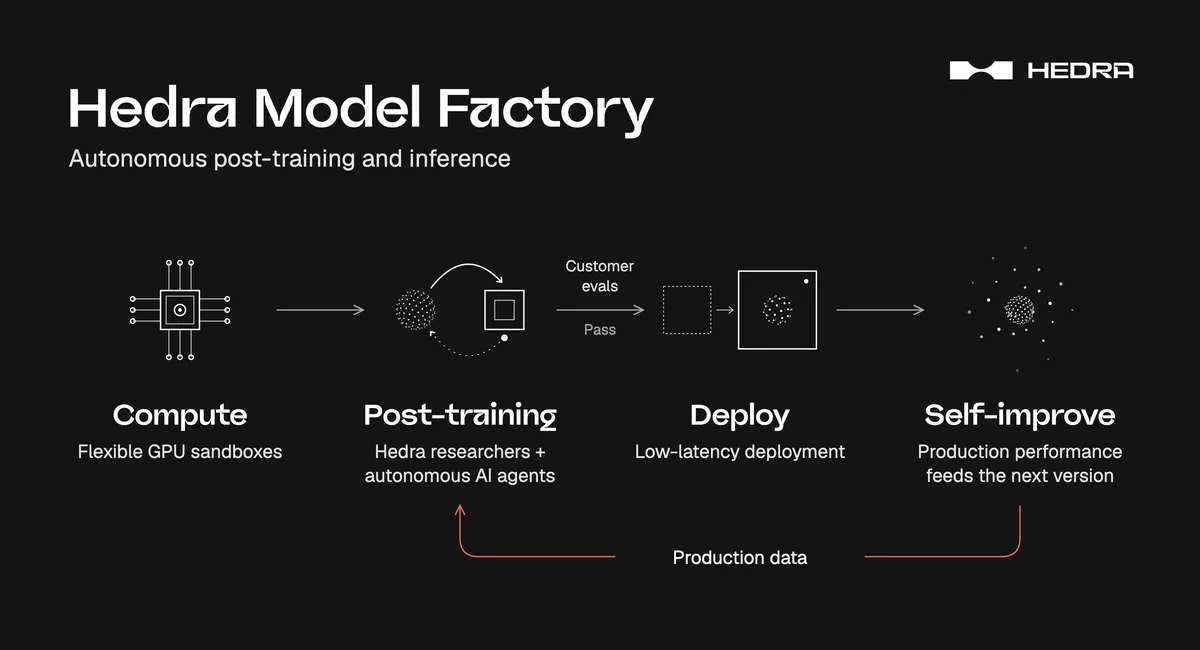
According to its announcement, Hedra grew revenue 15x in the past 12 months. It now sells the research and infrastructure behind that growth as Hedra Model Factory. The buyers are robotics, manufacturing, biology and defense teams. They get flexible GPU sandboxes with no long-term lock-in.
Michael Lingelbach, founder and CEO who worked on reinforcement learning at Stanford and NVIDIA, said "Recursive self-improvement is already changing how frontier models get built." He said the next step is video, sensors and simulation for real-world teams, according to the announcement.
The shift is notable for a San Francisco startup best known for AI video, reported by The Next Web. Hedra now asks customers to bring simulation engines and proprietary data. Hedra researchers then build reinforcement learning environments and datasets alongside customer teams.
Deployment runs on low-latency compute on premises or at the nearest partner data center, the company said. The work includes distilling action models to run faster than real time and fitting vision-language-action models onto edge devices. Teams can also serve an existing model on Hedra’s inference engine.
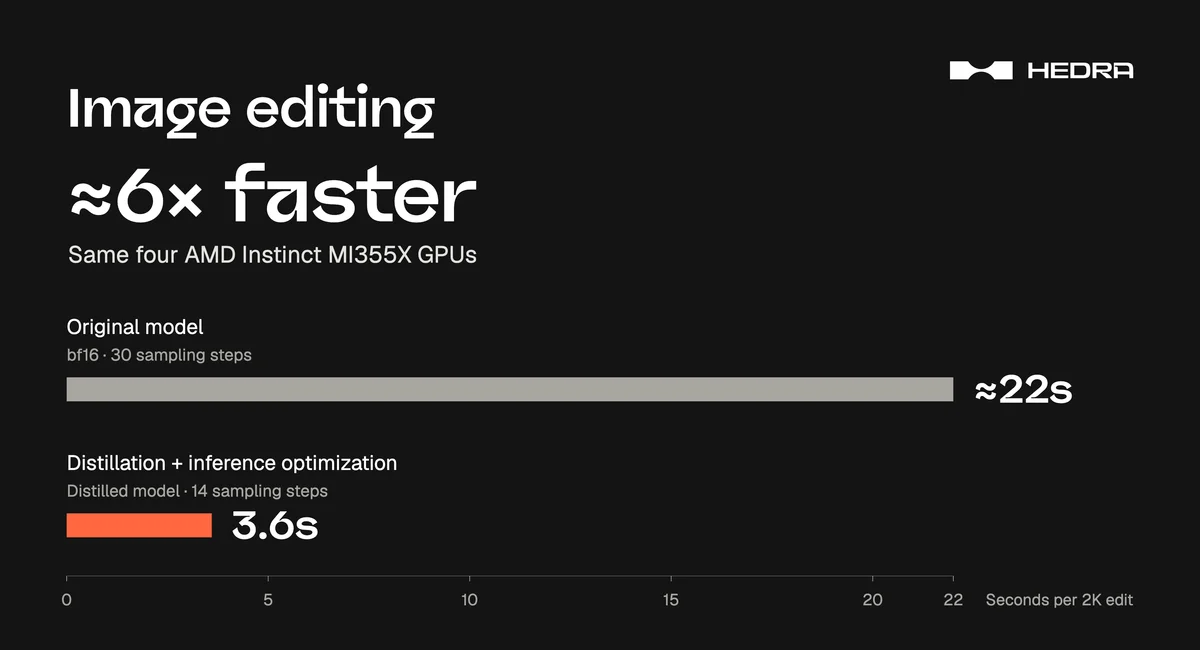
Hedra cut Krea 3 2K image edits from about 22 seconds to 3.6 seconds on the same four AMD Instinct MI355X GPUs, the company said. The comparison pits an original bf16 model at 30 sampling steps against a distilled 14-step model, per the announcement. Krea 3 now runs on MI355X on Hedra, according to the company.
Hedra retrained H3 for physical consistency and scored 34.9 on Google DeepMind’s Physics-IQ benchmark versus 30.3 for H3 Max, the company said. An autonomously distilled version rendered a five-second clip in under three seconds on AMD MI355X GPUs, per the announcement.
In a simulation study, Hedra restored a robot’s task success from near zero to near 100% after a gripper swap with no retraining, the company said. It matched the new gripper’s reach and grasp point in the wrist camera view. The result comes from simulation, not factory hardware.
Hedra’s research team includes talent from Stanford, Berkeley and UIUC with experience at Meta Superintelligence Labs, Fireworks AI and Salesforce, the company said. The team has published generative video and embodied AI research at NeurIPS, CVPR and ICLR. Hedra Model Factory is live now at hedra.com.