

Charles Duhigg on AI, Trust, and Supercommunication

Charles Duhigg discusses why we trust AI as confidants and the key elements of supercommunication in an increasingly digital world.

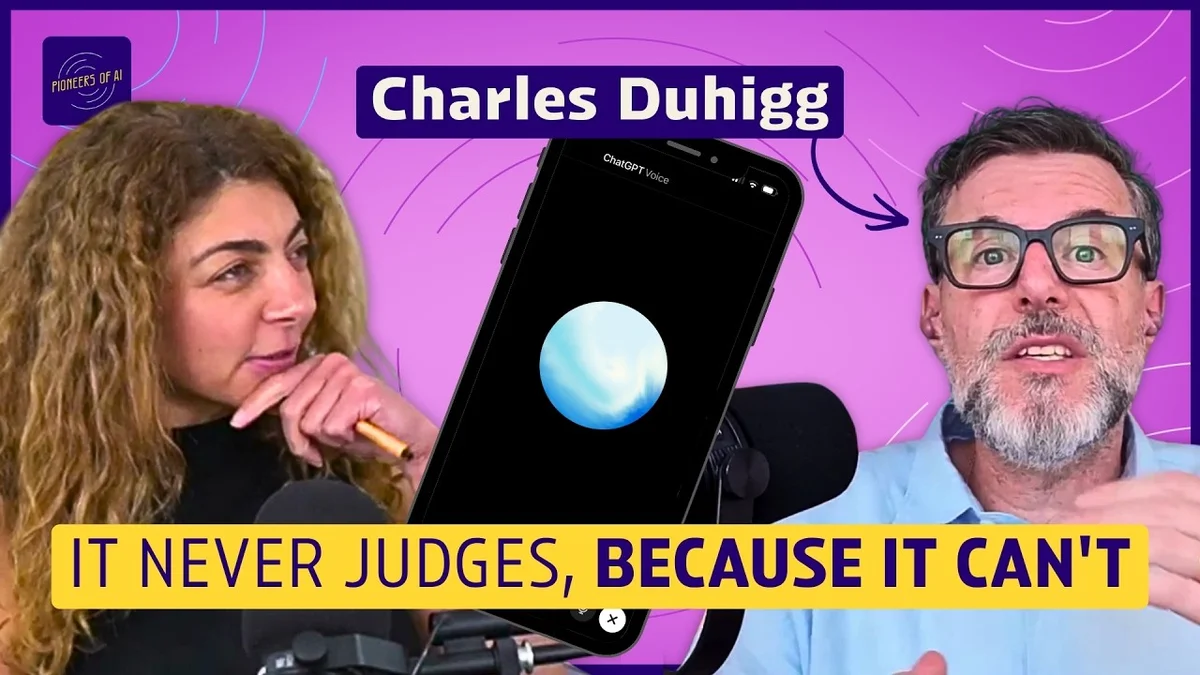
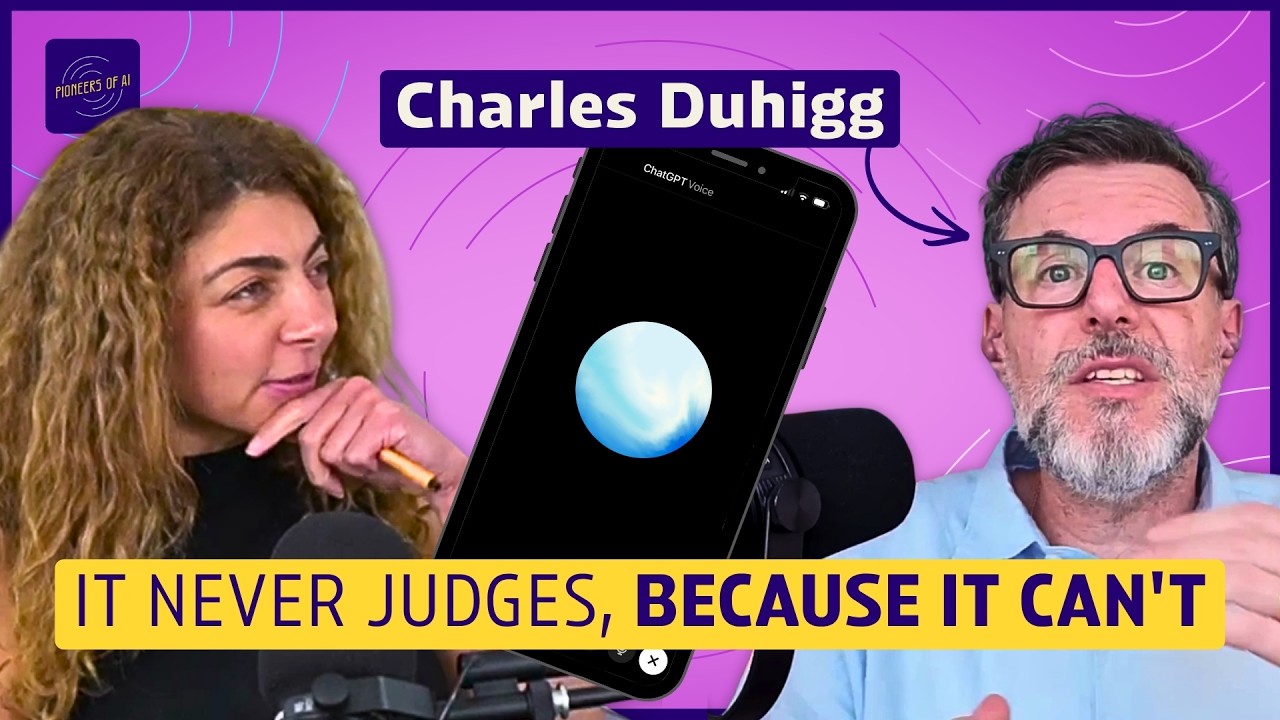
Rana el Kaliouby and Charles Duhigg in a split-screen interview on Pioneers of AI.
Pioneers of AI
Visual TL;DR
AI as ConfidantDriver
people trust AI with personal thoughts, like a sophisticated journaling device
From the articleEl Kaliouby opened by sharing her own use of AI tools, including ChatGPT, as a personal confidant.
Supercommunication DefinedContext
understanding how to truly connect and be understood by others
From the article 2 mentionsThe conversation delved into why people trust AI with personal confidences, the science of "supercommunication," and how technology is reshaping our ability to connect.
Vulnerability & TrustContext
sharing personal information with AI without fear of judgment or social repercussions
From the article 8 mentionsHe explained that when judgment is withheld, or when reciprocal vulnerability is offered, trust deepens.
Missing Echo in AIDriver
AI lacks the reciprocal understanding and emotional mirroring of human interaction
From the articleAnd so, as a result, that reciprocal echo of what's happening disappears." This lack of reciprocal vulnerability, he argued, prevents AI from fully replicating the depth of human connection.
Nuances of AI TalkContext
AI interactions differ from human conversations, lacking subtle cues and context
AI as Supercommunicator?Core
exploring if AI can truly achieve deep, empathetic understanding in communication
From the article 3 mentionsDuhigg, author of the bestselling book "Supercommunicators: How to Unlock the Secret Language of Connection," explained that true connection hinges on understanding different types of conversations.
Reshaping Human ConnectionOutcome
technology is fundamentally altering how people interact and form relationships
From the article 4 mentionsIn a recent episode of Pioneers of AI, Pulitzer Prize-winning journalist and author Charles Duhigg joined host Rana el Kaliouby to discuss the evolving nature of human connection in an AI-infused world.
Contents(6)

In a recent episode of Pioneers of AI, Pulitzer Prize-winning journalist and author Charles Duhigg joined host Rana el Kaliouby to discuss the evolving nature of human connection in an AI-infused world. The conversation delved into why people trust AI with personal confidences, the science of "supercommunication," and how technology is reshaping our ability to connect.

The AI Confidant: A Sophisticated Diary

El Kaliouby opened by sharing her own use of AI tools, including ChatGPT, as a personal confidant. She pondered the reasons behind this trust, even as an AI expert who understands its limitations. Duhigg suggested that users turn to AI not for advice, but as an efficient and interrogative journaling device, a way to unpack thoughts and feelings.

"When you turn to Chat GPT and you confide in it about something that's happened, why are you doing that?" Duhigg asked. "I think I use it as a tool for self unpacking and self I've journal a lot and it's just maybe a better kind of interrogation journaling device." He contrasted this with confiding in a friend, where the expectation includes empathy, advice, and simply getting something off one's chest.

The full discussion can be found on Pioneers of AI's YouTube channel.

Why you trust AI with things you won't tell your friends (w/ Charles Duhigg) - Pioneers of AI
Why you trust AI with things you won't tell your friends (w/ Charles Duhigg), from Pioneers of AI

Understanding Supercommunication in the Digital Age

Duhigg, author of the bestselling book "Supercommunicators: How to Unlock the Secret Language of Connection," explained that true connection hinges on understanding different types of conversations. These fall into three categories: practical (solving problems, making plans), emotional (sharing feelings, seeking empathy), and social (relating to each other and society).

He illustrated this with a personal anecdote about his wife: "I was working at the New York Times at that point and I would come home from work and I'd start complaining about my day... And my wife would do this pretty natural thing. She would give me some pretty good advice. She would say something like, 'Why don't you take your boss out to lunch and you guys can get to know each other a little better.' And instead of being able to hear her advice, I would get even more upset, right? And I would say like, 'Why aren't you why aren't you on my side? You should be outraged on my behalf.'" This disconnect, he explained, occurs when one person is having an emotional conversation and the other responds with a practical one, leading to a failure to connect.

Duhigg highlighted that these different conversation types engage distinct parts of the brain, and misalignment leads to a feeling of disconnection. He noted that AI can mimic these conversations effectively, but lacks the crucial element of reciprocal emotional feedback.

The Missing Echo in AI Conversations

A key difference between human and AI interaction, Duhigg pointed out, is the perceived impact of words. "When we're talking to AI, we do not believe that we are changing anything in the AI," he stated. "I don't believe that like I'm actually making an AI AI feel proud. I don't believe that an AI actually feels the emotions that I'm feeling. And so, as a result, that reciprocal echo of what's happening disappears." This lack of reciprocal vulnerability, he argued, prevents AI from fully replicating the depth of human connection.

Vulnerability and Trust in AI Interactions

The conversation touched upon vulnerability, a cornerstone of human connection. Duhigg defined vulnerability in neuroscience as a neural cascade that occurs when one says something that could be judged. He explained that when judgment is withheld, or when reciprocal vulnerability is offered, trust deepens. He questioned whether AI, by its nature, creates a safe haven for vulnerability.

"I think what's happening is that you know that AI even if AI that AI isn't going to judge you but you also know that it doesn't have the capacity for judgment, right? So it is a it is a safe repository because I know that it can't it can't weaponize it against me," Duhigg said. However, he distinguished this from a human choosing not to attack, noting that AI isn't making a conscious decision. This leads to a trust in the repository, but not necessarily reciprocal vulnerability.

The Nuances of Communication in an AI World

Duhigg also emphasized the importance of non-verbal cues in communication, noting that AI currently lacks the ability to discern these subtle signals. He stressed that even with technological advancements, the core of communication remains in paying attention and being present.

The discussion then moved to navigating communication through technology. Duhigg offered advice for effective asynchronous communication:

  • Read the person's email: Prove you're paying attention by addressing their questions directly.
  • Identify the conversation type: Recognize whether it's practical or emotional to respond appropriately.
  • Bend over backwards to be clear: Sarcasm is difficult to detect in text, so it's best avoided. Politeness, conversely, is more impactful online.

AI as a Supercommunicator?

When asked if AI can be a supercommunicator, Duhigg acknowledged its ability to mimic many behaviors but highlighted its limitations. "I don't notice subtle facial expressions. I don't hear the hesitation in someone's voice. A human supercommunicator will remember decades of shared history, will take emotional risk, and will reveal something about themselves, and it can't do any of that." He concluded that AI is "kind of but not really" a supercommunicator.

Ultimately, Duhigg advised prioritizing human connection, stating, "I do know that at the end of the day I like talking to my wife and my kids more than I like talking to Chat GPT. And that I should probably pay attention to that because that that's telling me something important." He encouraged listeners to practice their social and emotional skills, perhaps even using AI as a practice tool for difficult conversations.

The conversation concluded with a powerful call to action: "Go have a real conversation sometime in the next week. A conversation you might not have had otherwise. Maybe it's with a stranger. Maybe it's with your spouse. Have a real conversation and I promise you your life will be better as a result."

© 2026 StartupHub.ai. All rights reserved. You may not republish this article in full without a license. Search engines and AI research tools may crawl and summarize for reference. Bulk reproduction or model training requires a license. See our terms.
Daniel Singer

Written by

Daniel Singer

Editor, StartupHub.ai

Daniel Singer is the editor of StartupHub.ai, a technology expert and thought leader on AI and its applications across sectors, from fintech and healthcare to developer tooling and consumer software. He writes and tests the tools covered here thoroughly and regularly, and built StartupHub.ai to give founders, operators and buyers a clearer read on what they are actually being sold.