

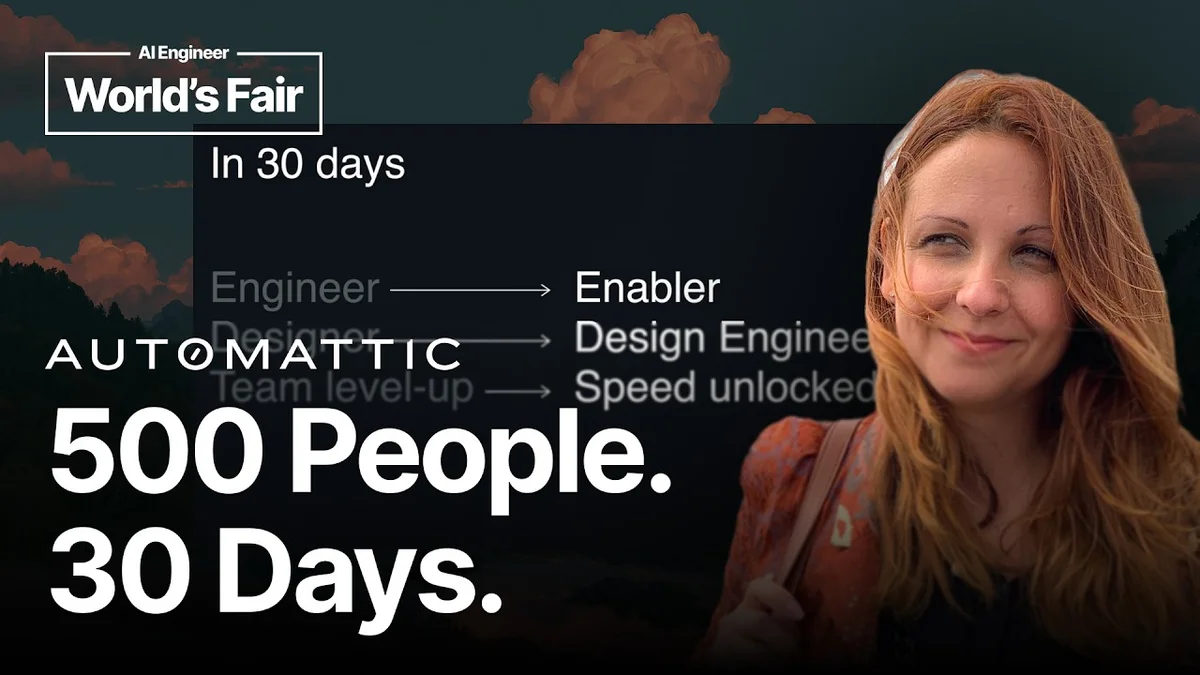
Automattic's Sanja Grbic on "Radical Speed Month"

Automattic Product Designer Sanja Grbic shares insights from the company's "Radical Speed Month," where AI tools accelerated team-led product development.

Sanja Grbic, Product Designer at Automattic, presenting on "Radical Speed Month"
AI Engineer
Visual TL;DR
Radical Speed MonthContext
company-wide initiative to empower teams for rapid product development
From the article 2 mentionsSanja Grbic, a Product Designer at Automattic, recently shared her experience participating in the company's "Radical Speed Month." This initiative involved 501 people over 30 days, resulting in the start of 794 projects.
Autonomy & FreedomDriver
teams given freedom to explore and bring ideas to fruition quickly
From the article 2 mentionsGrbic explained that "Radical Speed Month" was a company-wide initiative designed to empower teams to build and ship products with a high degree of autonomy.
Massive ParticipationOutcome
501 people participated, initiating 794 projects in 30 days
From the articleShe detailed her own participation, which involved building three projects within this timeframe.
AI ToolsCore
leveraged to accelerate product development and prototyping processes
From the article 7 mentionsGrbic emphasized that while the initiative was not strictly AI-focused, AI tools were leveraged to accelerate the process.
Team EnablementEffect
fostered collaboration and autonomy within distributed teams
From the article 7 mentionsThe core concept was to give teams the freedom to explore ideas and bring them to fruition quickly.
Product DevelopmentContext
focus on building and shipping new products with high speed
From the article 9 mentionsGrbic's presentation offered a unique look into how a large, distributed company can foster rapid product development and innovation.
Personal GrowthEffect
enabled individual learning and skill development through rapid iteration
From the article 2 mentionsShe shared her personal journey of moving from a traditional designer role to becoming a "design engineer," highlighting the shift in skills and approach required when working with AI.
Accelerated InnovationOutcome
demonstrated potential for rapid product creation and shipping
From the article 3 mentionsThis collaborative approach, amplified by AI, allows for faster innovation and a more dynamic product development cycle.
Contents(4)

Sanja Grbic, a Product Designer at Automattic, recently shared her experience participating in the company's "Radical Speed Month." This initiative involved 501 people over 30 days, resulting in the start of 794 projects. Grbic's presentation offered a unique look into how a large, distributed company can foster rapid product development and innovation.

Automattic's Sanja Grbic on "Radical Speed Month" - AI Engineer
Automattic's Sanja Grbic on "Radical Speed Month", AI Engineer

Automattic's Radical Speed Month

Grbic explained that "Radical Speed Month" was a company-wide initiative designed to empower teams to build and ship products with a high degree of autonomy. The core concept was to give teams the freedom to explore ideas and bring them to fruition quickly. The results were impressive, with 501 people participating and 794 projects being initiated within the 30-day period.

She detailed her own participation, which involved building three projects within this timeframe. Grbic emphasized that while the initiative was not strictly AI-focused, AI tools were leveraged to accelerate the process. She shared her personal journey of moving from a traditional designer role to becoming a "design engineer," highlighting the shift in skills and approach required when working with AI.

The Promise of AI in Product Development

A key theme Grbic touched upon was the transformative potential of AI in product development. She contrasted the traditional approach of building products in large organizations, which can involve extensive negotiation and handover processes among many people, with the agility that AI can enable. Grbic stated, "The promise of AI is speed."

She elaborated on how AI tools can compress timelines, allowing small teams to achieve significant progress. For instance, she described how her team used AI tools to quickly iterate on designs and code, enabling them to build a functional prototype of a "Design System Tracker" in just two and a half weeks. This project allowed users to browse, preview, and search for design components with ease, demonstrating the power of AI in accelerating development cycles.

Personal Growth and Team Enablement

Grbic's personal experience underscored the importance of embracing new tools and methodologies. She shared how her role evolved during the initiative, moving from a purely design-focused position to one that involved more direct coding and problem-solving with AI. This shift allowed her to not only build products more rapidly but also to gain a deeper understanding of the entire development process.

She emphasized the broader lesson learned: "The impact of enabling others may be greater than the impact of doing more engineering yourself." Grbic suggested that by providing the right tools and fostering an environment of experimentation, companies can empower their teams to achieve more. This collaborative approach, amplified by AI, allows for faster innovation and a more dynamic product development cycle.

Catalysts for Change

Grbic also outlined the key catalysts that drive successful change within large organizations. These include:

  • Executive support: Leadership buy-in is crucial for adopting new processes and tools.
  • Change champions: Individuals who advocate for and drive the adoption of new ways of working.
  • Experimentation: Creating a safe space for teams to try new technologies and approaches.
  • Agency: Empowering individuals and teams to take ownership and make decisions.

She concluded by reinforcing that while AI tools can significantly accelerate development, the human element of collaboration and continuous learning remains paramount. By embracing these catalysts, organizations can unlock new levels of speed and innovation.

© 2026 StartupHub.ai. All rights reserved. You may not republish this article in full without a license. Search engines and AI research tools may crawl and summarize for reference. Bulk reproduction or model training requires a license. See our terms.
Daniel Singer

Written by

Daniel Singer

Editor, StartupHub.ai

Daniel Singer is the editor of StartupHub.ai, a technology expert and thought leader on AI and its applications across sectors, from fintech and healthcare to developer tooling and consumer software. He writes and tests the tools covered here thoroughly and regularly, and built StartupHub.ai to give founders, operators and buyers a clearer read on what they are actually being sold.