

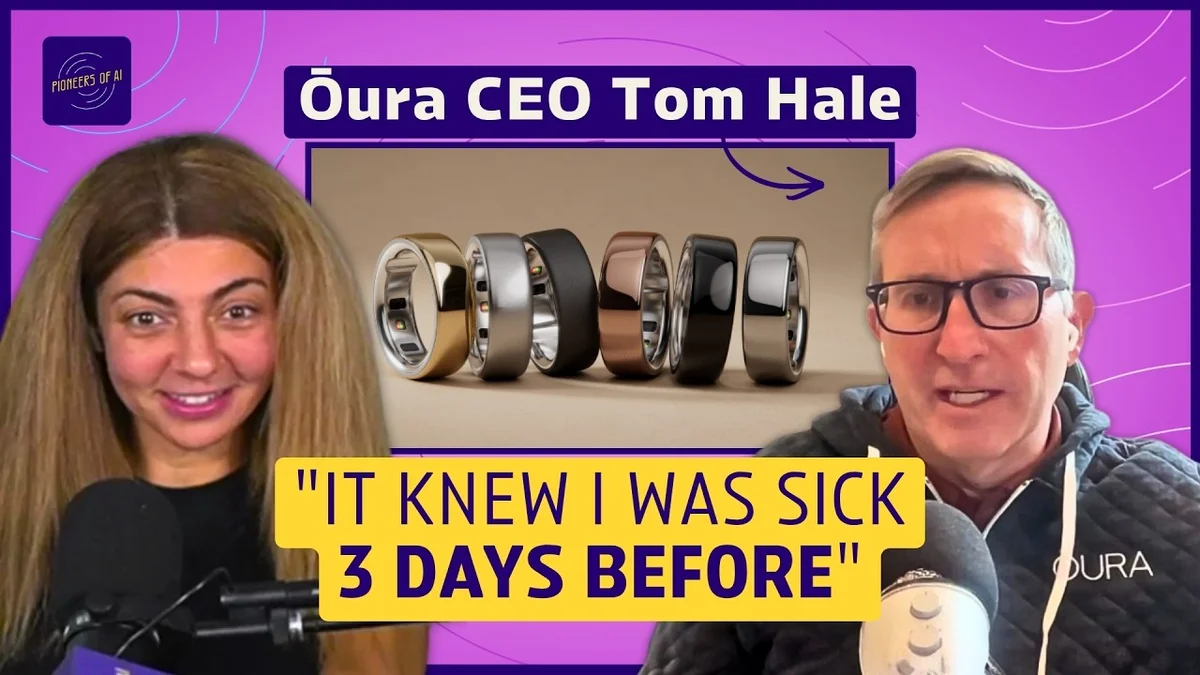
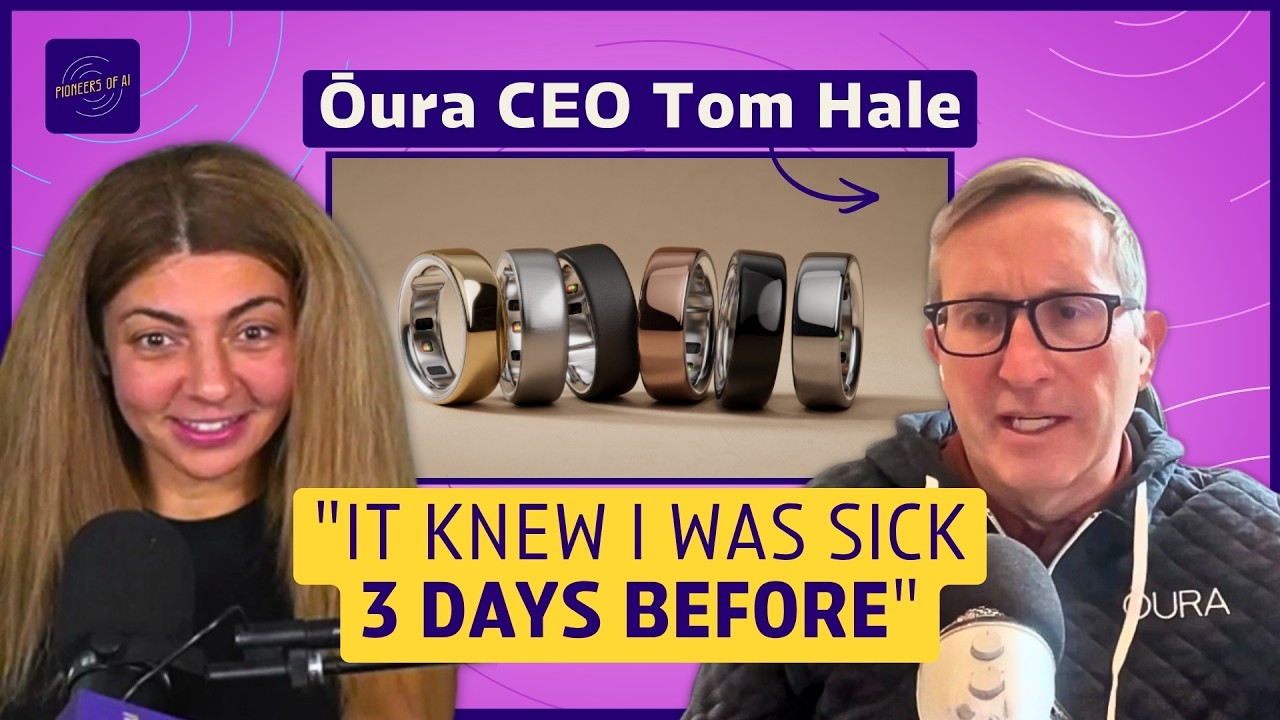
AI vs. Doctors: Oura CEO on Health Data

Oura CEO Tom Hale discusses how AI and wearables are transforming healthcare, potentially offering insights into our health that even doctors might miss.

ai vs. doctors vs vs  comparison
Pioneers of AI
Visual TL;DR
Oura CEO Tom HaleCore
discusses AI's burgeoning role in transforming healthcare
From the article 8 mentionsIn a recent episode of 'Pioneers of AI,' Oura CEO Tom Hale sat down with host Rana el Kaliouby to discuss the burgeoning role of artificial intelligence in healthcare, particularly how AI might be able to know individuals better than their own doctors.
AI in Personal HealthDriver
AI processes vast continuous physiological data from wearables
From the article 7 mentionsHale shared a personal anecdote about struggling with sleep during the COVID-19 pandemic.
Oura's Data ApproachCore
Oura ring tracks subtle changes and patterns over time
From the article 4 mentionsBy providing clear, actionable insights derived from their own data, Oura aims to foster a more proactive and preventive approach to healthcare.
Sensors, Data, MLContext
trifecta of sensors, data, and machine learning powers insights
From the article 9+ mentionsThe conversation then shifted to the core components driving AI in healthcare: sensors, data, and machine learning.
AI Doctor in PocketEffect
From the article 4 mentionsHe elaborated on the concept of an 'AI doctor in your pocket,' powered by sophisticated AI models that analyze data from wearables.
Beyond Doctor VisitsContext
continuous monitoring offers more nuanced predictions than infrequent check-ups
From the articleUnlike traditional healthcare, which often relies on snapshots of health during infrequent doctor visits, AI can track subtle changes and patterns over time.
Transforming HealthcareOutcome
empowering individuals with health insights doctors might miss
From the article 4 mentionsIn a recent episode of 'Pioneers of AI,' Oura CEO Tom Hale sat down with host Rana el Kaliouby to discuss the burgeoning role of artificial intelligence in healthcare, particularly how AI might be able to know individuals better than their own doctors.
Contents(4)

In a recent episode of 'Pioneers of AI,' Oura CEO Tom Hale sat down with host Rana el Kaliouby to discuss the burgeoning role of artificial intelligence in healthcare, particularly how AI might be able to know individuals better than their own doctors. Hale, who joined Oura in 2022 and has overseen its growth to a reported $1.1 billion valuation, highlighted how wearable technology is at the forefront of this transformation.

The Rise of AI in Personal Health

Hale emphasized that AI's ability to process vast amounts of continuous physiological data from wearables like the Oura ring offers a unique advantage. Unlike traditional healthcare, which often relies on snapshots of health during infrequent doctor visits, AI can track subtle changes and patterns over time. This continuous monitoring allows for more nuanced predictions and personalized interventions.

He elaborated on the concept of an 'AI doctor in your pocket,' powered by sophisticated AI models that analyze data from wearables. These models can predict future health events, such as the likelihood of a heart attack based on a user's long-term health trajectory. Hale stated, "In 10 years, if you don't change your course, you're going to have a heart attack. That's so powerful." He believes this predictive capability is a significant transformation in medicine, shifting the focus towards proactive and preventive care.

The full discussion can be found on Pioneers of AI's YouTube channel.

Does AI know you better than your doctor? (w/ Ōura CEO Tom Hale) | Pioneers of AI - Pioneers of AI
Does AI know you better than your doctor? (w/ Ōura CEO Tom Hale) | Pioneers of AI, from Pioneers of AI

Oura's Data-Driven Approach

Rana el Kaliouby prompted Hale to discuss the specific metrics Oura tracks and how they contribute to this understanding of health. Hale explained that Oura's ring monitors various physiological signals, including sleep, heart rate, heart rate variability (HRV), body temperature, and activity levels. He highlighted that the ability to continuously collect this data is key, as it provides a more complete picture than intermittent measurements.

Hale shared a personal anecdote about struggling with sleep during the COVID-19 pandemic. He discovered that by simply adjusting his bedtime routine and sleep environment, he could significantly improve his sleep quality and, consequently, his overall well-being. This personal experience underscored the power of data-driven insights for behavioral change.

The Trifecta of Sensors, Data, and Machine Learning

The conversation then shifted to the core components driving AI in healthcare: sensors, data, and machine learning. Hale explained how Oura's ring uses advanced sensors to collect precise physiological data. This data is then processed by sophisticated machine learning algorithms to identify patterns and provide actionable insights to users. The combination of these elements allows for personalized health recommendations, helping individuals take greater agency over their health.

He also touched upon the fact that not all data is created equal, and the interpretation of this data is where AI truly shines. By analyzing multiple data points in conjunction, AI can identify complex relationships that might be missed by human observation alone. This sophisticated analysis is what allows AI to potentially know a patient better than a doctor, by providing a continuous, granular understanding of their physiology.

Empowering Individuals and Transforming Healthcare

Hale emphasized that Oura's mission is to empower individuals with the knowledge and tools to improve their health. By providing clear, actionable insights derived from their own data, Oura aims to foster a more proactive and preventive approach to healthcare. This aligns with a broader trend in the industry, where technology is increasingly being used to shift from a reactive, sick-care model to a proactive, health-care model.

The discussion also touched on the importance of data privacy and security in this domain. Hale assured that Oura takes these concerns very seriously, ensuring that user data is handled with the utmost care and confidentiality. The ultimate goal, he reiterated, is to help people live healthier, more fulfilling lives by providing them with a deeper understanding of their own bodies.

© 2026 StartupHub.ai. All rights reserved. You may not republish this article in full without a license. Search engines and AI research tools may crawl and summarize for reference. Bulk reproduction or model training requires a license. See our terms.
Daniel Singer

Written by

Daniel Singer

Editor, StartupHub.ai

Daniel Singer is the editor of StartupHub.ai, a technology expert and thought leader on AI and its applications across sectors, from fintech and healthcare to developer tooling and consumer software. He writes and tests the tools covered here thoroughly and regularly, and built StartupHub.ai to give founders, operators and buyers a clearer read on what they are actually being sold.