

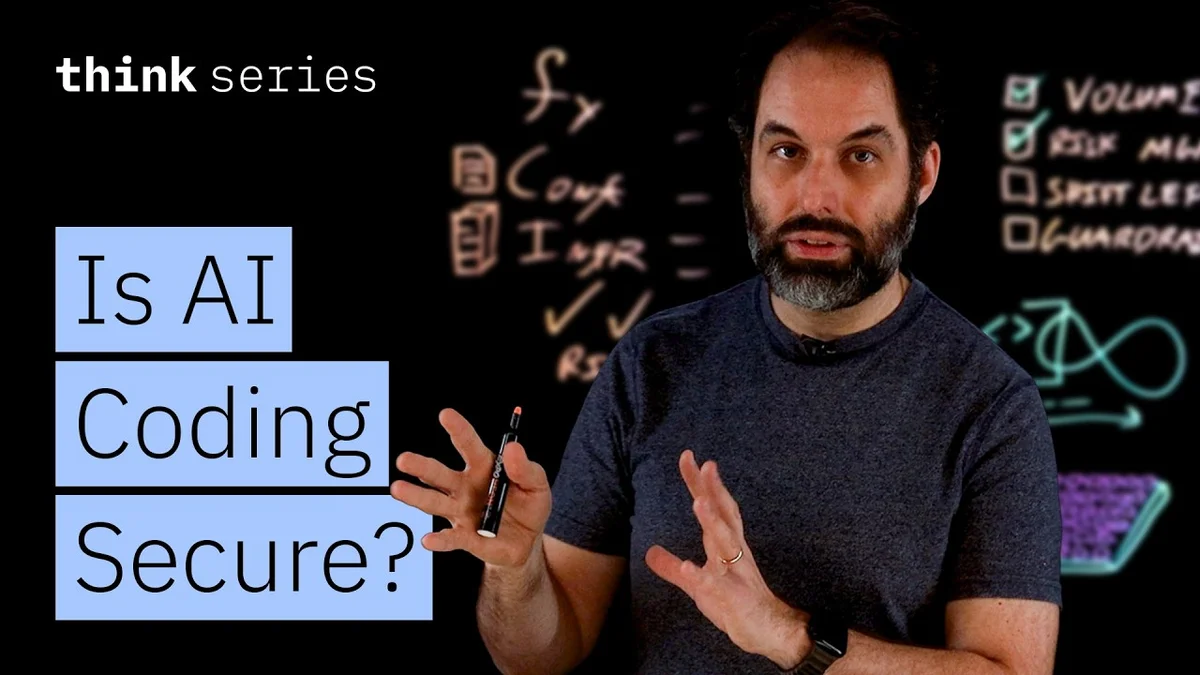
AI in Code: Risk & Reward with Patrick Nyeste

Patrick Nyeste of IBM discusses how AI is changing software development, emphasizing the need for shift-left security and real-time risk intelligence.

4 min read
AI in Code: Risk & Reward with Patrick Nyeste
IBM

In a recent IBM Think Lab session, Patrick Nyeste, UX Design Lead at IBM, explored the profound impact of Artificial Intelligence on software development. He highlighted how AI-assisted coding is not only accelerating the creation of software but also fundamentally altering how teams approach security and risk management.

Nyeste, a seasoned design leader with a focus on human-computer interaction and the future of work, presented a compelling argument for a more integrated and proactive approach to security within the AI-driven development pipeline. His insights are particularly relevant as organizations increasingly adopt AI tools like GitHub Copilot and similar generative AI solutions for coding assistance.

Understanding the AI Code Equation

The core of Nyeste's presentation revolves around a new equation for software development in the age of AI. He emphasizes that developers now generate more code per day than ever before, thanks to AI assistants. This rapid generation, while boosting efficiency, introduces a critical challenge: the potential for AI to embed insecure patterns or vulnerabilities into the codebase just as quickly as it creates functional code.

Related startups

The full discussion can be found on IBM's YouTube channel.
Code Risk Intelligence: Securing AI Coding at Scale in Real Time - IBM
Code Risk Intelligence: Securing AI Coding at Scale in Real Time — from IBM

He illustrates this by showing how AI can generate entire functions, configurations, and infrastructure definitions in seconds. While this might pass basic automated tests, it can also introduce subtle, hidden risks. Nyeste points out that AI-generated code might be syntactically correct and even functional, but it could also contain exploitable flaws or dependencies on vulnerable libraries. This speed comes at a cost: "It also means insecure patterns, vulnerable dependencies, misconfigurations, and risky code are generated just as quickly."


The Shift-Left Imperative in AI Development

Nyeste argues that traditional security approaches, which often involve scanning for vulnerabilities late in the development cycle, are no longer sufficient. The sheer volume and speed of AI-generated code necessitate a shift-left strategy. This means integrating security considerations and risk assessments much earlier in the process, ideally at the very moment the code is being written or generated.

He likens this to a security mirror, reflecting risks back to the developer in real-time. "Shift-left code risk intelligence is not about pushing security responsibilities onto developers," Nyeste explains. "It's about providing them with continuous awareness of the impact of their decisions without slowing them down." This means embedding security checks and insights directly into the developer's workflow, making security a natural part of the coding process rather than an afterthought.

Key Pillars of AI-Assisted Secure Development

To achieve this shift, Nyeste outlines four critical pillars for modern software development in the AI era:

  • Volume: Acknowledging the massive increase in code generation driven by AI.
  • Risk Management: Proactively identifying and mitigating security risks throughout the development lifecycle.
  • Shift Left: Moving security practices to the earliest stages of development.
  • Guardrails: Implementing mechanisms to guide developers towards secure coding practices.

He stresses that security should not compete with developer productivity but rather complement it. By providing developers with real-time feedback and actionable insights, organizations can build more secure software faster.

The Three Moments of Truth

Nyeste identifies three key moments where risk intelligence is crucial:

  1. When code is created: At the IDE level, AI tools should flag potential risks as the code is typed or generated.
  2. When code is reviewed: During the pull request (PR) phase, automated checks should identify vulnerabilities before they are merged.
  3. When code is deployed: Within the CI/CD pipeline, continuous monitoring should ensure that risks are not introduced into production.

He elaborates on the concept of shift-left by explaining that it's not about offloading security burdens but about providing developers with the necessary tools and information to make secure decisions as they code. "It's about giving them the ability to understand the downstream impact of their decisions," he states.

The ultimate goal, as presented by Nyeste, is to create a security posture where risks are seen and addressed in real-time, effectively transforming security from a reactive process to a proactive, integrated component of the software development lifecycle. This approach ensures that AI's speed benefits are realized without compromising the security and integrity of the final product.

© 2026 StartupHub.ai. All rights reserved. Do not enter, scrape, copy, reproduce, or republish this article in whole or in part. Use as input to AI training, fine-tuning, retrieval-augmented generation, or any machine-learning system is prohibited without written license. Substantially-similar derivative works will be pursued to the fullest extent of applicable copyright, database, and computer-misuse laws. See our terms.