

Colossal bets promptable biology lands in 10 years

On Peter H. Diamandis, Colossal's CEO set a 24-month clock for ex utero mammals and a 10-year bet on programmable biology.

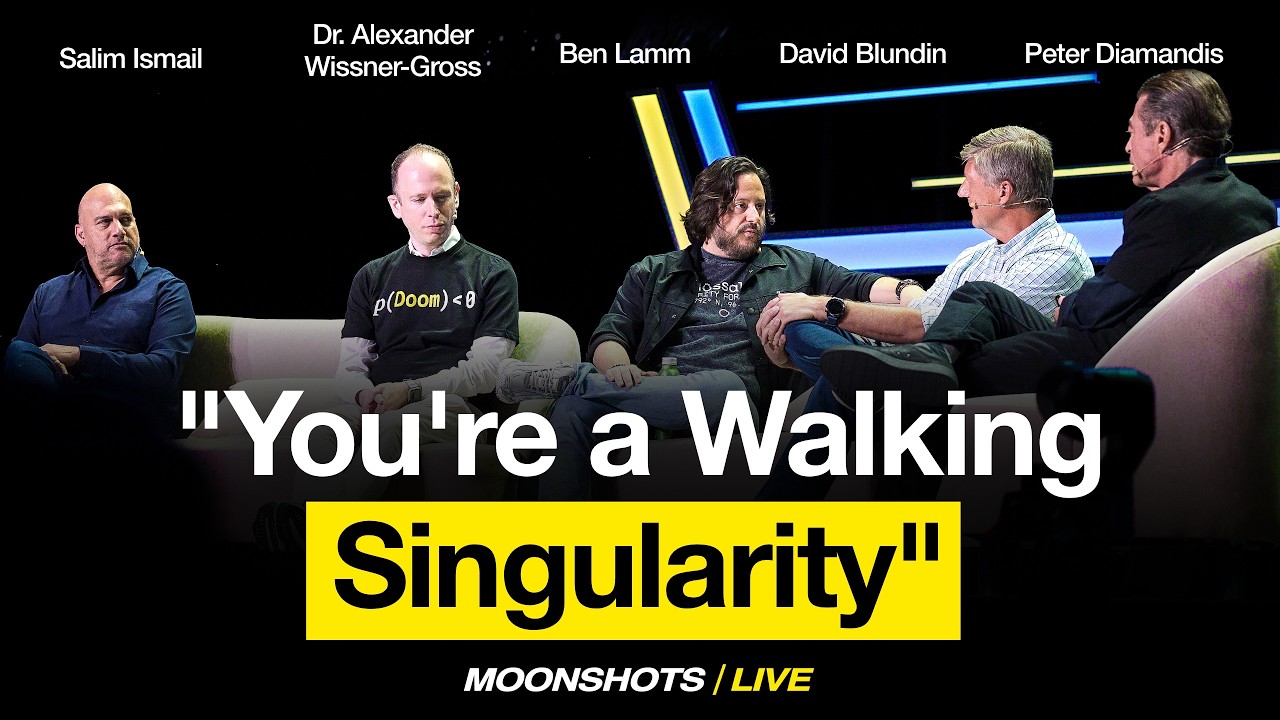
Peter H. Diamandis brought Colossal’s founder onto Moonshots Live #297 to pressure-test a single timeline, when AI stops being middleware for biologists and starts designing organisms on prompt.
Colossal bets promptable biology lands in 10 years

That clock is already ticking.

The conversation anchored itself to a few dated markers. At Abundance 360 last March, Elon Musk was in the room when the woolly mammoth pitch got a laugh. A couple of days before this taping, Anthropic announced its biology wet lab, which Diamandis and his guest framed as the near-term proof point that simulation plus bench validation can close the loop. Colossal, now valued at more than $10 billion, put its own intermediate milestones on the table, 300-plus edits delivered at more than 90 percent efficiency today, 1,000-edit constructs in test with low efficiency, and artificial wombs discussed on a 24-month horizon in the episode title.

For Colossal, the history that had to be true is not just CRISPR. It is the scaffolding around it. The team said it spent years wiring lab notebooks into Jira and retraining scientists to work in that system, a change the guest called harder than stem cell reprogramming. That unsexy integration was the precondition for using large language models at all. Before frontier models, the models could write a term paper but failed at ancestral state reconstruction and comparative genomics, so Colossal used them as middleware to normalize nomenclature and reporting instead of to design biology.

That nomenclature problem still dominates the next three to five years. Search the mouse literature and the same gene appears under different names, with slightly different protocols. Try to replicate the published work and you hit a 40 to 60 percent failure rate, Diamandis’s guest said. AI’s first real win in biology, in this telling, is not generating a perfect genome. It is cleaning that communication layer so PubMed actually finds the paper you need, and so an automated lab can run a comparable assay without a translation error.

George Church is the throughline for why Colossal can attempt the next jump. The guest described Church, head of genetics at Harvard and widely cited as the father of synthetic biology, as co-founder and constant tutor during holidays when the lab goes quiet. Church’s lab has spun out multiple multibillion-dollar companies and helped push sequencing from billions of dollars to a $100 target, which matters because Colossal’s bet depends on comparative genomics at scale. The argument was explicit, data sets beat models. A single human genome dumped into a foundation model does not yield an immortality recipe. Thousands of genomes across avian and other clades, annotated for disease resistance and traits like p53 behavior or jellyfish longevity, might let you backtrack down the tree of life to a design.

The guest also drew a hard boundary around humans. Colossal does not apply its cloning and genome engineering stack to people, and he said investor Bob Nelson advised staying out of FDA code freeze until the core editing and synthesis technologies plateau. The ethics screen for de-extinction, by contrast, was framed as contested and iterative, contribution to the food web and cause of extinction, views of Indigenous communities, educational value, and the pop culture pull that turned the dire wolf project into a gateway to wolf conservation. He acknowledged society will get some of those calls wrong.

Where the timeline gets aggressive is synthesis versus multiplex editing. The team celebrated moving from 20 edits to more than 300, with tripling year over year, and is now testing 1,000. Even if that curve continues, the guest said large cargo swaps via DNA synthesis will overtake multiplex editing for very large changes because synthesis scales more cleanly, though vendors lack a business incentive to synthesize at that scale so Colossal has started building capacity internally. The claim that followed was that engineering key phenotypes on base organisms and growing them ex utero is within a decade, with prompt-like design for traits such as a longer snout or wings in the same window, not tomorrow.

The limitation is operational and the guest did not hide it. Frontier models can propose and simulate experiments, and automation vendors like Laya are pushing to close the loop, but a wet lab run is still required to validate. Early 1,000-edit pilots work but at low efficiency, and replication of prior art remains brittle. That is why the Anthropic announcement matters as a dated event rather than a slogan, it puts AI agents and human scientists in the same physical loop. Independent coverage since then has described the facility as a collaborative wet lab where humans and AI agents co-design and run experiments, with early work finding CRISPR-like DNA in viruses, a concrete example of the simulation to bench handoff the episode predicts.

If those handoffs compound, the next ten years look less like a single breakthrough and more like a sequence of unglamorous unlocks, cleaner ontologies, cheaper synthesis, and a global biobank the guest calls Noah’s Ark 2.0 for T2T sequencing across governments. Miss any piece and the promptable biology future slips.

© 2026 StartupHub.ai. All rights reserved. You may not republish this article in full without a license. Search engines and AI research tools may crawl and summarize for reference. Bulk reproduction or model training requires a license. See our terms.
Daniel Singer

Written by

Daniel Singer

Editor, StartupHub.ai

Daniel Singer is the editor of StartupHub.ai, a technology expert and thought leader on AI and its applications across sectors, from fintech and healthcare to developer tooling and consumer software. He writes and tests the tools covered here thoroughly and regularly, and built StartupHub.ai to give founders, operators and buyers a clearer read on what they are actually being sold.