

Addy Osmani: Own Your Verdict in the Age of AI Agents

Addy Osmani, former Google Cloud AI Director, discusses the evolving role of engineers in the age of AI agents, emphasizing judgment, accountability, and ownership.

9 min read
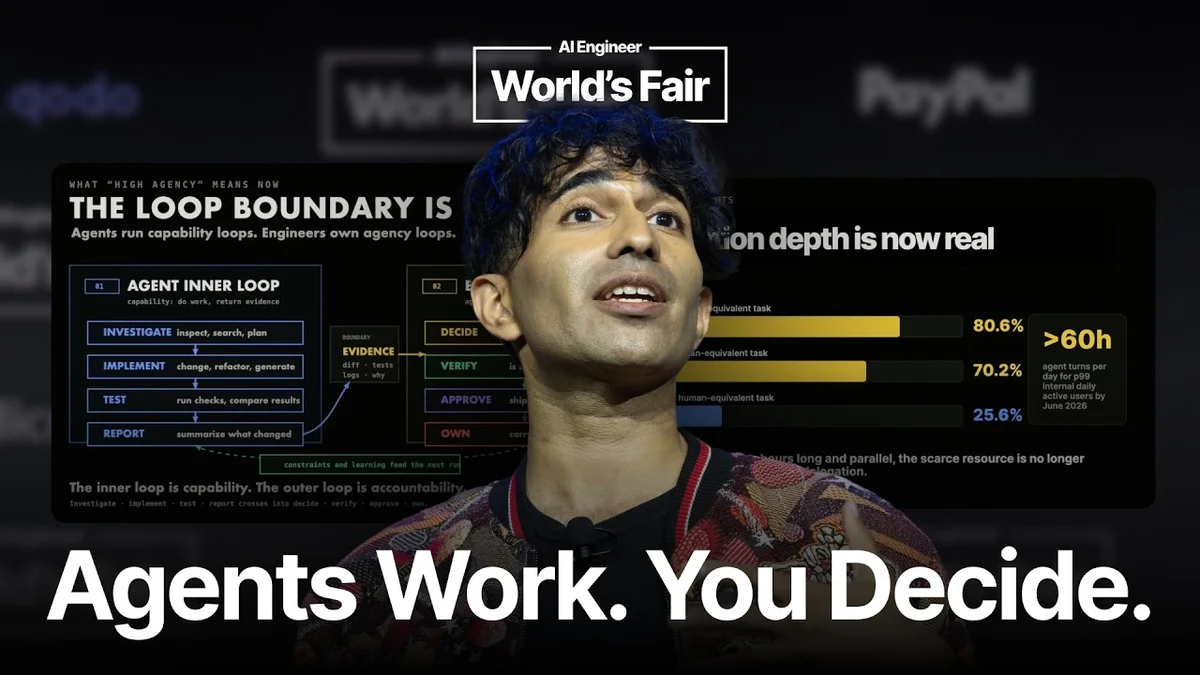
Addy Osmani speaking on stage at AI Engineer World's Fair
AI Engineer

Visual TL;DR. AI Agents Evolve drives Engineer Role Shifts. Engineer Role Shifts requires Judgment & Ownership. Judgment & Ownership ensures Human Accountability. Engineer Role Shifts means Beyond Code. AI Agents Evolve creates need for Trust & Governance. Judgment & Ownership highlights Taste & Judgment.

  1. AI Agents Evolve: increasingly automated workflows driven by AI agents handling many tasks
  2. Engineer Role Shifts: moving beyond code to judgment, ownership, and system design
  3. Judgment & Ownership: engineers choose what's worth doing, owning evidence and verdicts
  4. Human Accountability: humans remain accountable for production decisions: what ships, risks accepted
  5. Beyond Code: future engineering focuses on agency, not just writing code
  6. Trust & Governance: addressing the governance gap in AI-driven engineering processes
  7. Taste & Judgment: enduring value of human taste and judgment amidst AI automation
Visual TL;DR
Visual TL;DR, startuphub.ai AI Agents Evolve drives Engineer Role Shifts. Engineer Role Shifts requires Judgment & Ownership. Judgment & Ownership ensures Human Accountability drives requires ensures AI Agents Evolve Engineer Role Shifts Judgment & Ownership Human Accountability From startuphub.ai · The publishers behind this format
Visual TL;DR, startuphub.ai AI Agents Evolve drives Engineer Role Shifts. Engineer Role Shifts requires Judgment & Ownership. Judgment & Ownership ensures Human Accountability drives requires ensures AI Agents Evolve Engineer RoleShifts Judgment &Ownership HumanAccountability From startuphub.ai · The publishers behind this format
Visual TL;DR, startuphub.ai AI Agents Evolve drives Engineer Role Shifts. Engineer Role Shifts requires Judgment & Ownership. Judgment & Ownership ensures Human Accountability drives requires ensures AI Agents Evolve increasingly automated workflows driven byAI agents handling many tasks Engineer Role Shifts moving beyond code to judgment, ownership,and system design Judgment & Ownership engineers choose what's worth doing,owning evidence and verdicts Human Accountability humans remain accountable for productiondecisions: what ships, risks accepted From startuphub.ai · The publishers behind this format
Visual TL;DR, startuphub.ai AI Agents Evolve drives Engineer Role Shifts. Engineer Role Shifts requires Judgment & Ownership. Judgment & Ownership ensures Human Accountability drives requires ensures AI Agents Evolve increasinglyautomated workflowsdriven by AI agents… Engineer RoleShifts moving beyond codeto judgment,ownership, and… Judgment &Ownership engineers choosewhat's worth doing,owning evidence and… HumanAccountability humans remainaccountable forproduction… From startuphub.ai · The publishers behind this format
Visual TL;DR, startuphub.ai AI Agents Evolve drives Engineer Role Shifts. Engineer Role Shifts requires Judgment & Ownership. Judgment & Ownership ensures Human Accountability. Engineer Role Shifts means Beyond Code. AI Agents Evolve creates need for Trust & Governance. Judgment & Ownership highlights Taste & Judgment drives requires ensures means creates need for highlights AI Agents Evolve increasingly automated workflows driven byAI agents handling many tasks Engineer Role Shifts moving beyond code to judgment, ownership,and system design Judgment & Ownership engineers choose what's worth doing,owning evidence and verdicts Human Accountability humans remain accountable for productiondecisions: what ships, risks accepted Beyond Code future engineering focuses on agency, notjust writing code Trust & Governance addressing the governance gap in AI-drivenengineering processes Taste & Judgment enduring value of human taste and judgmentamidst AI automation From startuphub.ai · The publishers behind this format
Visual TL;DR, startuphub.ai AI Agents Evolve drives Engineer Role Shifts. Engineer Role Shifts requires Judgment & Ownership. Judgment & Ownership ensures Human Accountability. Engineer Role Shifts means Beyond Code. AI Agents Evolve creates need for Trust & Governance. Judgment & Ownership highlights Taste & Judgment drives requires ensures means creates need for highlights AI Agents Evolve increasinglyautomated workflowsdriven by AI agents… Engineer RoleShifts moving beyond codeto judgment,ownership, and… Judgment &Ownership engineers choosewhat's worth doing,owning evidence and… HumanAccountability humans remainaccountable forproduction… Beyond Code future engineeringfocuses on agency,not just writing… Trust &Governance addressing thegovernance gap inAI-driven… Taste & Judgment enduring value ofhuman taste andjudgment amidst AI… From startuphub.ai · The publishers behind this format

In the rapidly evolving AI landscape, the role of the engineer is undergoing a significant transformation. The traditional focus on writing code is giving way to a greater emphasis on judgment, ownership, and system design. Addy Osmani, former Director of Google Cloud AI, delivered a compelling keynote at the AI Engineer World's Fair, outlining how engineers can remain effective and accountable amidst increasingly automated workflows driven by AI agents.

Addy Osmani: Own Your Verdict in the Age of AI Agents - AI Engineer
Addy Osmani: Own Your Verdict in the Age of AI Agents — from AI Engineer

The Engineer of the Future: Judgment and Ownership

Osmani began by framing the future of engineering not around the ability to code, but around the capacity to choose what is worth doing. The engineer of the future, he stated, will be the one who owns the evidence, understanding, and verdict for work increasingly automated by AI agents. This shift means that while agents will handle many tasks, humans will be accountable for the ultimate production decisions: what ships, what gets blocked, and what risks are accepted.

He introduced a taxonomy of engineering modes: prototype, build, sweep, grow, and maintain. While agents can assist in all these, Osmani stressed that the scarce resource is not task execution, but knowing which mode a product needs, the applicable quality bar, and who ultimately owns the outcome.

From Harness to Factory: The Evolution of AI in Engineering

Osmani traced the evolution of AI in engineering, starting with 'harness engineering,' where the agent is the model plus the surrounding context and tools. This progressed to 'loop engineering,' where systems are designed for continuous prompting, checking, and remembering, making agents feel like infrastructure. The culmination of this is the 'agential software factory,' where agents operate within an inner loop, producing evidence that humans then use for production decisions.

He highlighted that AI-generated and AI-assisted code is becoming commonplace, citing a Sonar survey indicating that AI-assisted code is no longer marginal. This trend makes 'answerability', the ability to explain and stand behind decisions, a critical engineering requirement. Furthermore, Osmani pointed out that clean code, long valued for human readability, also benefits AI agents by reducing token usage and revisits, leading to greater efficiency.

Trust, Bandwidth, and the Governance Gap

Despite the efficiency gains, Osmani noted a significant trust gap, with a Sonar survey revealing that 96% of people do not fully trust AI-generated code. This creates a dangerous scenario of 'distrust without bandwidth' if engineers don't verify AI outputs before committing. The solution, he argued, lies in making verification cheaper, clearer, and harder to skip. On an organizational level, review and validation can become bottlenecks when governance fails to keep pace with AI adoption.

This leads to critical questions such as: Did a model touch this file? What constraints guided its work? What evidence was produced? What risk was accepted? And who owned the result?

Alpha, Decay, and the Enduring Value of Taste and Judgment

Osmani introduced the concepts of 'alpha' and 'decay' in the context of career development. Alpha represents the gap between current human capabilities and what models can do, while decay is the rate at which models catch up. He referenced Paul Graham's idea that in the AI age, choosing what to make becomes paramount. However, Osmani refined this by quoting Mitchell Hashimoto: taste is the ability to make high-quality qualitative judgments where no objective metric exists yet.
This 'taste' is valuable because it precedes benchmarks and market validation. Osmani cautioned that taste should not be a nebulous concept but rather a skill that can be translated into critique and improved judgment over time. He predicted that while many capabilities will 'decay' as models improve, taste and judgment will likely decay much more slowly, though they too will be influenced by model learning.

The Future of Engineering: Beyond Code, Towards Agency

The core question for engineers, Osmani asserted, is no longer what AI can't do, but what only a human can be answerable for. This is because certain decisions require ownership, context, risk acceptance, and post-ship responsibility. The term 'engineer' itself needs to become stricter, encompassing not just coding but the ability to reason about systems, understand constraints, defend trade-offs, manage risk, and be the point person when things break.

He warned against three pitfalls: cognitive debt (erosion of understanding due to over-reliance on AI), cognitive surrender (blind acceptance of AI outputs), and orchestration tax (the overhead of managing numerous parallel AI agents). The solution is not necessarily fewer agents, but designing one's attention as a system.

Ultimately, Osmani argued that accountability is what allows the entire system to scale. If agents can do more work faster and in parallel, the scarce resource becomes the human ability to explain intent, inspect evidence, accept risk, and improve the system. He presented an 'agency ladder' illustrating levels of responsibility, from flagging a problem to discerning which paths deserve ownership.

The Human Verdict: Evidence and Responsibility

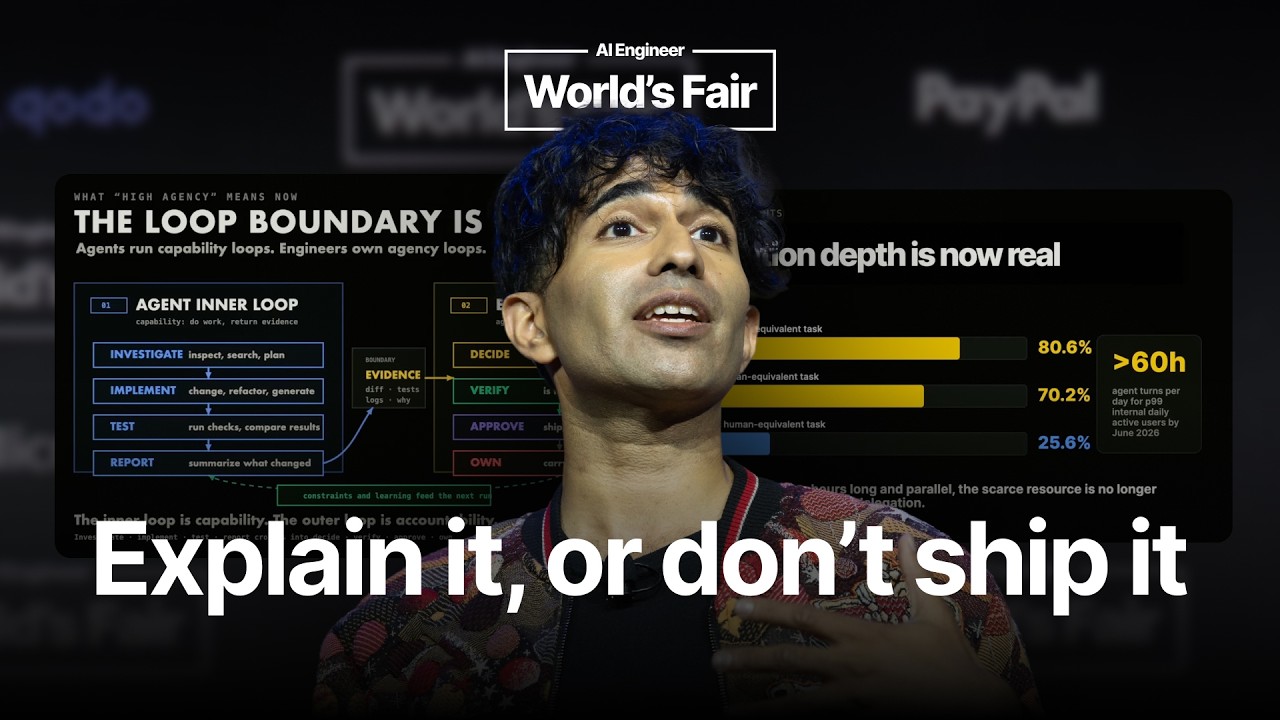
Osmani concluded by emphasizing that agents run the 'inner loop' of capability, while engineers own the 'outer loop' of agency. The boundary between them is evidence and responsibility. His operational rule is simple: "Explain it or don't ship it." This is because, he explained, one must understand the work well enough to defend it, regardless of whether an agent generated it. He likened this to the concept of an 'owners file' in large codebases, highlighting the need for clear accountability.

The future of engineering, Osmani believes, is not about fewer keystrokes but about a greater surface area requiring taste, verification, ownership, and care. He drew a parallel to the history of software development, where making it easier to write code led to exponentially more software being created. AI agents will do the same, shifting the bottleneck from creation to the crucial questions of 'should this exist?' and 'can we answer for it?'. His final call to action: "Build the factories, keep the lights on, own the verdict."

© 2026 StartupHub.ai. All rights reserved. Do not enter, scrape, copy, reproduce, or republish this article in whole or in part. Use as input to AI training, fine-tuning, retrieval-augmented generation, or any machine-learning system is prohibited without written license. Substantially-similar derivative works will be pursued to the fullest extent of applicable copyright, database, and computer-misuse laws. See our terms.