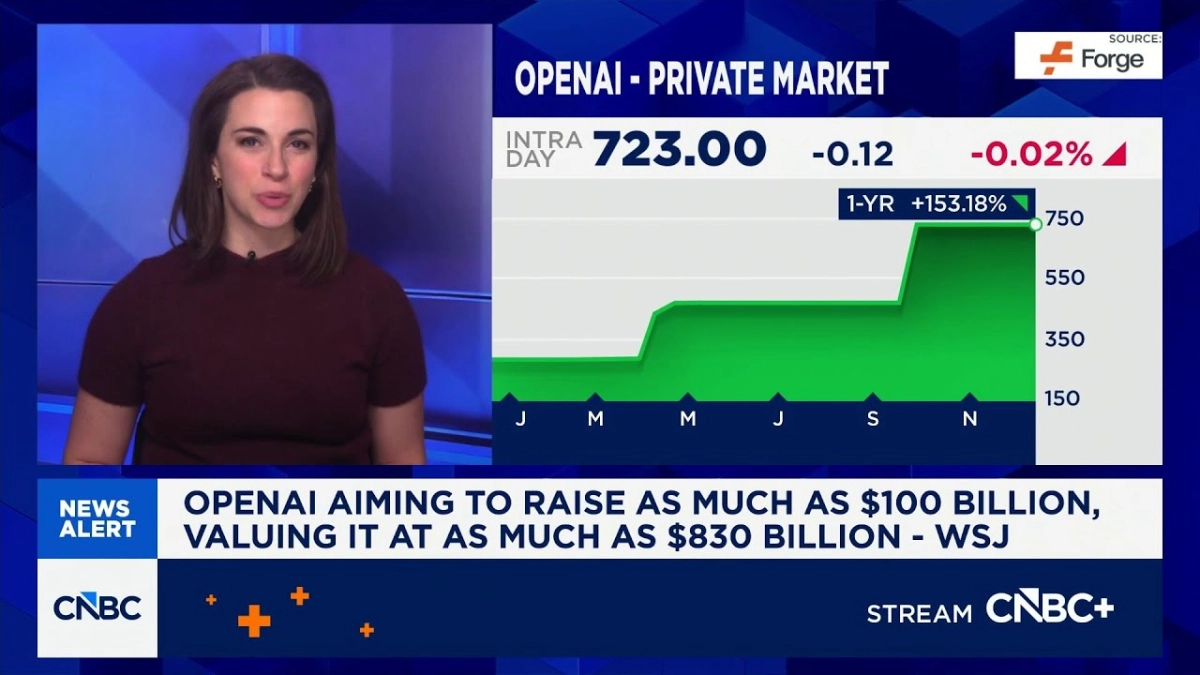
The staggering ambition of OpenAI, reportedly targeting a $100 billion fundraising round that could catapult its valuation to an astonishing $830 billion, has ignited fervent discussion among tech and financial observers. This monumental figure, a significant leap from previous valuations, raises profound questions about the mechanics of private market capital raises, the true cost of pioneering artificial intelligence, and the opaque nature of the industry's financial underpinnings.
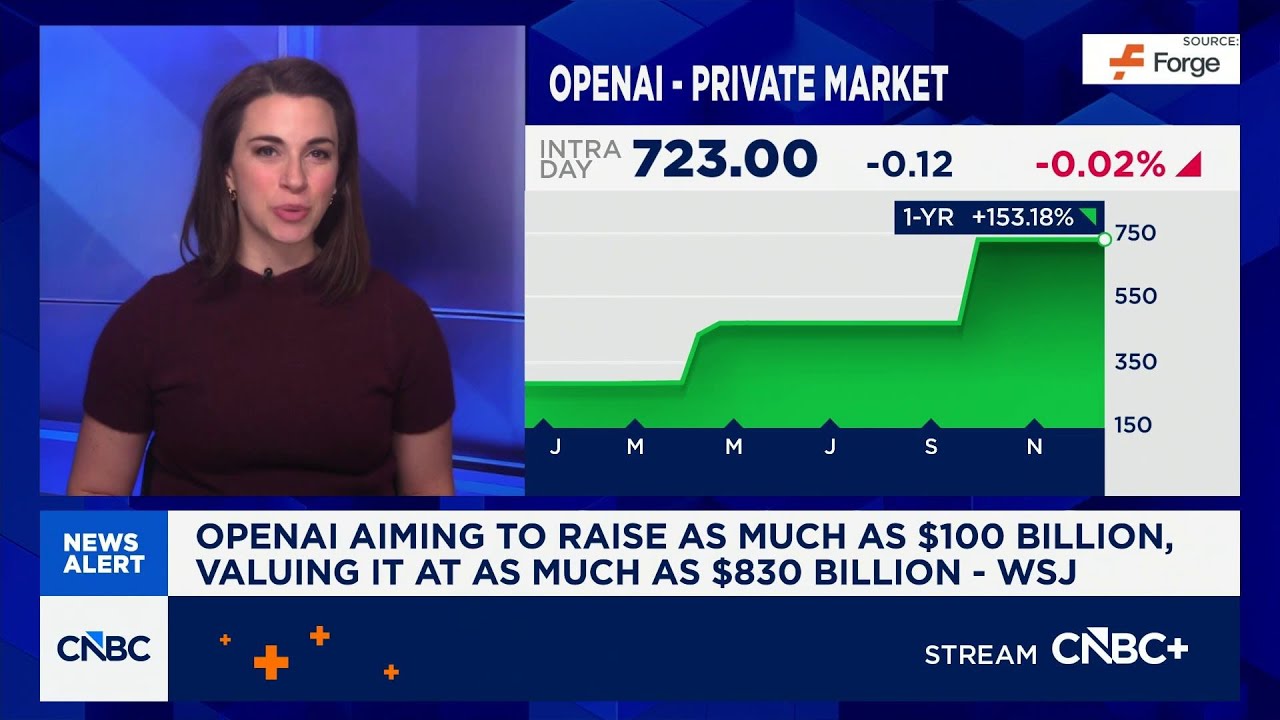
On CNBC's "Fast Money," reporter Leslie Picker shared insights from a Wall Street Journal report detailing OpenAI's latest fundraising efforts. The subsequent panel discussion, featuring Melissa Lee, Karen Finerman, Dan Nathan, Guy Adami, and Brian Kelly, delved into the implications of such a valuation, dissecting the unique dynamics at play in the rapidly accelerating AI sector. Their commentary highlighted a blend of awe at the technological frontier and skepticism regarding the financial sustainability and transparency of these colossal private market figures.
Leslie Picker articulated the sheer scale of the endeavor, stating, "OpenAI is in the early stages of a fundraising round that could raise as much as $100 billion… it could value the company at as much as $830 billion." This announcement follows a series of escalating valuations for the AI pioneer, a trajectory that has left many questioning the underlying drivers. The rapid appreciation, from $50 billion to $150 billion, then $300 billion, $500 billion, and now potentially $830 billion, in a relatively short span suggests an unprecedented market frenzy. It points to an environment where the promise of future innovation, rather than current profitability, dictates value, drawing parallels to historical tech bubbles.
A core concern raised by the panel revolved around the inherent opaqueness of OpenAI's financials. Karen Finerman observed, "It's such a black box from the outside… I would think there would be more clarity, more transparency or a leak or something about the underlying financials there than there seems to be." This lack of public disclosure, characteristic of private companies, allows for valuations that might not withstand the scrutiny of public markets. The absence of traditional financial reporting makes it challenging for external observers to ascertain the true health and cost structure of the business, fostering an environment ripe for speculative valuation.
The discussion also touched upon the seeming paradox of such a soaring valuation just weeks after the widely reported internal turmoil at OpenAI, including the temporary ousting of CEO Sam Altman and concerns over a "Code Red" discovery regarding advanced AI capabilities. Dan Nathan questioned this incongruity directly, asking, "How did we go from $500 billion to $800 billion since the last time there was money?" This sentiment underscores a critical insight: the market's perception of OpenAI's value appears largely disconnected from internal corporate governance or even immediate operational stability. Instead, the narrative of groundbreaking AI progress, despite internal friction, seems to have only amplified investor appetite.