

Yang says AI will widen inequality, not fix it

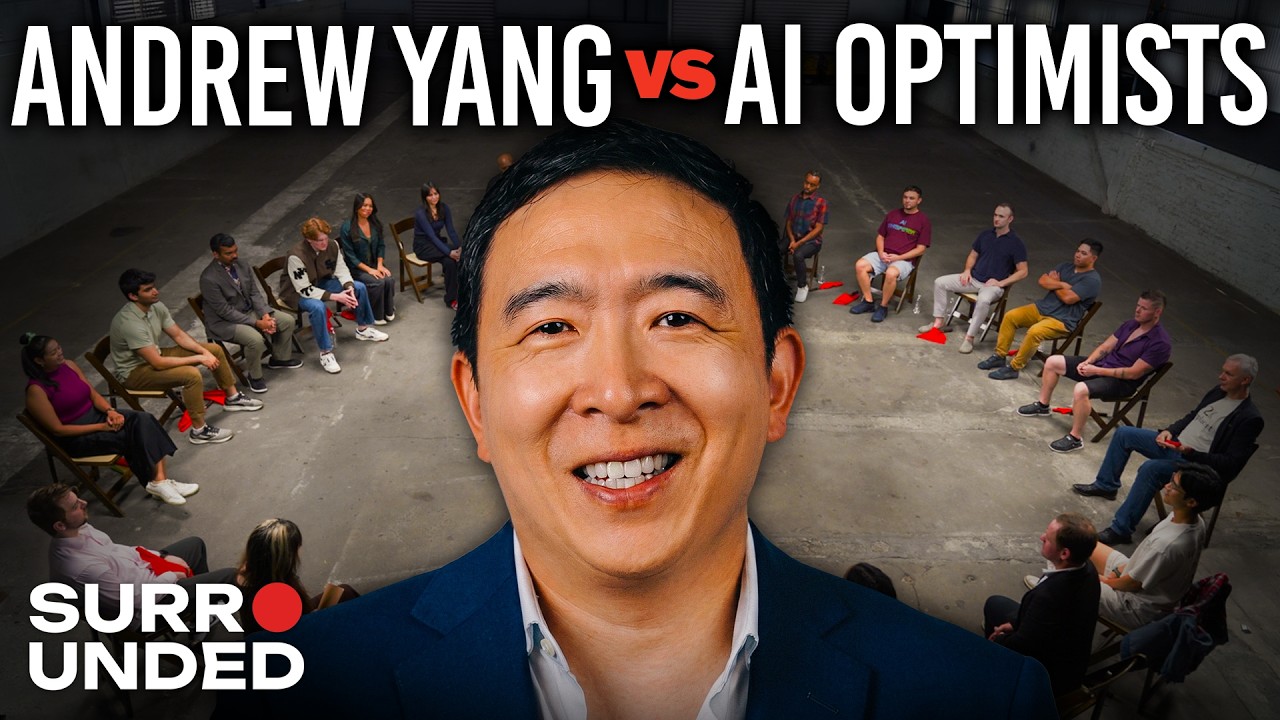
Andrew Yang told Jubilee's Surrounded that AI will concentrate gains in a multi-trillion vortex, while 20 optimists argued it lowers costs and spreads opportunity.

Andrew Yang stepped into Jubilee's Surrounded to argue that AI will accelerate inequality at unprecedented scale, facing 20 self-described optimists who said the technology will spread opportunity. No centralized prediction market posted live odds or volume on the outcome of the taping, so there is no tradable price to show which way sentiment moved during the debate. That absence is a limit on reading crowd conviction from prices alone. Not financial advice. Markets move fast.
Yang says AI will widen inequality, not fix it

The claim is stark.

Yang, entrepreneur, co-founder of the Forward Party and CEO of Noble Mobile who ran for president in 2020 on universal basic income, told the room the gains from AI will not be broadly shared. He framed the engine as four forces converging, capital, AI, data and processing power, into what he called a multi-trillion dollar vortex that will hoover up value from office parks and businesses large and small. The winners, in his view, will be shareholders and employees of model makers, investors and anyone positioned to monetize efficiencies. Everyone else will be left asking what happened to call center or driving work.

Jubilee built the episode around that tension. Will AI democratize opportunity or entrench the hierarchy, whether UBI becomes necessary in an AI-driven economy, and what happens to dignity when markets reward productivity above all else. The format forces one person to hold a position while a rotating challenger takes the chair, with the room voting who stays.

Christina, who said she has worked in AI safety for three years and holds a master's in public policy from Carnegie Mellon, pushed first. She conceded the power concentration point but argued AI is simultaneously democratizing capability for consumers. You can build an app without having learned to code, stand up a website, use the system as a tutor or therapist. Her case was that both things can be true at once, broader access and heavier concentration.

Yang did not dispute that individuals will benefit. He said many new jobs and opportunities will appear, but winners will be vastly outnumbered by people on the outside looking in. His analogy was e-commerce. Early on the pitch was that anyone could sell anything. A decade later Amazon is a $3 trillion company and competing with it looks impractical. Vibe coding an app is easier, he said, but discovery is the bottleneck. Millions of new apps with almost no distribution creates a few outliers and a lot of unseen work. The room voted Christina out.

Drago, a founder building a spiritual growth app he named Holy Habits, offered the small business counter. He described himself as Catholic and said AI shrinks the output gap between a five-person team and a team of 100, letting small firms compete with larger structures that have flattened distribution over the last century. He invoked the American small business spirit as a founding bet that AI could revive.

Yang agreed on two premises. The economy is already highly unequal, with the top 10 percent controlling about 67 percent of wealth and about 90 percent of stock market holdings. And the ethos of running a small company is real, he said, because as a serial entrepreneur he remembers when doing right by the business directly grew headcount. He also agreed AI will help some of those firms. His break was about who captures the underlying rent. Even Holy Habits likely licenses data or model access from a major provider and pays that provider. The primary beneficiaries remain the holders of large datasets and frontier models, now carrying trillion-dollar valuations built on hundreds of billions in compute and data infrastructure. Yang pointed to Verizon as an example of how incumbents convert efficiencies to shareholder returns, noting the carrier pays about $11 billion a year in dividends while recently laying off 15,000 workers after saying AI can handle customer service better than people. The larger brand with spectrum, capital and distribution, he argued, extracts more from AI than the insurgent. The room voted to keep Drago up.

Essie Magic, who introduced herself as a small business owner behind ZAM Jewelry, brought data to the same argument. She said business registrations have risen since ChatGPT launched in 2022, along with product launches on sites like Product Hunt, especially for solo founders. She also reframed access as cost. Legal advice, accounting or tax help that once cost thousands is now available through systems like Claude or ChatGPT, which lowers the barrier for people who could never afford those services. In that sense, the wealth gap narrows, and for workers she argued multiple income streams, including side businesses built with AI, are now prudent rather than optional.

Yang welcomed the point but called the change zero sum at the task level. Saving on accounting or marketing helps the owner, he said, but that saving is revenue denied to the accountant or firm that would have been hired. The second-order effect is headcount. He said his own company pulled a junior engineer and a junior data analyst posting because AI made those roles less necessary. The short-term balance sheet improves while the entry rung erodes. On the incorporation surge, he argued the key question is not formation but what happens after. Many new filings are consultants who lost jobs at tech firms and file as a business. Most never hire a full-time employee beyond the founder, and may not even produce full-time income for that founder. Formation numbers can look rosy while distribution of value does not. The room voted to keep her up.

Val, a beauty, makeup and fashion creator, pressed the most optimistic version of the distribution story. She said AI democratizes intellectual access. Health advice, legal pointers and a tutor in your pocket are newly available to anyone with a basic model and an internet connection. That, she said, can elevate everyone.

Yang agreed more people can get expert-like answers, but warned about cognitive outsourcing. He reached for a personal memory from before Waze, when he navigated by map and retained a sense of direction that app dependence eroded. He cited early evidence that drafting and structured thinking are being offloaded, pointing to an anecdote from Brown University where he said economics students who scored 96 percent with AI fell to 48 percent without it, and noting younger students are struggling to write first drafts unaided. He compared it to calculators and the internet, which did advance society, while adding a limit that attention is finite. Drawing on a Substack writer's complaint about paid subscriptions hitting zero sum, he argued the creator economy has a time budget. There is a cap on how many human influencers people can follow, and AI-generated influencers will take a share of that fixed attention. A few human creators will still break through, but the dynamic tilts more winner take all and the space for humans shrinks. The niche argument, Val said, cuts the other way. Where once three celebrities dominated, now hyper-specific communities like BookTok and K-beauty sustain many micro-audiences, which to her looks more democratic. She was voted out.

Nikquil, a software engineer at what he called Facebook, brought the open-source rejoinder and the self-hosting case. Not everyone has to use Anthropic or OpenAI, he said. Many capable models can run locally on phones or on a few GPUs at home for voice assistants, coding help and household tasks. Users can control their data and what they do with it.

Yang did not contest that local models work for personal use cases. He challenged the labor story underneath it. Entry-level coding wages have fallen, he said, and placement for computer science graduates has collapsed from what looked like a sure path eight years ago. He referenced a Stanford study, Bureau of Labor Statistics data and conversations with university placement officers to put a number on it, a placement rate that flipped from roughly 88 percent to about 12 percent. The talent who can already engineer with open tools benefits, but the market no longer values the junior hard skill as it did. Nikquil said media narratives overstate that slide, but Yang said he would be glad to be wrong and keeps hunting for contradictory data.

The sharper friction was data compensation. Yang said Americans' data is being sold and resold commercially for more than $300 billion a year and no one sees a dime. He called Meta, Nikquil's employer, a primary beneficiary and a main seller and compiler of that data. Data is the new oil, he said, and Meta is now one of the major geysers. Most people, stopped on the street in Seattle or Los Angeles and asked if they have been paid for their data, answer no.

He also widened the inequality frame beyond pay. About one third of working American men, he said, is no longer in the workforce at all, a shift that predates generative AI and shapes how additional automation will land. If AI eliminates jobs faster than new roles appear and profits pool at the top, he argued, the policy response has to include broad-based cash, the UBI position he has advocated since his presidential campaign that sits behind Jubilee's stated topics for this episode. Per Jubilee, those topics explicitly include whether UBI becomes necessary and how markets weigh profit against human dignity, even though the clipped transcript focuses on inequality and jobs. Consumption, he suggested, cannot be an afterthought if production needs fewer people.

Each exchange added a mechanism, not just a mood. Concentration via compute and proprietary data, margin expansion without hiring, discovery bottlenecks in app stores and feeds, and uncompensated data as an input subsidy. The optimists answered with mechanisms of their own, lower cost of expertise, cheaper formation, local models and micro-niches. What is still untested is the conversion rate between those lower costs and durable livelihoods, especially for entrants without capital, distribution or a brand to carry model outputs to customers. The debate did not settle that math, but it made the trade clear: more people can make more things, and fewer people may get paid stably to make them.

© 2026 StartupHub.ai. All rights reserved. You may not republish this article in full without a license. Search engines and AI research tools may crawl and summarize for reference. Bulk reproduction or model training requires a license. See our terms.
Daniel Singer

Written by

Daniel Singer

Editor, StartupHub.ai

Daniel Singer is the editor of StartupHub.ai, a technology expert and thought leader on AI and its applications across sectors, from fintech and healthcare to developer tooling and consumer software. He writes and tests the tools covered here thoroughly and regularly, and built StartupHub.ai to give founders, operators and buyers a clearer read on what they are actually being sold.