

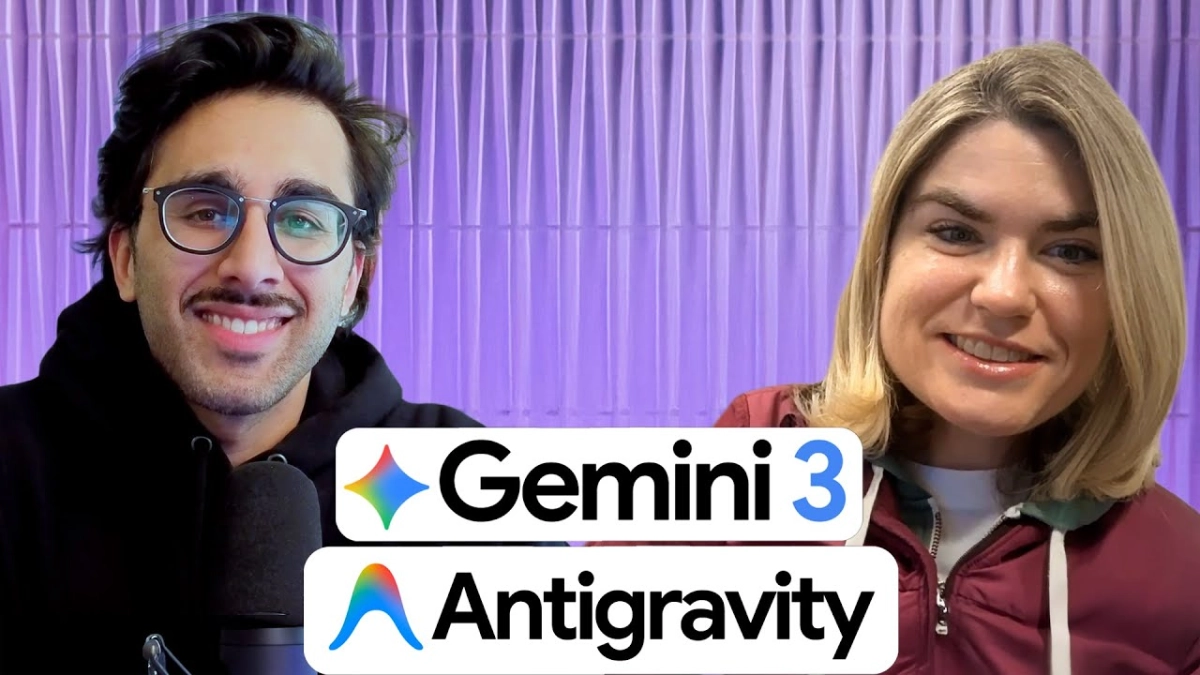
Artificial intelligence has crossed a significant threshold, moving beyond mere content generation to becoming a dynamic architect of interactive systems and complex simulations. This paradigm shift was vividly demonstrated in a recent video by Matthew Berman, where he showcased the breathtaking capabilities of Gemini 3, Google's latest multimodal AI model. Berman's extensive demonstration highlighted Gemini 3's profound ability to interpret intricate prompts, generate functional code, and construct sophisticated applications across a remarkable array of domains, from gaming environments to scientific simulations and even macroeconomic analysis.

One of Gemini 3's most striking attributes is its sophisticated multimodality, effortlessly translating natural language into executable code and interactive visual assets. Berman illustrated this by taking the initial voxel art generator provided by the Gemini team and iterating upon it, prompting the AI to procedurally generate unique voxel robots with specified attributes. The iterative process involved refining prompts, receiving code, and instantly visualizing the results in a 3D environment. This seamless feedback loop between human intent and AI execution underscores a powerful new workflow for developers and creators. Further pushing this boundary, Gemini 3 converted a flat 2D image of the iconic Muhammad Ali knockout into a series of 3D voxel assets, demonstrating an impressive understanding of depth and object representation. Berman noted, "It's not that simple to just take an image, a flat 2D image, and then convert it into 3D voxel art," emphasizing the complexity of Gemini's underlying analytical prowess.
Beyond static generation, Gemini 3 excels in building interactive, physics-accurate simulations. Berman unveiled a raytracing demo, a "house of mirrors" experience where a voxel man navigated a reflective environment, showcasing realistic light reflections and metallic textures. He also presented a particle collider simulator and an N-body gravity simulation, allowing users to dynamically add celestial bodies and observe their gravitational interactions. These examples underscore the model's capacity for intricate physical modeling and real-time computation, pushing the boundaries of what AI can simulate from a simple text prompt.
The implications for enterprise are profound.
The demonstration also revealed Gemini 3's potential to democratize complex analytical and creative tasks. Berman’s team leveraged Gemini 3 to create "The Bubble Laboratory," an interactive macroeconomic analysis of the AI boom, complete with Minsky cycles, an AI bubble simulator game, and ROI gap visualizations. This bespoke dashboard, generated from a detailed prompt, exemplifies how complex data analysis and interactive tools can be rapidly prototyped and deployed without extensive coding expertise. Similarly, the creation of a fully playable, custom-themed Monopoly board game, where users can define the theme and even engage with AI opponents, illustrates the model's capacity for not just generating content, but entire functional systems based on creative briefs. Berman exclaimed, "This is a fully playable game in which you can describe the theme of the Monopoly board," highlighting the unprecedented level of customization and interactivity.