

Claude Opus 4.5 has achieved a remarkable feat, scoring higher than any human candidate ever on Anthropic's notoriously difficult take-home exam for prospective performance engineering hires. This astounding benchmark, highlighting both technical ability and judgment under time pressure, signals a paradigm shift in what AI models are capable of, prompting critical questions about the future of engineering professions. Matthew Berman, in his analysis of Anthropic’s latest release, unpacks the implications of this new frontier model, its impressive benchmarks, innovative features, and strategic pricing.
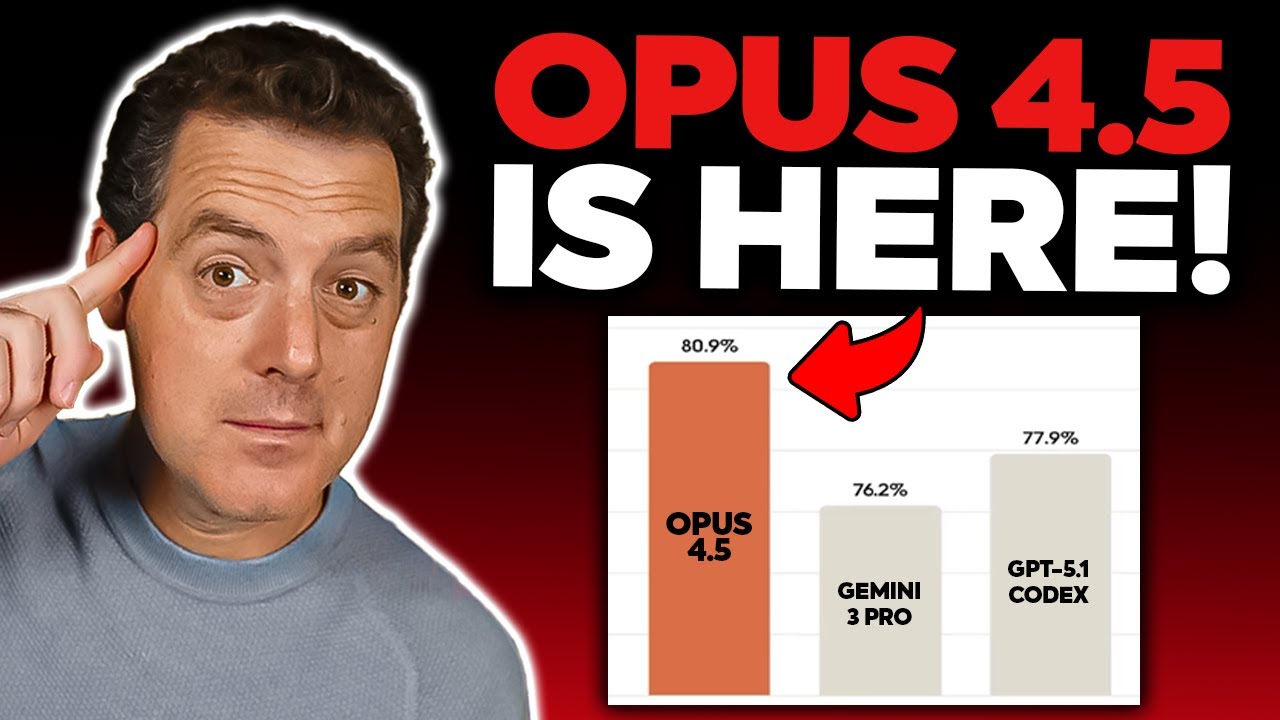
The competitive landscape of large language models is intensely dynamic, with new frontier models emerging rapidly. Opus 4.5, Anthropic's newest offering, positions itself as a leader across several crucial metrics, particularly in areas vital for enterprise and developer applications. Its standout performance in software engineering, with an 80.9% accuracy on the SWE-bench Verified benchmark, significantly surpasses its predecessor Sonnet 4.5 (77.2%), and rivals like GPT-5.1 Coder-Max (77.9%) and Google’s Gemini 3 Pro (76.2%). This dominance extends to agentic coding and tool use, suggesting a model highly adept at autonomous task execution.
However, Opus 4.5 is not without its competitive challenges. In graduate-level reasoning, Google’s Gemini 3 Pro edged it out with a 91.9% score against Opus 4.5’s 87.0% on GPQA Diamond. Similarly, for visual reasoning (MMMU), GPT-5.1 Coder-Max achieved 85.4%, slightly ahead of Opus 4.5’s 82.7%. These nuanced results indicate that while Opus 4.5 leads in many agentic and coding-centric tasks, the race for overall intelligence remains tightly contested across various cognitive domains.
A critical insight from this release is Opus 4.5’s innovative approach to "advanced tool use" on the Claude Developer Platform. This suite of three new beta features, Tool Search Tool, Programmatic Tool Calling, and Tool Use Examples, addresses a fundamental challenge in AI agents: the consumption of context window by extensive tool definitions. Traditionally, loading multiple tools like GitHub, Slack, Sentry, Grafana, and Splunk could consume up to 55,000 tokens before a conversation even began, severely limiting the model's effective working memory.
Anthropic’s solution is elegantly simple yet profoundly impactful. The Tool Search Tool allows Claude to dynamically discover and access thousands of tools without pre-loading their definitions into the context window. This means the model only "gets the tool that it needs, when it needs it," as Berman explains, preserving an astonishing 95.65% of the context window as free space, compared to just 61.4% with the traditional approach. Such a "massive reduction in context window usage" is a game-changer for agentic workflows, enabling more complex, longer-running tasks without performance degradation. Programmatic Tool Calling further enhances this by allowing Claude to invoke tools in a code execution environment, reducing context impact, while Tool Use Examples provide a universal standard for effective tool demonstration.