

PyannoteAI's Bredin on Building Conversational Voice AI

Hervé Bredin of pyannoteAI discusses the crucial role of speaker diarization in building voice AI that understands conversations, showcasing open-source tools and future advancements.

6 min read
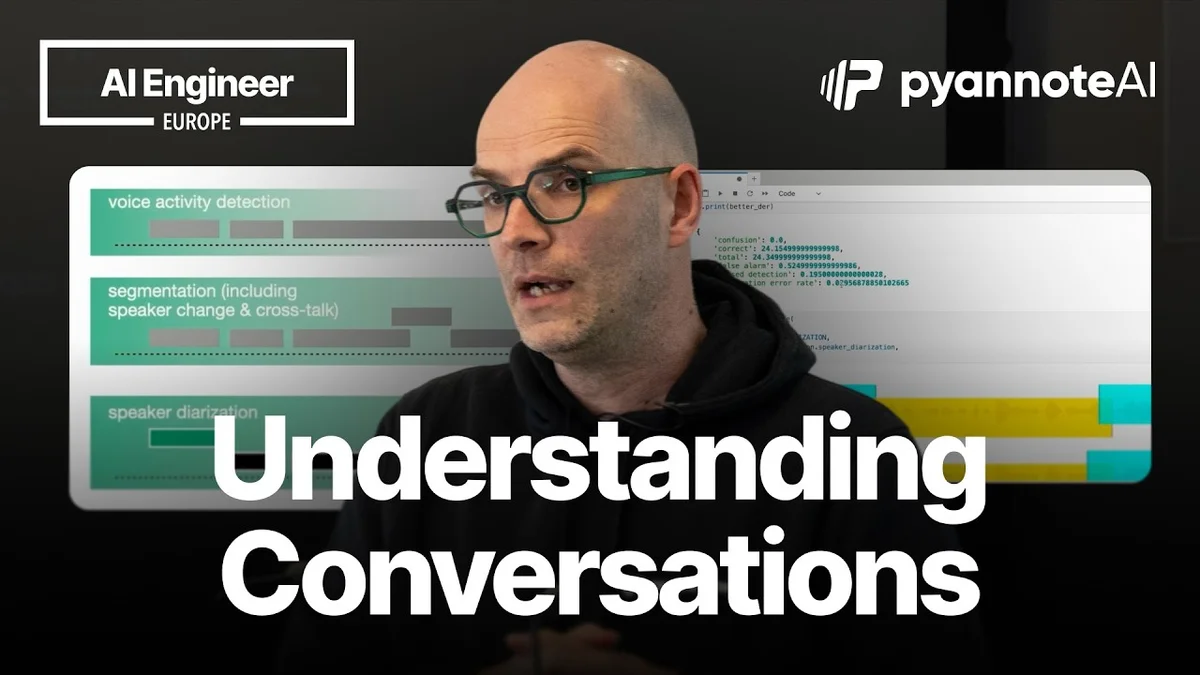
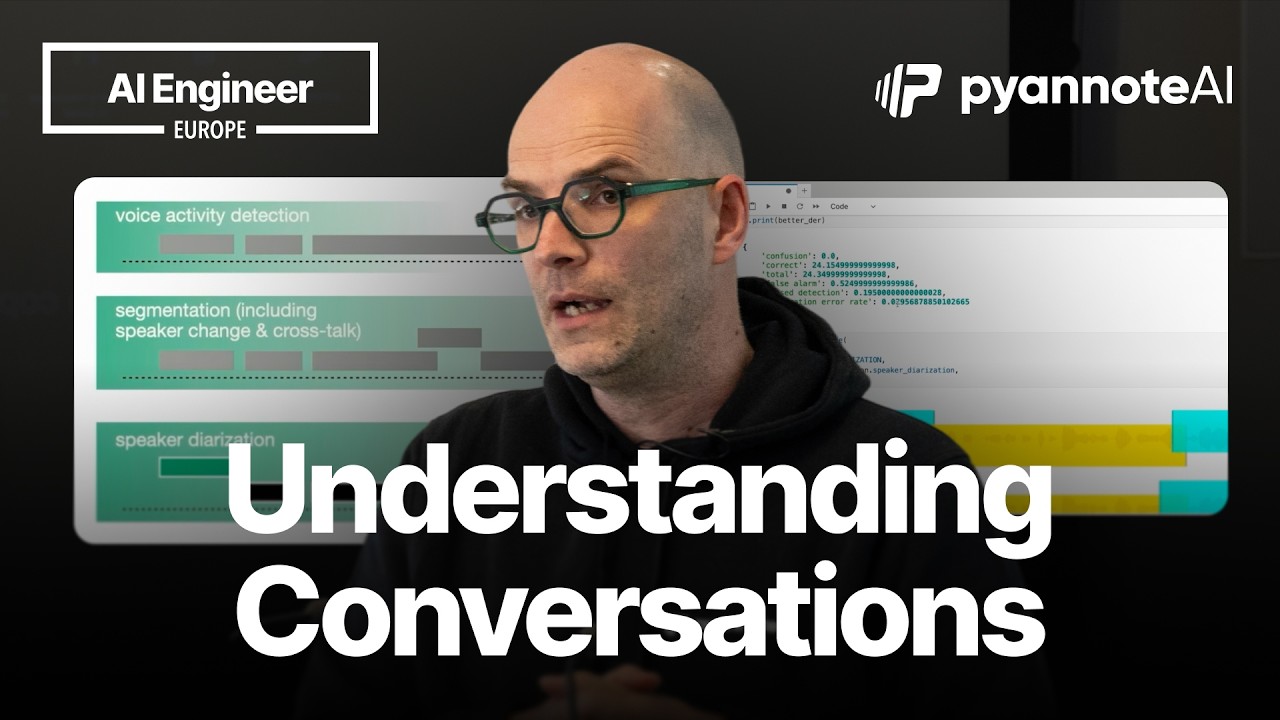
Hervé Bredin presenting on 'Beyond Transcription: Building Voice AI That Understands Conversations' at AI Engineer London.
AI Engineer

In the pursuit of truly intelligent voice AI, simply transcribing spoken words is no longer enough. Hervé Bredin, Chief Science Officer and co-founder of pyannoteAI, recently highlighted the critical importance of understanding the nuances of conversation, particularly who is speaking when and how. In his presentation at AI Engineer London, Bredin underscored that moving "Beyond Transcription" requires sophisticated speaker diarization capabilities.

PyannoteAI's Bredin on Building Conversational Voice AI - AI Engineer
PyannoteAI's Bredin on Building Conversational Voice AI — from AI Engineer

Visual TL;DR. Beyond Transcription requires Speaker Diarization. Speaker Diarization enabled by pyannote.audio toolkit. pyannote.audio toolkit provides Richer Information. Richer Information for Real-World Conversations. Richer Information supports Benchmarking. Benchmarking leads to Future Advancements.

  1. Beyond Transcription: voice AI needs to understand conversational nuances
  2. Speaker Diarization: identifying who speaks when in audio streams
  3. pyannote.audio toolkit: open-source tools for speech data processing
  4. Richer Information: enhancing transcription with speaker identity
  5. Real-World Conversations: understanding complex human speech patterns
  6. Benchmarking: evaluating performance of voice AI models
  7. Future Advancements: improving voice AI capabilities
Visual TL;DR
Visual TL;DR — startuphub.ai Beyond Transcription requires Speaker Diarization. Speaker Diarization enabled by pyannote.audio toolkit. pyannote.audio toolkit provides Richer Information requires enabled by provides Beyond Transcription Speaker Diarization pyannote.audio toolkit Richer Information From startuphub.ai · The publishers behind this format
Visual TL;DR — startuphub.ai Beyond Transcription requires Speaker Diarization. Speaker Diarization enabled by pyannote.audio toolkit. pyannote.audio toolkit provides Richer Information requires enabled by provides BeyondTranscription SpeakerDiarization pyannote.audiotoolkit RicherInformation From startuphub.ai · The publishers behind this format
Visual TL;DR — startuphub.ai Beyond Transcription requires Speaker Diarization. Speaker Diarization enabled by pyannote.audio toolkit. pyannote.audio toolkit provides Richer Information requires enabled by provides Beyond Transcription voice AI needs to understandconversational nuances Speaker Diarization identifying who speaks when in audiostreams pyannote.audio toolkit open-source tools for speech dataprocessing Richer Information enhancing transcription with speakeridentity From startuphub.ai · The publishers behind this format
Visual TL;DR — startuphub.ai Beyond Transcription requires Speaker Diarization. Speaker Diarization enabled by pyannote.audio toolkit. pyannote.audio toolkit provides Richer Information requires enabled by provides BeyondTranscription voice AI needs tounderstandconversational… SpeakerDiarization identifying whospeaks when inaudio streams pyannote.audiotoolkit open-source toolsfor speech dataprocessing RicherInformation enhancingtranscription withspeaker identity From startuphub.ai · The publishers behind this format
Visual TL;DR — startuphub.ai Beyond Transcription requires Speaker Diarization. Speaker Diarization enabled by pyannote.audio toolkit. pyannote.audio toolkit provides Richer Information. Richer Information for Real-World Conversations. Richer Information supports Benchmarking. Benchmarking leads to Future Advancements requires enabled by provides for supports leads to Beyond Transcription voice AI needs to understandconversational nuances Speaker Diarization identifying who speaks when in audiostreams pyannote.audio toolkit open-source tools for speech dataprocessing Richer Information enhancing transcription with speakeridentity Real-World Conversations understanding complex human speechpatterns Benchmarking evaluating performance of voice AI models Future Advancements improving voice AI capabilities From startuphub.ai · The publishers behind this format
Visual TL;DR — startuphub.ai Beyond Transcription requires Speaker Diarization. Speaker Diarization enabled by pyannote.audio toolkit. pyannote.audio toolkit provides Richer Information. Richer Information for Real-World Conversations. Richer Information supports Benchmarking. Benchmarking leads to Future Advancements requires enabled by provides for supports leads to BeyondTranscription voice AI needs tounderstandconversational… SpeakerDiarization identifying whospeaks when inaudio streams pyannote.audiotoolkit open-source toolsfor speech dataprocessing RicherInformation enhancingtranscription withspeaker identity Real-WorldConversations understandingcomplex humanspeech patterns Benchmarking evaluatingperformance ofvoice AI models FutureAdvancements improving voice AIcapabilities From startuphub.ai · The publishers behind this format

Bredin, a researcher with a long history in speech processing, explained that his journey into this field began with a focus on speaker diarization. This led to the development of the open-source pyannote.audio toolkit, which has become a popular resource for researchers and developers working with speech data. The toolkit provides pre-trained models and tools for various tasks, including speaker diarization, which aims to segment an audio stream into homogeneous segments according to the speaker identity.

Related startups

The Challenge of Real-World Conversations

The core of Bredin's message revolved around the limitations of current speech-to-text (STT) systems when applied to complex conversational scenarios. While STT models excel at transcribing single-speaker recordings or clean audio, they often struggle with the messy reality of real-world conversations. These challenges include:

  • Distant microphones: Audio captured from a distance introduces noise and reverberation, degrading transcription quality.
  • Speaker change: Rapid shifts in who is speaking can confuse STT models.
  • Cross-talk: Multiple speakers talking simultaneously makes it difficult for STT to isolate and transcribe individual utterances accurately.
  • Interruptions: Overlapping speech and unexpected interjections further complicate transcription.

Bredin emphasized that simply knowing "what was said" is insufficient; understanding "who said what" is equally vital for many applications. This is where speaker diarization plays a crucial role. The process involves identifying speaker turns and assigning them to the correct speaker, even without prior knowledge of the speakers or their number.

Enhancing Transcription with Richer Information

Bredin illustrated how speaker diarization enriches transcription by providing a more comprehensive understanding of conversational dynamics. He showcased examples of how identifying speaker turns, detecting pauses, and even noting non-speech vocalizations like coughs or laughter can add valuable context. This richer output is essential for applications such as meeting summarization, call center analytics, and personalized voice assistants.

The pyannote.audio toolkit, as demonstrated through a live coding example, facilitates this by providing ready-to-use models for speaker diarization. Bredin highlighted the ease with which developers can integrate these tools into their workflows, citing the availability of pre-trained models on Hugging Face and a Python SDK for premium models.

Benchmarking and Future Directions

The presentation also touched upon the state-of-the-art in speaker diarization, presenting benchmark results on various datasets. These benchmarks, including conversational telephone speech (CTS) and noisy restaurant environments, illustrate the ongoing challenges and progress in the field. Bredin noted that while models are improving, handling highly noisy environments with multiple overlapping speakers remains a significant hurdle.

Looking ahead, Bredin pointed to "real-time diarization" and "source separation" as key areas for future development. These advancements will be critical for enabling more natural and interactive voice AI experiences.
The core takeaway from Hervé Bredin's talk is that the future of voice AI lies not just in accurate transcription, but in a deep understanding of conversational context, powered by robust speaker diarization and other advanced speech processing techniques. The pyannote.audio toolkit represents a significant step forward in making these capabilities accessible to developers.

© 2026 StartupHub.ai. All rights reserved. Do not enter, scrape, copy, reproduce, or republish this article in whole or in part. Use as input to AI training, fine-tuning, retrieval-augmented generation, or any machine-learning system is prohibited without written license. Substantially-similar derivative works will be pursued to the fullest extent of applicable copyright, database, and computer-misuse laws. See our terms.