Fireworks AI ran 1,259 tasks across eight practitioner benchmarks to test single-model defaults. GPT-6 Astra completed 52%, more than any other model, per Fireworks AI.
Is the strongest model worth paying for on every call? For most calls, the data say no.
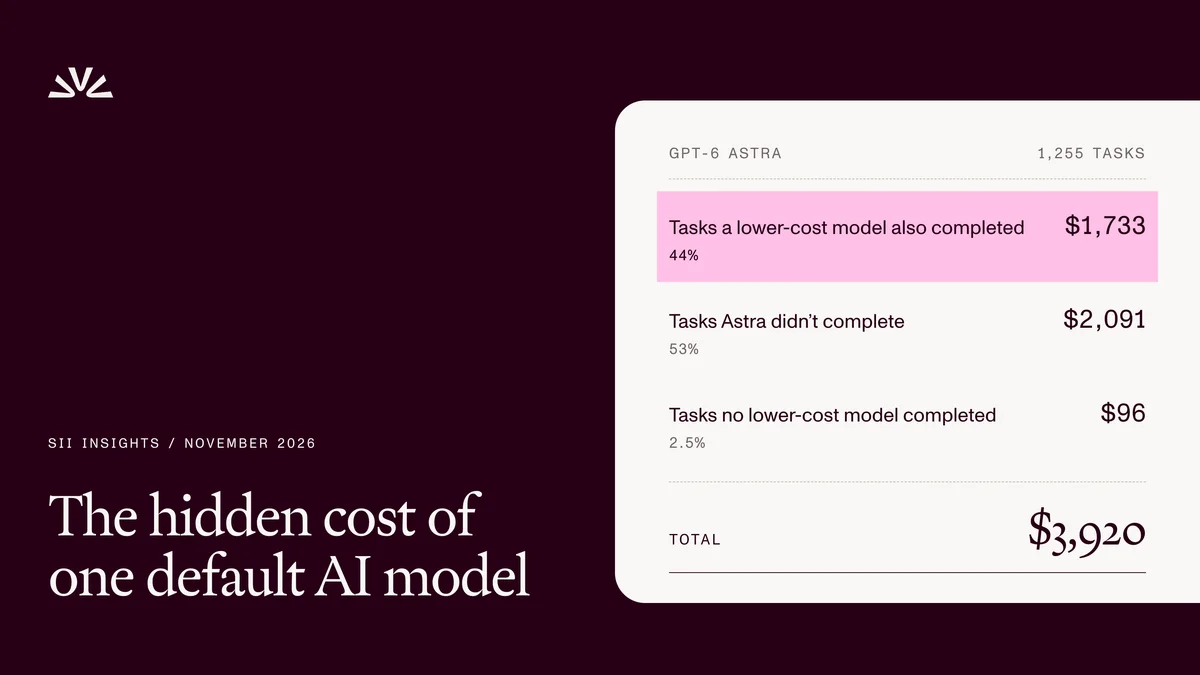
Inference cost is the price paid for each model attempt, and Astra's bill shows the problem. Running Astra on every evaluated task cost $3,920 in inference, per Fireworks AI. Of that total, 44% went to tasks a lower-cost model also completed and 53% went to tasks Astra missed, per Fireworks AI. Just 2.5% went to tasks only Astra could do cheaply, or at all, per Fireworks AI.
Cheaper matches were common.
On 421 of the 653 tasks Astra completed, another model finished for at least 90% less per attempt, per Fireworks AI. Where more than 60% of models succeeded, Astra was never cheapest and cost a median 24 times the lowest-cost winner, per Fireworks AI. On 47 tasks Astra was cheapest to succeed, and 44 of those were solved by no more than 20% of models, per Fireworks AI.
Leadership also hid missed work. Other models completed 255 tasks Astra missed, and open models completed about four in five of those, per Fireworks AI. Gemini 4 Argon leads Rogo financial research but ranks last of 14 on Factory legacy code, per Fireworks AI. An ensemble is a setup that routes each task type to a different model, and it captures that spread without replacing the default everywhere.
That spread is not an outlier. Open models sit within 5 percentage points of first place on 17 benchmarks, per the Fireworks Specialized Intelligence Index page. DeepSeek V4.1 Flash ranks first on SecIT Bench, per that page.
Averages lie.
Epiq CorporateBench asks the same 48 questions in two settings, and at least one model completed 98% over the records database but 29% over emails and documents, per Fireworks AI. Crosby Redline Bench shows 7% completed on first edits versus 40% on later drafts, per Fireworks AI. Factory Legacy-Bench shows 91% completed on Java 7 versus 72% on COBOL, with median lowest cost of 6 cents versus 17 cents, per Fireworks AI.
Astra keeps negotiation, Luna takes the database
Fireworks AI then simulated picking models from a sample to guide deployment. Clinical work gave little reason to move, since lower-cost models rarely hit 95% of the best completion rate, per Fireworks AI. Finance rewarded change, as Kimi K3.1 Pro completed 68% of banking support tasks versus Astra at 49% at half the cost, per Fireworks AI.
Legal and software rewarded mixing. GPT-6 Luna hit 86% on records questions versus Astra at 85% at 97% lower cost, while GPT-6.1 Sol matched Astra on knowledge tasks at 84% lower cost, per Fireworks AI. No rival beat Astra on contract negotiation, so it stayed, per Fireworks AI. Software selection by task type cut cost further and completed more work than one replacement, per Fireworks AI.
Latency was not measured and HealthBench costs were averaged across attempts, per Fireworks AI, so it doesn't map cleanly to production. Start with your highest-volume task type, test one open model against your default on the same examples, and track cost per completed task.