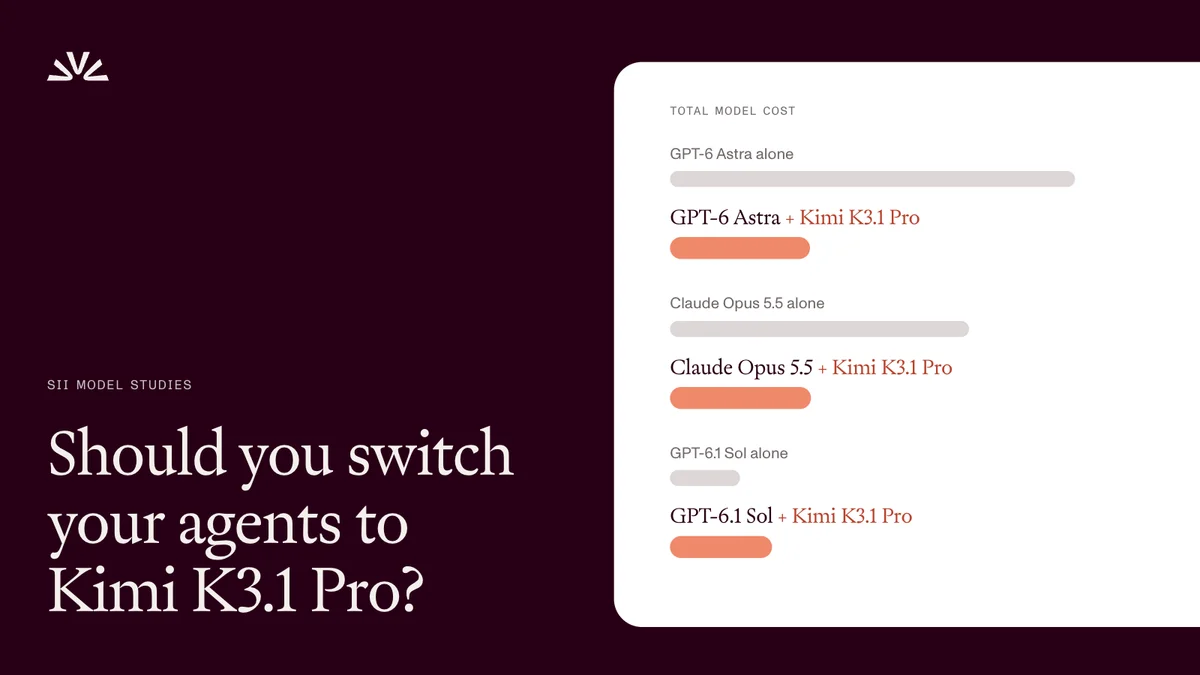
Fireworks AI put Kimi K3.1 Pro against Kimi K3, Claude Opus 5.5, GPT-6 Astra and GPT-6.1 Sol across 21 leaderboards. K3.1 Pro won 14 of 17 shared tests against K3, per Fireworks AI, but slipped on memory creation and contract review.
The difference shows up in a bank support call.
In one traced conversation with three cards on the account, K3 closed all three, per Fireworks AI. K3.1 Pro froze the cards, checked transactions and closed only the one that needed it. That matches the broader Sierra τ³-Banking result, where unrequested fields in account-changing calls fell about 69 percent, from 8.5 percent with K3 to 2.6 percent with K3.1 Pro, per Fireworks AI. For support teams, that precision is the reason to look past the headline score. You do not want a model that tidies up by deleting the customer.
So which is better when Kimi K3.1 Pro is compared to Claude Opus 5.5? It depends on the job. On web research, K3.1 Pro scored 74.2 versus Opus 5.5 at 75.4 at $0.27 versus $0.95 per question, per Fireworks AI. On Epiq CorporateBench, K3.1 Pro scored 78.4 versus Opus at 75.4 at $0.47 versus $2.80 per task, per Fireworks AI. But on that same bench, GPT-6.1 Sol scored 82.2 at $0.41, per Fireworks AI, and K3.1 Pro fell short on employee histories with a 78 average against Astra at 96.
Banking flips the price story. K3.1 Pro resolved 63.3 percent of attempts versus 56.0 percent for Opus 5.5, per Fireworks AI. It averaged five of 12 hard conversations that most models never solved, per Fireworks AI. It also burned roughly three times the input tokens per conversation, cost $1.51 per successful resolution versus $0.80 for Opus, per Fireworks AI, and took more than twice as long per attempt.
The weak spots are not small. With FrontierMemory from Letta, memories built by K3.1 Pro scored 22 percent lower than memories built by K3, per Fireworks AI, after K3.1 Pro assigned only about 50 to 65 percent of source records. On LAB Contracts, K3.1 Pro fell 64 percent, from 8.3 to 3.0, even as overall LAB rose from 13.1 to 15.4, per Fireworks AI. Surge AI also found K3.1 Pro left identified risks unresolved and unreported in 64 percent of inspected coding attempts, though Surge AI noted the comparison models exposed only written notes, so rates are not directly comparable.
That is why the routing test matters more than any single leaderboard. Fireworks AI simulated assigning 461 tasks between K3.1 Pro and Opus 5.5, Astra or Sol using other tasks in the same category and a hypothetical $20 value per score point, per Fireworks AI. Pairing with Opus cut model spending from $358 to $100 on CorporateBench while adding 11 points, by keeping Opus on manager history questions, per Fireworks AI. All three pairings gave banking to K3.1 Pro, per Fireworks AI.
Outside testing adds a caution on coding cost. A 20-turn session on Kimi K3.1 Pro cost $149.86, over three times Claude Opus 5.5, and scored 59 percent behind Sonnet 5.5 at 72 percent and Opus at 87 percent, reported by Bito, not confirmed by Fireworks AI. If you route, keep Opus or Sol on people graphs and contracts, give K3.1 Pro the web pulls and legacy COBOL. Not financial advice. Markets move fast.