#Vision-Language Models
10 articles with this tag
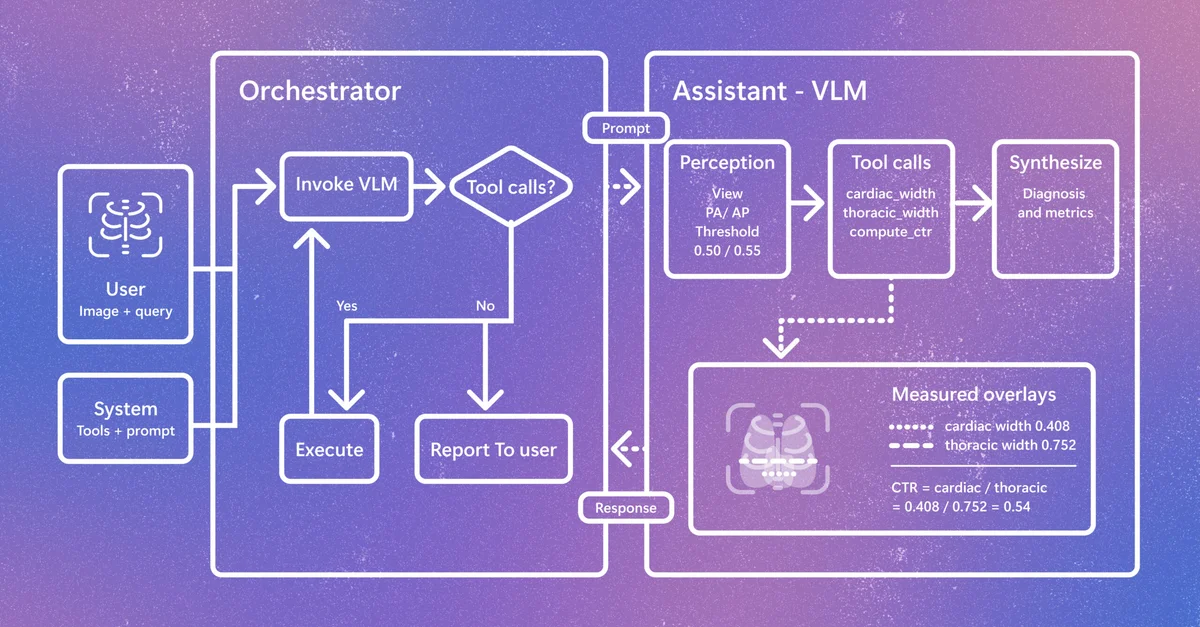
Microsoft's CARE-X tackles radiology AI
Microsoft Research's CARE-X advances radiology AI with a unified VLM for chest X-ray interpretation, combining generation, structured prediction, and tool-augmented measurement.
Grounding VLMs: VAORA's Leap in Physical AI
VAORA, a novel reward design, tackles VLM hallucination and reasoning-action misalignment in physical tasks, significantly improving generalization through visual context and outcome alignment.

LinkedIn's AI Tester Sees Bugs
LinkedIn's new AI QA Agent uses generative AI and VLMs to autonomously test apps, finding bugs and democratizing quality assurance for non-engineers.

Beyond Observable Data: Imaginative Perception for VLMs
Researchers introduce Imaginative Perception Tokens (IPTs) to enable VLMs to reason about unobserved spatial configurations, outperforming textual chain-of-thought.

LocateAnything: Parallel Decoding for Vision
LocateAnything revolutionizes vision-language models with Parallel Box Decoding, boosting speed and accuracy in visual grounding and detection.
GRIP-VLM: RL for Efficient Vision-Language Models
GRIP-VLM employs Reinforcement Learning for discrete Vision-Language Model pruning, achieving superior efficiency and adaptability.

Unlocking AI Agents with Gym-Anything
Gym-Anything enables scalable creation of complex AI agent environments, leading to the vast CUA-World benchmark and more efficient VLM agents.

ThinkJEPA: AI Learns World Models Better
ThinkJEPA framework integrates vision-language models with latent world models to enhance AI's understanding and prediction capabilities.

RL Fixes Overfitting in AI Radiology Reports
Microsoft Research’s UniRG framework uses reinforcement learning guided by clinical error signals to achieve state-of-the-art performance in AI radiology reports.