


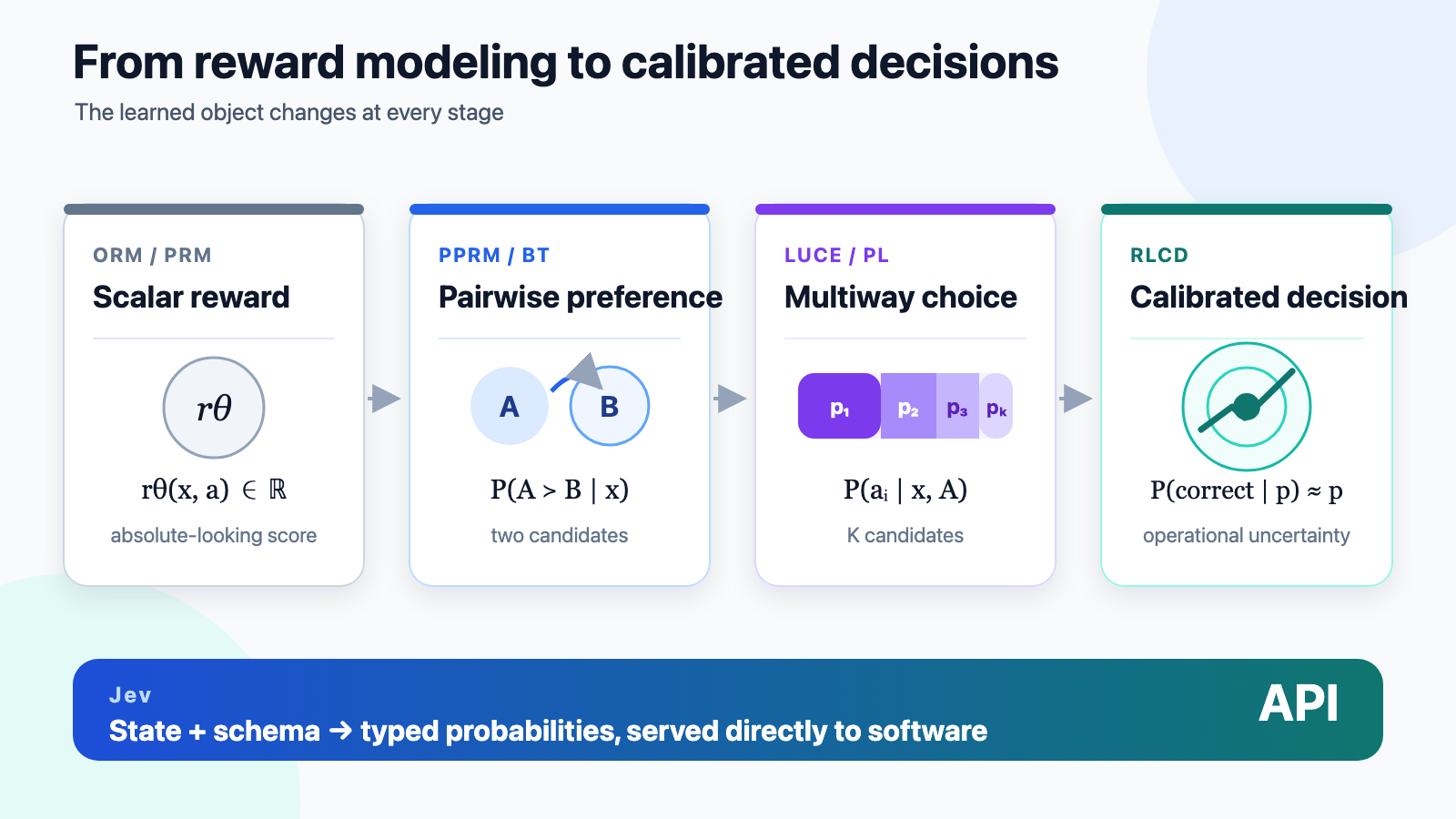
Di Zhang, a PhD candidate at Fudan University working on LLM reasoning, published a September 21 breakdown that recasts TypeSafe’s Jev. He argues it is not a chat model at all, but a reward model turned into the interface.
That inversion explains the name RLCD.
Zhang defines it simply as multiway preference modeling plus probability calibration. More formally, he calls RLCD a schema-conditioned Plackett-Luce objective, with Jev adding typed outputs and parallel inference on top. The reward model no longer hides behind a generator. It becomes the model.
The lineage starts with scalar rewards. A conventional outcome or process reward model scores a context x and candidate a as r(x,a) in real numbers. Zhang notes a 0.8 means little across problems or checkpoints. It was always relative, useful only as r(x,a1) greater than r(x,a2).
LLaMA-Berry made that explicit. Its Pairwise Preference Reward Model, or PPRM, asks is a1 better than a2 and models it as Bradley-Terry, P(a1 over a2 | x) = exp u(x,a1) / (exp u(x,a1)+exp u(x,a2)), or sigma(u1 minus u2). It was trained on almost 7.8 million mathematical solution pairs and optimized with DPO, using Enhanced Borda Count downstream for MCTS search. The conceptual move matters more than the search. Reward modeling becomes preference probability.