

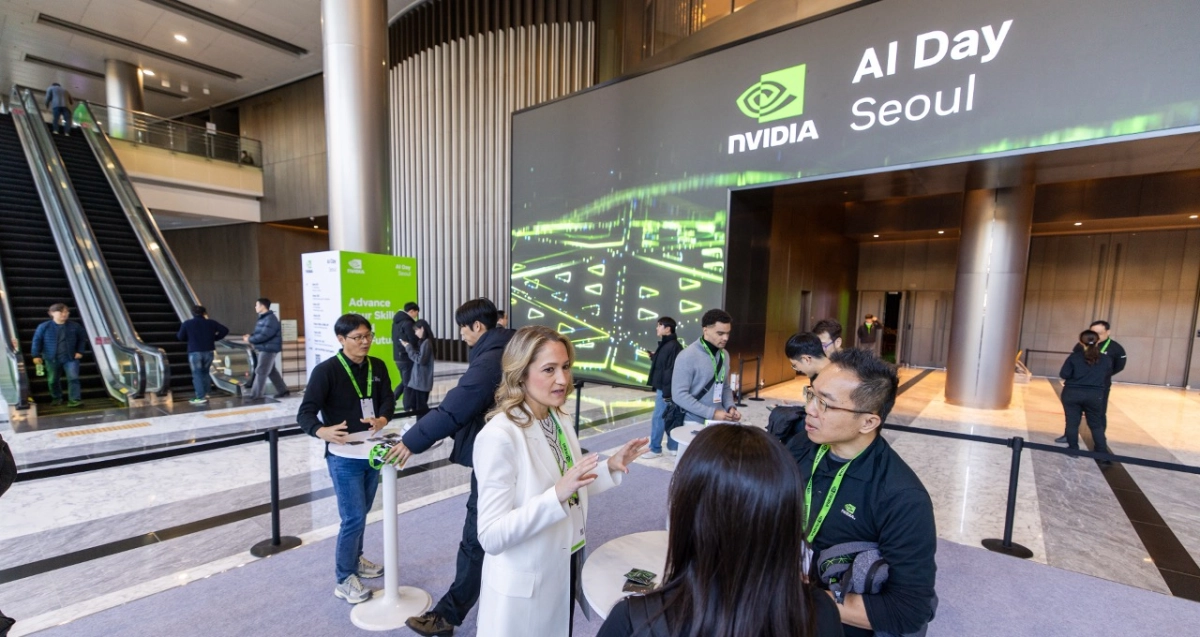
South Korea is making an aggressive play for technological self-reliance in artificial intelligence, committing to a massive 260,000 GPU infrastructure rollout for its developers. This significant investment, announced at the recent APEC Summit, underpins the nation's strategic push for "Sovereign AI Korea," aiming to cultivate national AI models and capabilities tailored to its unique priorities. The initiative signals a clear intent to build a robust, domestically controlled digital foundation, moving beyond mere adoption to active creation and ownership of advanced AI systems.
The concept of Sovereign AI Korea extends beyond hardware, encompassing a full-stack approach from infrastructure to applications across diverse sectors. NVIDIA's AI Day Seoul highlighted how this vision is already taking shape, with AI driving advancements from industrial manufacturing and robotics to government services and the burgeoning K-pop industry. Major Korean conglomerates like Samsung, SK Group, Hyundai Motor Group, and NAVER Cloud are deeply integrating AI, leveraging it to process documents, optimize logistics, and enhance consumer experiences. This widespread adoption underscores a national strategy to embed AI into the very fabric of Korea's digital economy, ensuring that the benefits and control of these transformative technologies remain within national borders.
Korean industry leaders are actively building out their AI capabilities using advanced NVIDIA technologies. NAVER Cloud, for instance, is deepening its collaboration with NVIDIA to develop agentic AI systems, utilizing the NeMo Agent Toolkit to derive optimization insights. LG AI Research is pushing the boundaries of large language model training with the NVIDIA NeMo framework, achieving significant speed improvements and enhanced reasoning performance through FP8 training recipes. Meanwhile, Coupang Intelligent Cloud is constructing an "AI factory" powered by NVIDIA DGX systems, based on Hopper and Blackwell architectures, to deliver AI-powered solutions for demand forecasting, logistics, and ad personalization. These efforts collectively demonstrate a concerted drive to establish Korea as a leader in AI development, not just consumption.
Fueling the AI Ecosystem
The commitment to Sovereign AI Korea is also profoundly impacting the nation's startup and developer ecosystem. NVIDIA's Inception program, which recognized five Korean startups at AI Day Seoul, serves as a critical accelerator, providing technical support and visibility. The event itself offered invaluable opportunities for developers to engage directly with NVIDIA experts on real-world challenges, fostering a collaborative environment essential for rapid innovation. This direct engagement, coupled with the forthcoming 260,000 GPU infrastructure, is designed to empower Korean startups and researchers to accelerate their development cycles and bring novel AI solutions to market faster.
The strategic implications of this massive GPU investment are far-reaching for Korea's global standing and technological sovereignty. By providing unparalleled access to high-performance computing resources, Korea aims to reduce its reliance on foreign AI infrastructure and foster the development of AI models trained on national data, reflecting Korean culture and language. This move is not merely about economic development; it is about securing a strategic advantage in the global AI race, ensuring that Korea can innovate independently and compete effectively on the world stage. The Ministry of SMEs and Startups' active partnership with NVIDIA further solidifies the government's commitment to nurturing this ecosystem, positioning Korea as a formidable player in the future of artificial intelligence.