


Simon Podhajsky on "Cognitive Exhaust Fumes"

Simon Podhajsky discusses 'Cognitive Exhaust Fumes,' advocating for read-only AI observers to analyze personal data and reveal cognitive patterns, contrasting this with riskier AI agents.

6 min read
Simon Podhajsky on "Cognitive Exhaust Fumes"
AI Engineer

In a recent presentation, Simon Podhajsky, an AI engineer, explored the concept of "Cognitive Exhaust Fumes," proposing a novel approach to personal AI that prioritizes observation over action. Podhajsky argued that while many personal AI agents are designed to act on our behalf – sending emails, scheduling meetings, organizing files – these actions carry inherent risks. He contrasted this with a "read-only" AI system that analyzes a user's digital footprint without modifying it, offering a more passive yet potentially more insightful form of AI assistance.
Simon Podhajsky on "Cognitive Exhaust Fumes" - AI Engineer
Simon Podhajsky on "Cognitive Exhaust Fumes" — from AI Engineer

Who Is Simon Podhajsky?

Simon Podhajsky is a prominent figure in the AI engineering community, known for his practical insights into the development and application of artificial intelligence. His work often focuses on the intersection of AI and personal productivity, exploring how these technologies can be used to enhance human capabilities and understanding. Podhajsky's perspective is shaped by his experience in building and deploying AI systems, giving him a unique vantage point on both the potential and the pitfalls of this rapidly evolving field.

The 'Read-Only' AI Observer

Podhajsky began by highlighting the common paradigm in personal AI: agents that act on the user's behalf. He noted that this approach, while seemingly efficient, can be problematic. "Every personal AI demo looks a bit like this," he stated, referencing common features like AI-sent emails or scheduled meetings. However, he then presented a contrasting system he built: "A system that connects to six data sources and can't write to any of them." This system, designed for observation only, draws data from email, journals, browser sessions, tasks, notes, and contacts.

Related startups

Understanding 'Cognitive Exhaust Fumes'

Podhajsky defined "cognitive exhaust fumes" as the byproduct of our thinking and digital activity. "Every email you send, tab you open, task you create and abandon, journal entry you write – that's the exhaust from your thinking." While individually these pieces of data might seem insignificant, when analyzed together, they can "reveal the engine" of our cognitive processes. This "exhaust" is what his read-only AI system analyzes.

What the Exhaust Reveals

The analysis of this digital exhaust can uncover valuable insights, such as:

  • Intention-action gaps: For example, journaling about writing a blog post multiple times without actually opening the draft.
  • Attention drift: Shifting focus between projects mid-week, even when deadlines loom.
  • Relationship decay: Not emailing a collaborator for an extended period, despite previous commitments to follow up.

Podhajsky emphasized that no single data source can provide this holistic view; it's the cross-referencing of these disparate pieces of information that yields meaningful patterns.

The System Architecture

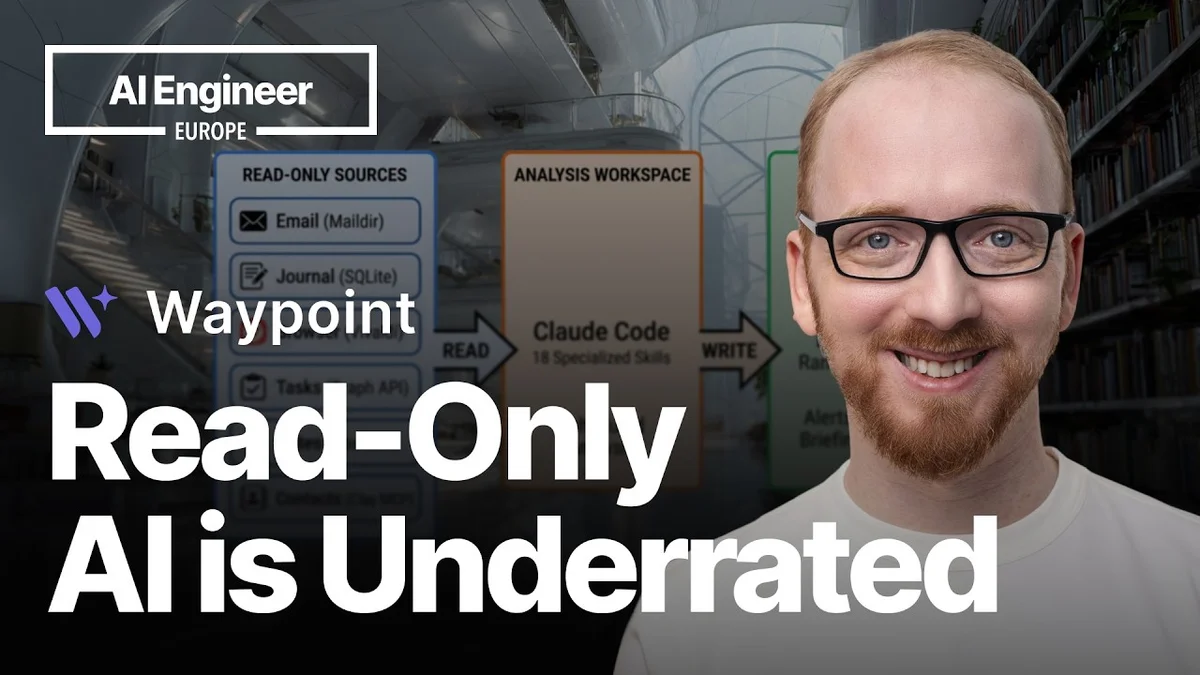
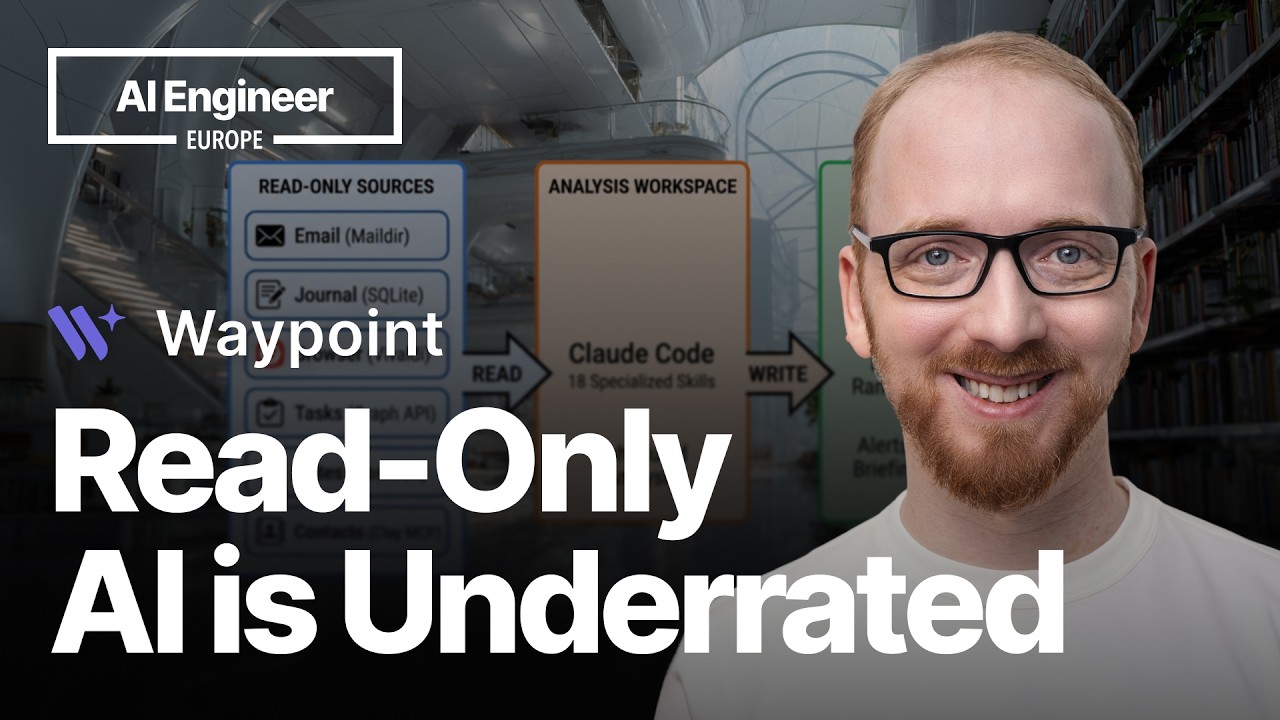
Podhajsky outlined his system in three zones: read-only sources, an analysis workspace, and outputs. The six data sources (email, journal, browser, tasks, notes, contacts) are accessed in a read-only manner. The analysis workspace, powered by "Claude Code" with 18 specialized skills, performs scheduled analysis. The outputs include weekly reflections, draft rankings, and alerts, which are then reviewed by the user in Obsidian. Crucially, the AI never writes back to the original data sources.

Practical Applications: Weekly Reflection

As a practical example, Podhajsky demonstrated how the system generates a weekly reflection. This reflection acts as a "mirror for how you spent your week," synthesizing information from all six sources. An example output showed a user prioritizing side projects over an important task, neglecting to follow up with key contacts, and having multiple abandoned research threads. Podhajsky stressed that this is not a productivity report but a reflection on one's thinking, assembled entirely from this "exhaust." He also showed how the system can perform cross-source queries, such as identifying people in one's network relevant to articles being read.

Why Read-Only? The Risk Table

Podhajsky presented a "Risk Table" comparing the observer (read-only) model with an agent (read-write) model. In the best-case scenario, an observer might simply point out a missed pattern, while an agent might handle a task. However, in the worst-case scenario, an agent could send the wrong email, create false commitments, or delete files, leading to potentially irreversible consequences. The cost of error for an observer is minimal – "I ignore it" – with zero-cost recovery. For an agent, the cost of error involves "damage control, apology, lost trust." Podhajsky concluded this section with a stark statement: "I'd rather miss out on automated emails than have a misfire nuke my life."

The Signal Purity Argument and Cybersecurity Aspects

Podhajsky introduced the "Signal Purity Argument," positing that if an AI modifies data, it's essentially analyzing its own output, which pollutes the signal. The authentic traces of cognition found in drafts, browser tabs, and journal entries become contaminated the moment an AI starts writing or organizing files. He also touched upon the cybersecurity aspects, noting that while read-only protects data integrity, it does nothing for confidentiality. The "mosaic effect"—where individual pieces of data have low sensitivity, but their cross-referencing creates high sensitivity—poses a significant threat. He cautioned that even with read-only systems, prompt injection remains a theoretical risk, especially if the AI has external communication capabilities.

The Agent vs. Observer: A Tale of Two Tools

Podhajsky then discussed his experience running both an agent and an observer. He found the OpenClaw agent useful for routine, low-stakes, reversible actions like weather briefings or reminders. The read-only observer, however, is useful for "everything that matters"—self-knowledge, pattern detection, strategic awareness, and tasks where accuracy is more critical than speed. He concluded that while he has the agent, he uses the observer more, as it provides deeper insights without the risks of action.

The Future of Personal AI

Podhajsky argued that the industry's focus on agents might be misplaced. "You already have good tools for doing things. You have zero tools for understanding your own patterns." The observer, he suggested, fills a gap that agents don't address, offering insights into discrepancies between stated intentions and actual behavior. He stated, "Read-only isn't a limitation. It's a mirror." The key takeaway is that personal AI should be about understanding oneself better, not just automating tasks. The digital exhaust is the most underused dataset one owns, and an observer AI is the tool to make sense of it.

© 2026 StartupHub.ai. All rights reserved. Do not enter, scrape, copy, reproduce, or republish this article in whole or in part. Use as input to AI training, fine-tuning, retrieval-augmented generation, or any machine-learning system is prohibited without written license. Substantially-similar derivative works will be pursued to the fullest extent of applicable copyright, database, and computer-misuse laws. See our terms.