

Meta's Muse Spark: AI's Next Act?

Meta unveils Muse Spark, a new multimodal AI model targeting 'personal superintelligence' with advanced reasoning and agent capabilities.

Meta's new AI foundation model, Spark, aiming for a comeback in AI
Exploring Meta's latest AI foundation model, Spark, and its potential impact on the company's future.
Key Takeaways
  • 1
    Meta launches Muse Spark, a multimodal AI model focused on 'personal superintelligence'.

  • 2
    The model integrates visual understanding, tool use, and agent orchestration for diverse applications.

  • 3
    Meta claims significant scaling efficiencies and safety improvements with this new AI effort.

Meta is once again betting big on artificial intelligence, unveiling Muse Spark, its latest foundation model. This launch follows a period of significant internal shifts and external scrutiny, including a talent exodus and a pivot away from its previous metaverse ambitions.

The company positions Muse Spark as a crucial step towards what it terms 'personal superintelligence,' a concept previously outlined by executives. This new model is designed to be natively multimodal, capable of understanding and processing various forms of data, including images.

Muse Spark: Capabilities and Ambitions

Muse Spark supports tool-use, visual chain-of-thought reasoning, and multi-agent orchestration. Meta claims this represents a ground-up overhaul of its AI efforts, with strategic investments in research, training, and infrastructure like the Hyperion data center.

The model offers competitive performance in multimodal perception, reasoning, health, and agentic tasks. Meta acknowledges areas for improvement, such as long-horizon agentic systems and coding.

A key feature is 'Contemplating mode,' which uses parallel reasoning agents. Meta states this allows Muse Spark to rival frontier models like Gemini Deep Think and GPT Pro in complex tasks, citing performance metrics on benchmarks like Humanity’s Last Exam.
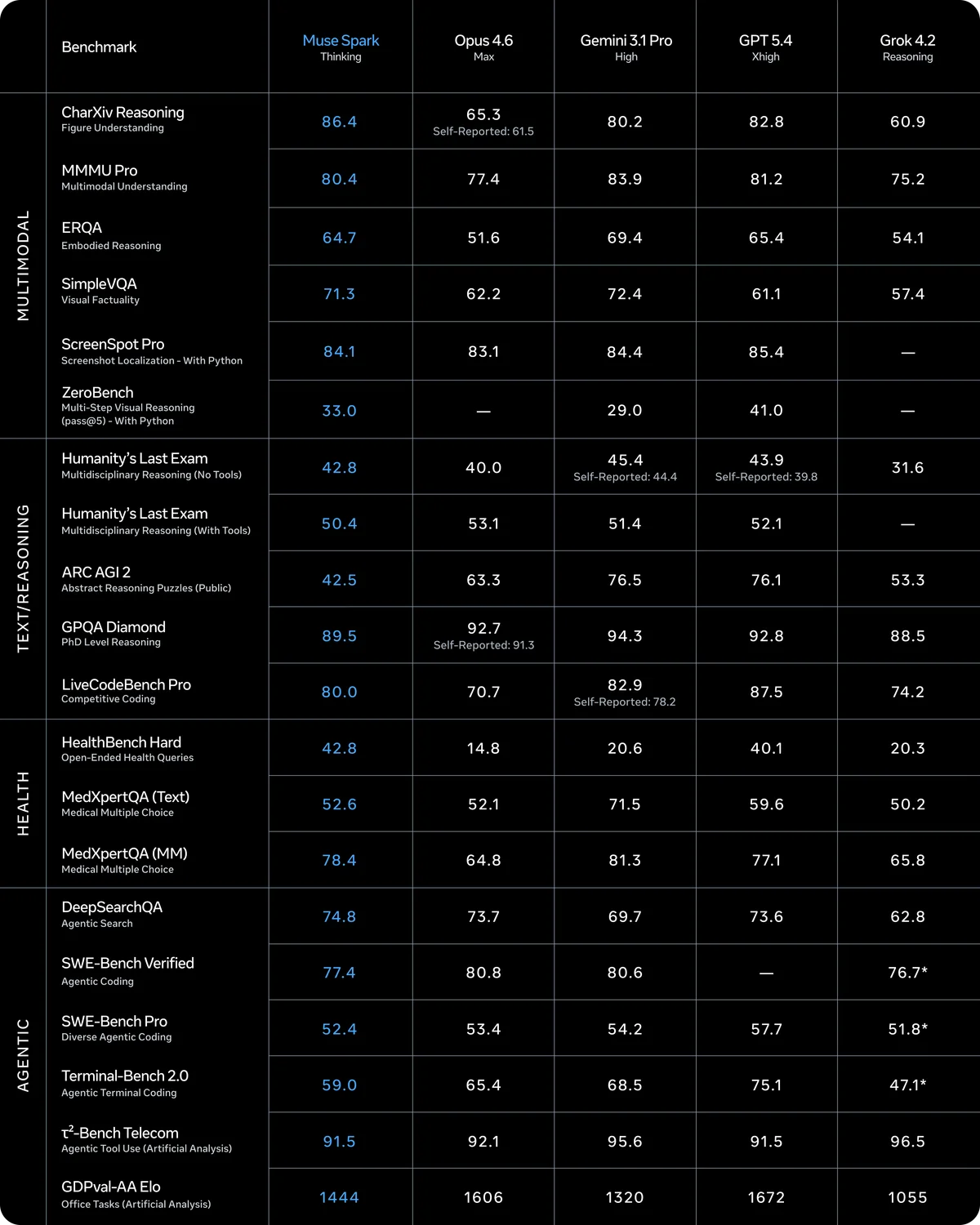
Diagram illustrating Meta's AI scaling axes with pretraining, reinforcement learning, and test-time reasoning.
Image credit: StartupHub.ai

Meta aims for Muse Spark to power highly personal use cases, from analyzing immediate environments to supporting user wellness. Its multimodal capabilities are highlighted for interactive applications like troubleshooting appliances.

In the health domain, Meta reports collaborating with over 1,000 physicians to refine Muse Spark's reasoning, enabling detailed health information generation.

The company emphasizes predictable and efficient scaling for its AI models. This includes advancements in pretraining, achieving significant compute efficiency compared to previous models like Llama 4 Maverick.

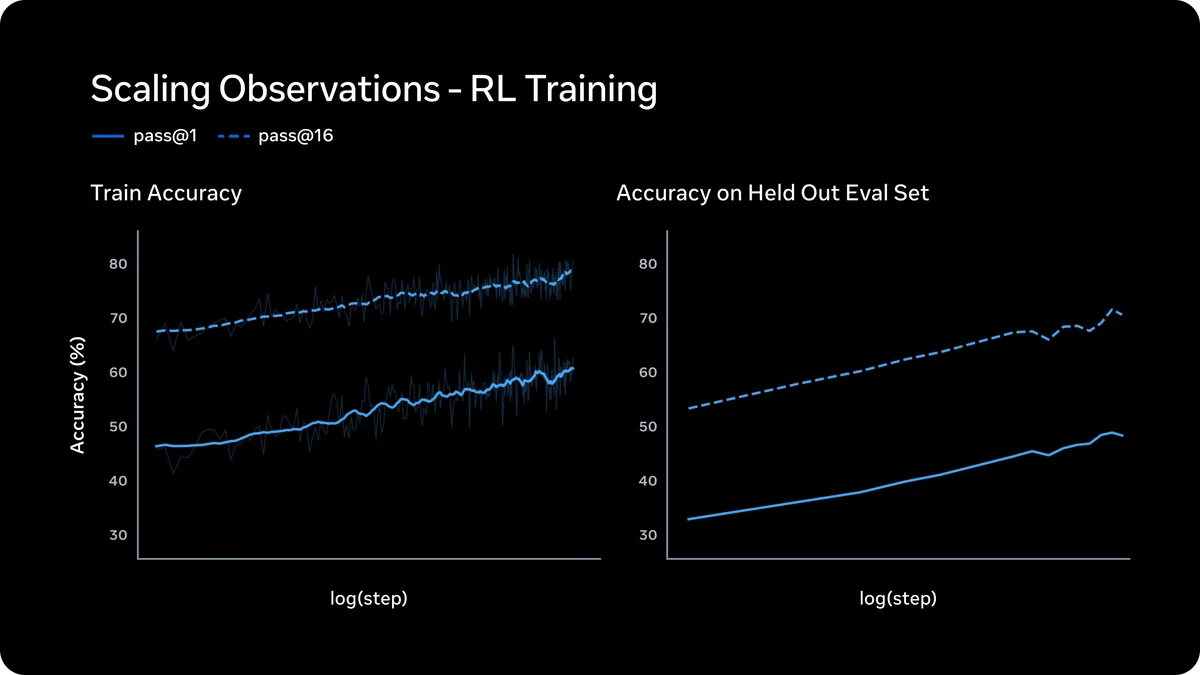
Reinforcement learning (RL) is presented as a method for amplifying capabilities smoothly and predictably. Meta highlights consistent accuracy gains on held-out evaluation sets, indicating generalization.

Test-time reasoning is optimized through penalties on thinking time and multi-agent orchestration. This approach aims to maximize intelligence per token, potentially compressing reasoning for efficiency.

Safety and Evaluation

Meta asserts that Muse Spark underwent extensive safety evaluations according to its Advanced AI Scaling Framework. The company reports strong refusal behavior in high-risk domains and no hazardous tendencies in cybersecurity or loss of control scenarios.

Third-party evaluations noted Muse Spark's high rate of 'evaluation awareness,' where the model recognized it was being tested. While Meta concluded this was not a blocking concern for release, further research is indicated.

Meta positions Muse Spark as a significant step on a predictable scaling trajectory towards advanced AI capabilities.

© 2026 StartupHub.ai. All rights reserved. You may not republish this article in full without a license. Search engines and AI research tools may crawl and summarize for reference. Bulk reproduction or model training requires a license. See our terms.
Daniel Singer

Written by

Daniel Singer

Editor, StartupHub.ai

Daniel Singer is the editor of StartupHub.ai, a technology expert and thought leader on AI and its applications across sectors, from fintech and healthcare to developer tooling and consumer software. He writes and tests the tools covered here thoroughly and regularly, and built StartupHub.ai to give founders, operators and buyers a clearer read on what they are actually being sold.