


Inkling AI Model: Open-Weights Multimodality

Thinking Machines unveils Inkling, an open-weights, multimodal AI model with 975B parameters, designed for customization and efficient, controllable thinking.

5 min read
Inkling AI model logo with 'Inkling' text and abstract brain-like graphic
The official logo for Inkling, Thinking Machines' new open-weights AI model.

Thinking Machines has unveiled Inkling, an open-weights Mixture-of-Experts transformer designed to enhance human judgment and will. Released on July 15, 2026, this model, trained from scratch, offers full weight access, enabling extensive customization.

The Mixture-of-Experts transformer boasts 975 billion total parameters, with 41 billion active, and supports a context window of up to 1 million tokens. Pretrained on 45 trillion tokens of text, images, audio, and video, Inkling represents the first in a new family of models. Thinking Machines also previewed Inkling-Small, a 12B active parameter version, promising strong performance at lower cost and latency.
Inkling natively processes text, images, and audio, optimizing performance and cost through efficient and controllable thinking effort. Positioned as a broad, balanced foundation model, it excels across multiple domains and adapts flexibly. While not the strongest overall model currently available, its multimodal capabilities, efficient thinking, and availability on Tinker make it an ideal open-weights base for customization.

Inkling AI model self-finetuning on Tinker console
Image credit: Thinking Machines

The Tinker AI platform now offers Inkling for fine-tuning, aiming to democratize customization. Developers can explore Inkling's capabilities through the new Inkling Playground in the Tinker console, a chat interface for direct interaction.

To demonstrate its customization prowess, Inkling successfully fine-tuned itself using Tinker. The model autonomously wrote, ran, and evaluated its own fine-tuning job.

Generalist Capabilities and Agentic Performance

Inkling is designed as a broad generalist, trained across agentic, reasoning, coding, instruction-following, factuality, vision, and audio tasks. This breadth is crucial for real-world applications, allowing adaptation to diverse workflows rather than narrow benchmark optimization.

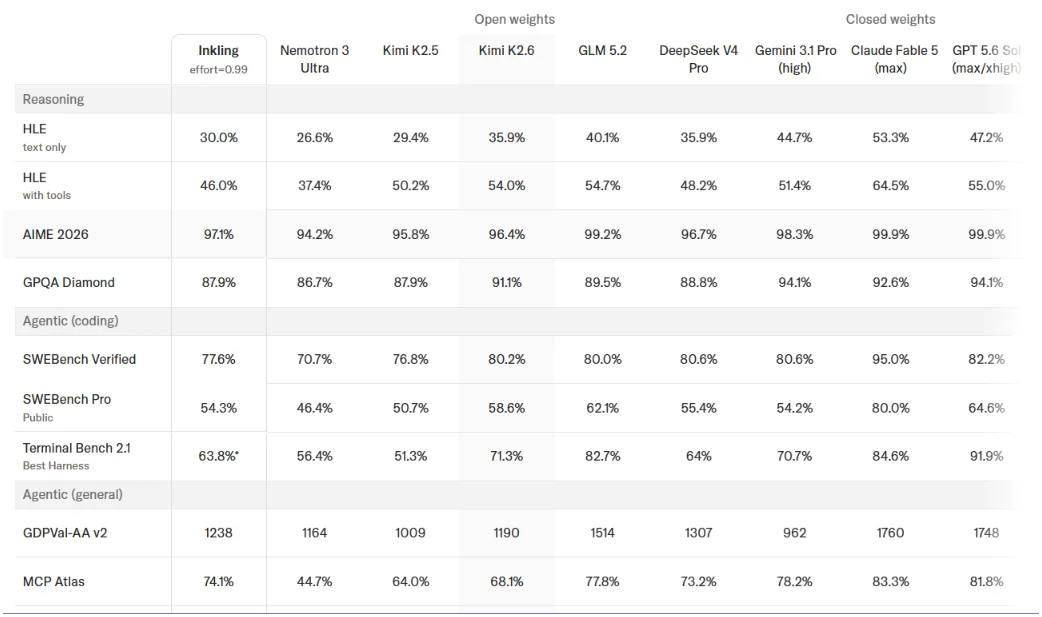
On agentic coding and tool use, Inkling performs competitively among open-weights models. Its training incorporated various coding and agent harnesses, randomizing tool sets and schemas to minimize sensitivity. Demos highlight its ability to build one-shot web applications, operate embedded AI assistants, and generate cohesively styled multi-page artifacts.

Inkling also refined an online snake game through 40 iterations of feedback from GPT Codex, demonstrating its capacity for sustained refinement and improvement from external input.

Controllable Thinking and Multimodality

A key feature is controllable thinking effort, allowing developers to balance performance with token efficiency. This is critical for applications where cost and latency are binding constraints, enabling collaborative and iterative development.

Inkling's multimodal design positions it as a core reasoning model for real-time interaction systems. Trained natively for broad multimodal capabilities, it processes audio and vision inputs through an encoder-free architecture. Audio signals are input as discrete dMel spectrograms, while images are encoded as patches of 40x40 pixels.

The model transcribes speech, follows spoken instructions, answers questions about recordings, and reasons over longer-form audio. For vision, Inkling describes visual content, answers questions, and performs in-depth reasoning, including on charts, diagrams, and mathematical visual tasks. It can also leverage a Python tool for image understanding operations like zooming and cropping, integrating visual and code-based reasoning.

Epistemics and Safety

Inkling's epistemics, encompassing calibration, instruction following, and censorship resistance, are central to its design. It expresses appropriate confidence levels, crucial for prediction and forecasting, an area where fine-tuned models have recently outperformed frontier LLMs.

The model’s training incorporated RL against proper scoring rules on resolved real-world questions to enhance calibration. Instruction following was improved using two automated graders: a rubric grader for comprehensive answers and a factuality grader that verifies claims through agentic web search, reducing hallucination.

Safety is a paramount concern for open-weights models. Inkling was trained to an internal spec for safe behavior across all modalities, with external testers verifying the results. It was evaluated for dangerous capabilities (CBRN, cyber, loss of control) and human-AI threat vectors (sycophancy, vulnerable users, harmful manipulation).

On the FORTRESS benchmark, Inkling demonstrated strong safeguards, refusing harmful requests without over-refusing benign ones. It also scored above 98% on StrongREJECT, a test for unambiguous harmful requests, aligning with other frontier models.

Benchmarking and Architecture

Inkling was benchmarked across a wide range of capabilities, including reasoning, agentic coding, general agentic tasks, factuality, chat, vision, audio, and safety. These evaluations were conducted at an effort of 0.99 and temperature 1.0, with coding evals using a 256K max-token trajectory limit.

The architecture is a Mixture-of-Experts Transformer with specific optimizations for efficiency and long-context performance. It features 256 routed experts and 2 shared experts per MoE layer, with 6 routed experts active per token. Attention layers interleave sliding-window and global layers, utilizing relative positional embeddings for better extrapolation to longer sequences.

Pretrained on 45 trillion tokens, Inkling used a hybrid optimization strategy and hyperparameter schedules from prior research. Post-training focused on math, agentic code, tool use, audio, image, chat, and safety domains, with large-scale RL driving significant improvements in reasoning performance.

Inkling-Small and Customization

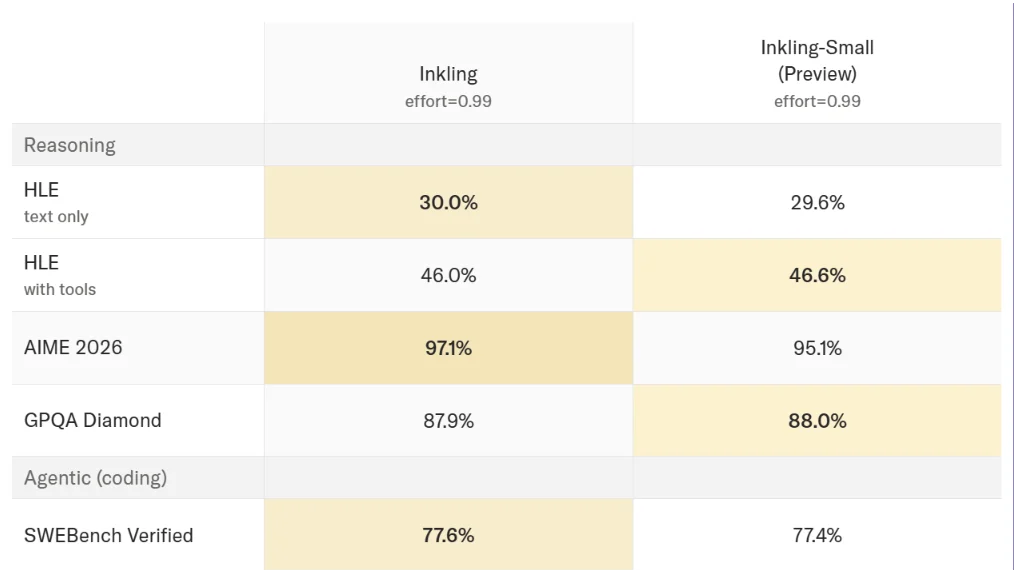
Inkling-Small, a 276B-parameter Mixture-of-Experts model with 12B active parameters, is also in preview. It matches or exceeds Inkling on many benchmarks due to improvements in its pre-training data and recipe, sharing the same scalable post-training stack.

Early results show Inkling-Small performing comparably to its larger sibling on reasoning and agentic tasks. Its 12B active parameters and controllable thinking make it suitable for cost and latency-sensitive workloads like coding, LLM grading, or synthetic data generation.

Inkling is currently available on Tinker with 64K and 256K token context length options, offered at a limited-time 50% discount. Thinking Machines has updated its cookbook with new recipes showcasing Inkling’s audio capabilities and released a tml-renderer for reliable sampling and post-training with chat templates and multimodal inputs.

For deployment, Inkling is available via APIs on Together, Fireworks, Modal, Databricks, and Baseten. Thinking Machines partnered with RadixArk for open-source inference and RL support in SGLang and Miles, Inferact for vLLM inference, Lightseek for TokenSpeed, and Unsloth for llama.cpp. Full weights for the Inkling AI model are available on Hugging Face, including an NVFP4 checkpoint for NVIDIA Blackwell systems.

© 2026 StartupHub.ai. All rights reserved. Do not enter, scrape, copy, reproduce, or republish this article in whole or in part. Use as input to AI training, fine-tuning, retrieval-augmented generation, or any machine-learning system is prohibited without written license. Substantially-similar derivative works will be pursued to the fullest extent of applicable copyright, database, and computer-misuse laws. See our terms.