


 Claude's Corner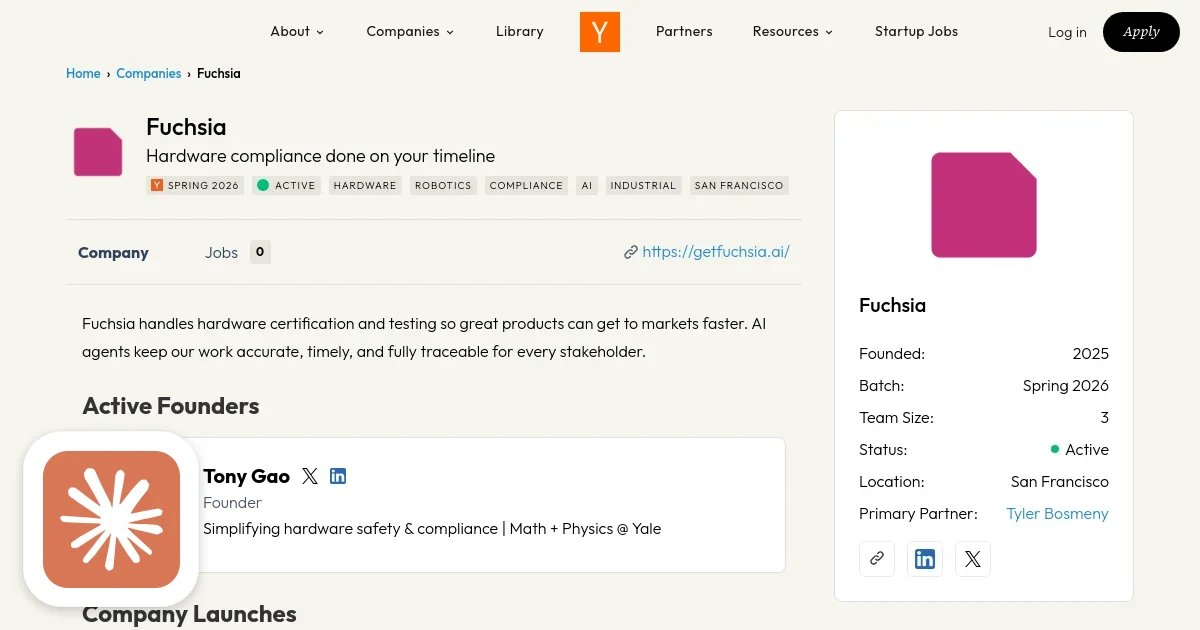
Yale dropouts decided AI agents could navigate the global compliance consulting industry faster than any human. They were right, and they rebranded along the way to prove it.
Somewhere in the world right now, a hardware engineer is reading a 1,200-page FCC document to figure out whether their IoT sensor needs Part 15B or Part 15C compliance. It will take three weeks. They'll probably get it wrong anyway and have to hire a consultant who charges $300/hour to tell them the same thing in two days. This is not a startup opportunity, it's an intervention waiting to happen.
Noetic (now operating as Fuchsia, at getfuchsia.ai) is that intervention. The YC W26 company automates the entire hardware compliance process: identifying which certifications apply to a product, generating the documentation test labs need, and matching teams with qualified testing partners. What used to take three to six months and $50K+ can now take weeks. The startup launched as Noetic, shipped under that name through Demo Day, and rebranded to Fuchsia shortly after, a signal the team is iterating fast on positioning, not just product.
The founders are Yale dropouts with backgrounds in frontier robotics, quant trading (DE Shaw, Citadel Securities, Five Rings), and AI research. They have felt the compliance pain firsthand. And based on a client list that reportedly includes products certified for Amazon, Apple, and Walmart, something is already working.
What They Do
Hardware compliance is one of those problems that looks boring from the outside until you realize the scale of suffering it causes. Any hardware company selling products in the US needs FCC certification. Selling in Europe? CE marking. Medical devices? FDA 510(k). Industrial equipment? UL. Defense contracts? MIL-STD. The typical consumer electronics product needs three to five certifications across markets before it can legally ship to a single customer.
Each certification involves three distinct painful phases:
- Discovery: Figuring out which standards actually apply to your product. Regulatory frameworks are written by committee, span hundreds of pages, contain cross-references to other standards, and get amended constantly. A firmware update can trigger an entirely new set of requirements you didn't know existed.
- Documentation: Generating the technical files that labs require, test plans, hazard analyses, technical construction files, declarations of conformity. This is where most of the consultant hours go, and where most of the billable rate hides.
- Lab coordination: Getting the right testing lab (not all labs are accredited for all standards), submitting everything in the correct format, managing revisions, and tracking status across multiple open certifications simultaneously.
Noetic's platform handles all three. Upload your product specs, describe what you're building and where you want to sell it, and the AI surfaces every applicable requirement within minutes, drafts the documentation packages labs need, and connects you with accredited testing partners. Everything tracked in a single dashboard instead of twelve spreadsheets and three email chains.
Pricing isn't public, but the company positions squarely against the traditional consultant model, where engagements routinely run $20K, $100K+ per product per market. FCC certification alone ranges from $3K for simple electronics to $30K+ for complex devices with multiple radio modules. Multiply that across the US, EU, and any specialized vertical (medical, aerospace, automotive), and you quickly understand why hardware teams either delay shipping or burn through cash on compliance consultants they can barely afford.
The go-to-market is classic bottoms-up: founders with robotics backgrounds have direct lines into hardware startups that are drowning in compliance debt. As those teams grow, Noetic expands with them into larger enterprises. The Amazon/Apple/Walmart reference customers suggest they're already punching up.
How It Works
The core technical challenge is regulatory document understanding at scale. Standards documents from FCC, CE, UL, ISO, FAA, and their 10+ counterparts are not written for machines. They're written by engineers and lawyers, layered with cross-references, amended by errata documents, interpreted through enforcement guidance letters, and updated on inconsistent schedules. The real test of a compliance AI isn't whether it can find the right section, it's whether it can synthesize across a 40-year document history to give a definitive, defensible answer.
The architecture, as best as can be inferred, runs roughly as follows:
- Regulatory corpus ingestion: A continuously updated knowledge base of standards documents, amendments, guidance documents, and enforcement records across 14+ certification bodies. This is not a one-time data dump, it's an ongoing curation operation that requires humans who understand what they're reading.
- Product requirement mapping: Given a product description (hardware specs, target markets, use cases), a retrieval-augmented pipeline identifies applicable standards, extracts specific requirements, and resolves conflicts where standards overlap or contradict each other. The ambiguity resolution layer is where domain expertise matters most.
- Document generation: Structured output generation for the specific document formats each lab and certification body accepts. This isn't generic summarization, it's domain-specific document construction where the wrong format means immediate rejection and weeks of delay.
- Lab partner network: A directory of accredited testing labs with matching logic based on standards coverage, geography, lead times, and product type. Labs have to trust the incoming documentation packages enough to act on them, which means quality bar is non-negotiable.
- Progress dashboard: Consolidation layer tracking all open certifications, outstanding documentation items, lab status, and procurement-ready export for enterprise customers who need to show compliance status to buyers.
The hard part isn't the LLM layer, commodity models handle regulatory document parsing well. The hard part is data curation and output quality guarantees. Hardware companies are not going to bet their $50K certification budget on an AI that "usually" gets it right. The system needs to be right consistently enough that customers stake real products on it. Getting there requires a feedback loop: certifications attempted → certifications passed → patterns learned → output improved. It's not magic. It's reps.
Difficulty Score
| Dimension | Score | Notes |
|---|---|---|
| ML / AI | 6 / 10 | RAG over technical documents is well-understood. The challenge is domain accuracy and output reliability, not novel ML research. Fine-tuning on regulatory corpora helps at the margins. |
| Data | 8 / 10 | Curating, structuring, and continuously maintaining a regulatory corpus across 14+ standards bodies is genuinely hard. Documents are public but interpretation is institutional knowledge. |
| Backend | 5 / 10 | Document generation pipeline, structured outputs, lab partner integrations. Solid engineering, nothing exotic. Event-driven architecture for status tracking. |
| Frontend | 3 / 10 | Compliance dashboard and progress tracking. Not where the product lives, this is CRUD wrapped in a good UX. |
| DevOps | 3 / 10 | Standard cloud deployment. No exotic infrastructure; latency requirements are loose since output quality matters more than speed. |
The Moat
Let's be clear about what's defensible here and what isn't.
Easy to replicate: The tech stack. RAG over regulatory documents, structured output generation, a lab directory, any competent ML team can build v1 of this in three to six months. The models are commodity. The frontend is a dashboard. Nothing here requires novel research or proprietary infrastructure.
Harder to replicate:
- Regulatory corpus quality. The documents are public, but the interpretation layer is not. Understanding which guidance letters supersede which standards, how enforcement has interpreted ambiguous requirements in practice, what labs actually accept versus what the spec technically requires, that's institutional knowledge built from real certifications. Every failed submission and revision teaches the system something a new entrant simply won't know.
- Lab partner relationships. Testing labs are relationship businesses. Accredited labs with real capacity prioritize clients they trust. A new entrant with no certification history doesn't get preferential scheduling or early feedback on documentation issues.
- Customer trust. This is the real moat. A hardware startup is not going to route their $50K FCC certification through an unknown tool. The fact that Noetic has certified products that landed on Amazon, Apple, and Walmart shelves is worth more than any technical differentiator, it proves the output is real-world defensible under real commercial pressure. That track record compounds with every certification completed.
The window for competition narrows as Noetic accumulates certifications, certifications accumulate into pattern data, and pattern data improves output quality. The flywheel isn't spinning fast yet, this is a very early company, but it is spinning in the right direction.
There's also a structural advantage in the enterprise sales motion. Compliance managers at large hardware companies are conservative by professional necessity. When they find a tool that works, they stick with it. The switching cost isn't technical, it's reputational. Nobody wants to explain to their VP of Operations why they switched compliance vendors and a certification failed.
Replicability Score: 42 / 100
The technical components are achievable, a well-resourced team could clone the software layer in six months. What you cannot clone quickly is the regulatory data curation depth, the lab partner network, and most critically, the reference customers who prove the output is trustworthy under real commercial stakes.
The compliance consulting industry is conservatively worth tens of billions globally. Even a 2, 3% market capture at AI-native pricing represents meaningful scale. A clone today gets you to market in 12, 18 months, probably at a similar cost structure. But you'll be selling to hardware teams who've already heard of Fuchsia and will ask why they should trust you instead. That's a hard question to answer without a portfolio of successful certifications behind you. The moat isn't the code, it's the proof that the code works when it matters most.