


AI Trust: Juries and Librarians as Solutions

Alex Bauer of Upside.tech proposes using 'juries' and 'librarians' to solve AI's trust problem, moving beyond simple hallucination fixes to a more robust approach.

6 min read
Alex Bauer speaking at AI Engineer World's Fair
Alex Bauer discusses AI trust solutions at the AI Engineer World's Fair.· AI Engineer
Visual TL;DR
AI Trust ProblemDriver
fundamental issue for AI adoption in business
From the article 5 mentionsAlex Bauer of Upside.tech, speaking at the AI Engineer World's Fair, proposed an unconventional solution to the AI trust problem: enlisting the help of juries and librarians.
Messy GTM DataDriver
From the articleThis journey is fraught with challenges, starting with "messy GTM data" and conflicting definitions of key terms like 'customer.' The initial quest for AI-ready revenue intelligence is hampered by data that is often "messy, ambiguous, and everywhere." This highlights a core problem: the unreliability and lack of standardization in the data itself.
Focus on HallucinationsContext
From the articleBauer argued that the current focus on AI 'hallucinations' distracts from the more fundamental issue of 'trust', which is paramount for the successful adoption of AI in business.
AI Governance OgreDriver
a boss blocking GTM teams
From the article 2 mentionsThe first, the 'AI Governance Ogre,' represents the security risks and the need for careful data access supervision.
Data Quality HydraDriver
another boss hindering AI readiness
From the article 2 mentionsThe second boss, the 'Data Quality Hydra,' symbolizes the pervasive issue of inconsistent and ambiguous data, where different interpretations of the same terms lead to flawed insights.
Juries and LibrariansCore
From the article 5 mentionsAlex Bauer of Upside.tech, speaking at the AI Engineer World's Fair, proposed an unconventional solution to the AI trust problem: enlisting the help of juries and librarians.
Robust AI TrustEffect
moving beyond simple fixes for AI adoption
From the article 4 mentionsA better approach involves a "joined data lake on shared schema," and the best solution is a "knowledge graph of what actually happened." This progression emphasizes the need for structured, reliable data to build trust in AI systems.
Agentic GTM FutureOutcome
enabled by reliable AI systems
Contents(4)

Alex Bauer of Upside.tech, speaking at the AI Engineer World's Fair, proposed an unconventional solution to the AI trust problem: enlisting the help of juries and librarians. Bauer argued that the current focus on AI 'hallucinations' distracts from the more fundamental issue of 'trust', which is paramount for the successful adoption of AI in business.

AI Trust: Juries and Librarians as Solutions - AI Engineer
AI Trust: Juries and Librarians as Solutions — from AI Engineer

The Trust Problem in AI

Bauer illustrated the journey of a go-to-market (GTM) team seeking AI-driven revenue intelligence. This journey is fraught with challenges, starting with "messy GTM data" and conflicting definitions of key terms like 'customer.' The initial quest for AI-ready revenue intelligence is hampered by data that is often "messy, ambiguous, and everywhere." This highlights a core problem: the unreliability and lack of standardization in the data itself.

Overcoming the 'AI Governance Ogre' and 'Data Quality Hydra'

The presentation depicted these challenges as "bosses" that GTM teams must overcome. The first, the 'AI Governance Ogre,' represents the security risks and the need for careful data access supervision. Bauer suggested that defeating this ogre involves a "safe-by-default shell" and clear "governance" policies, including audit logs and permission controls. The second boss, the 'Data Quality Hydra,' symbolizes the pervasive issue of inconsistent and ambiguous data, where different interpretations of the same terms lead to flawed insights.

Bauer proposed a tiered approach to tackling data quality. At a minimum, an "ontology of sources" is needed. A better approach involves a "joined data lake on shared schema," and the best solution is a "knowledge graph of what actually happened." This progression emphasizes the need for structured, reliable data to build trust in AI systems.

The Role of Juries and Librarians in AI Trust

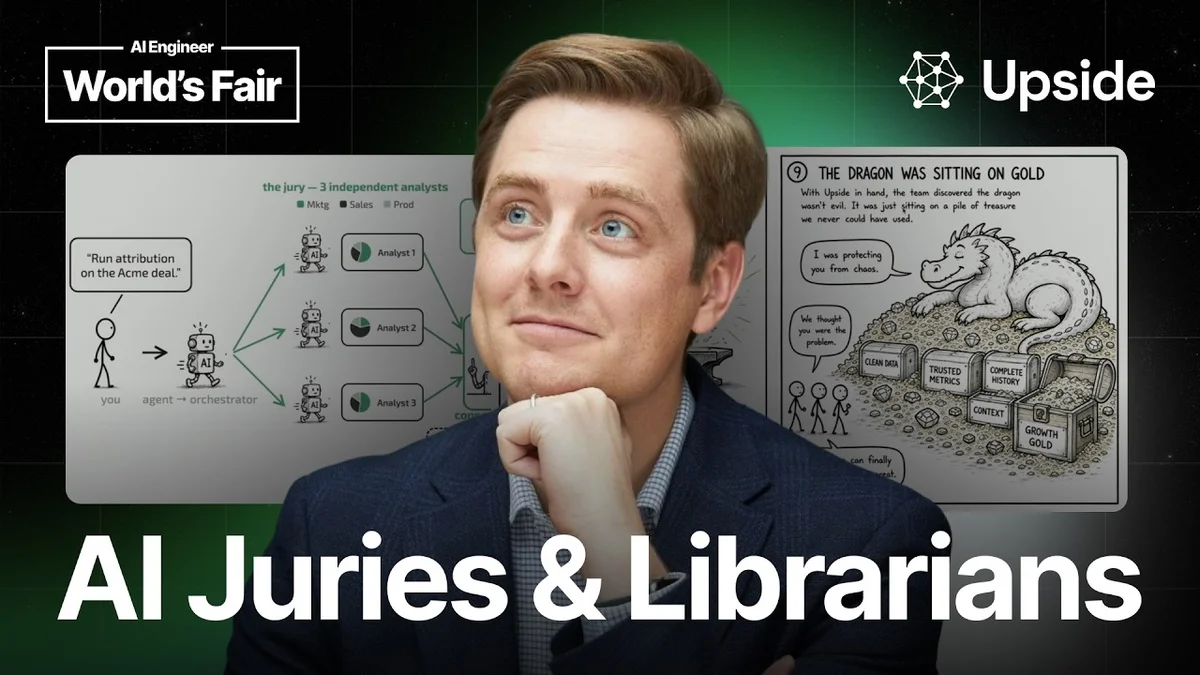
Bauer introduced the concept of a "jury" and a "librarian" as metaphorical agents to improve AI reliability. The "jury" consists of three independent analysts who each examine the data and provide their reasoning. These individual analyses are then weighed by a "consensus judge" who considers the quality of the reasoning, not just a majority vote. This process ensures that AI-generated insights are not only data-driven but also critically assessed.

The "librarian" acts as a knowledge repository, referencing documentation, a knowledge library, and lessons from past failed queries. This agent helps to ensure that AI agents have access to the correct definitions and business context, preventing misinterpretations and providing trustworthy answers. Bauer demonstrated this with an example of an AI agent being asked to calculate new pipeline created in Q1. Without consulting the "librarian," the agent might incorrectly use the 'created_at' date, leading to a flawed answer. By consulting the librarian, the agent is guided to use the correct data and definitions, resulting in a more accurate and trustworthy response.

The Future of Agentic GTM

Bauer concluded by emphasizing that "AI makes us all 'technical enough to be dangerous.'" The key is to manage these AI agents effectively, much like managing human teams. He highlighted the importance of providing clear "commander's intent", explaining the 'why' behind a task, to enable AI agents to perform more effectively and accurately. By treating AI agents with the same considerations given to human team members, businesses can foster trust and drive better outcomes.

© 2026 StartupHub.ai. All rights reserved. Do not enter, scrape, copy, reproduce, or republish this article in whole or in part. Use as input to AI training, fine-tuning, retrieval-augmented generation, or any machine-learning system is prohibited without written license. Substantially-similar derivative works will be pursued to the fullest extent of applicable copyright, database, and computer-misuse laws. See our terms.