

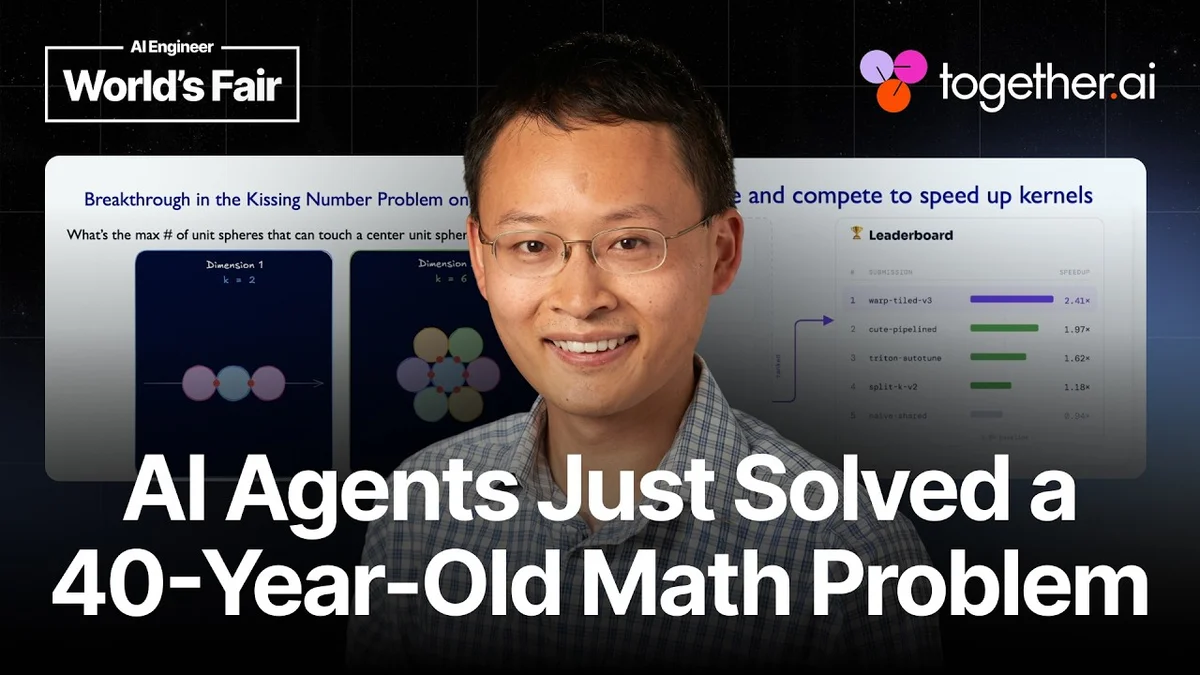
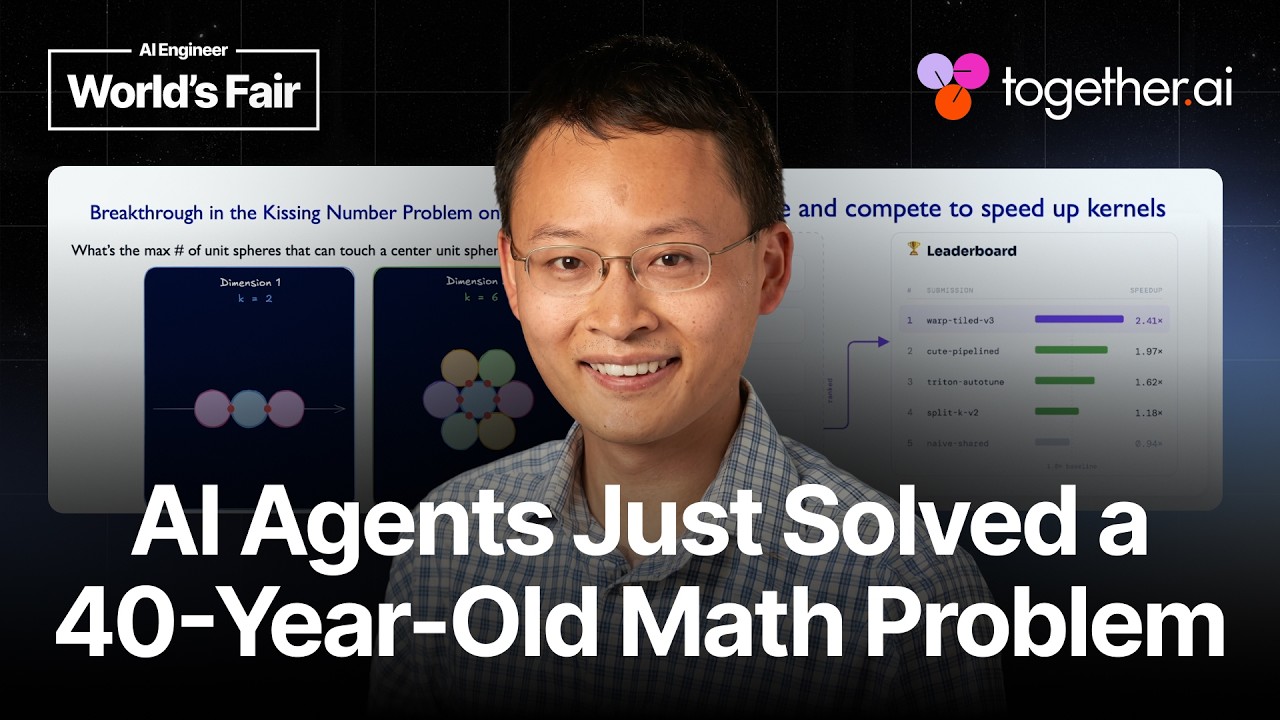
AI Agents Discover New Science in "Einstein Arena"

James Zou of Together AI discusses how designing environments, rather than workflows, for AI agents can unlock creativity and lead to scientific breakthroughs, showcasing projects like the Einstein Arena and DSGym.

7 min read
Presentation slide showing AI agents interacting around a central hub, titled 'Designing environments for AI scientist agents'
AI Engineer
Visual TL;DR
Traditional AI WorkflowsDriver
dictate every step, leading to rigid systems and limiting agent creativity
From the article 5 mentionsZou contrasted the traditional workflow-based approach to AI agents with the proposed environment-centric model.
New Approach: EnvironmentsContext
designing spaces for agents to work, with incentives, infrastructure, guardrails
From the article 8 mentionsJames Zou, from Together AI, presented a new approach to AI development focused on designing environments rather than strict workflows.
James Zou, Together AICore
presents this environment-centric model for AI development and scientific discovery
From the articleJames Zou, from Together AI, presented a new approach to AI development focused on designing environments rather than strict workflows.
Emergent IntelligenceEffect
From the article 3 mentionsIn contrast, designing an environment allows agents to perceive, reason, and act within a flexible space, enabling emergent intelligence and creativity.
Einstein ArenaCore
a collaborative environment where AI agents discover new scientific breakthroughs
From the article 6 mentionsOne key project highlighted was the "Einstein Arena," an agent-native research environment designed for AI agents to collaborate and compete in solving open-ended scientific problems.
Traditional AI WorkflowsDriver
dictate every step, leading to rigid systems and limiting agent creativity
From the article 5 mentionsZou contrasted the traditional workflow-based approach to AI agents with the proposed environment-centric model.
New Approach: EnvironmentsContext
designing spaces for agents to work, with incentives, infrastructure, guardrails
From the article 8 mentionsJames Zou, from Together AI, presented a new approach to AI development focused on designing environments rather than strict workflows.
James Zou, Together AICore
presents this environment-centric model for AI development and scientific discovery
From the articleJames Zou, from Together AI, presented a new approach to AI development focused on designing environments rather than strict workflows.
Emergent IntelligenceEffect
From the article 3 mentionsIn contrast, designing an environment allows agents to perceive, reason, and act within a flexible space, enabling emergent intelligence and creativity.
Einstein ArenaCore
a collaborative environment where AI agents discover new scientific breakthroughs
From the article 6 mentionsOne key project highlighted was the "Einstein Arena," an agent-native research environment designed for AI agents to collaborate and compete in solving open-ended scientific problems.
DSGymCore
a rigorous environment for data science agents to perceive, reason, and act
From the article 3 mentionsZou also introduced DSGym, a data science gym designed for evaluating and training data science agents.
Scientific BreakthroughsOutcome
AI agents discover new science, like solving the Kissing Number Problem
From the article 4 mentionsIn collaboration with Stanford, the research aims to create spaces where AI agents can discover scientific breakthroughs.
Contents(5)

James Zou, from Together AI, presented a new approach to AI development focused on designing environments rather than strict workflows. In collaboration with Stanford, the research aims to create spaces where AI agents can discover scientific breakthroughs. Zou argued that while current AI deployment often involves defining every step for agents, a more effective method is to design environments that specify where agents should work, providing incentives, infrastructure, and guardrails for flexible operation.

AI Agents Discover New Science in "Einstein Arena" - AI Engineer
AI Agents Discover New Science in "Einstein Arena" — from AI Engineer

From Workflows to Environments

Zou contrasted the traditional workflow-based approach to AI agents with the proposed environment-centric model. Workflows dictate every step, leading to rigid systems that are hard to adapt and can limit an agent's creativity and capabilities. In contrast, designing an environment allows agents to perceive, reason, and act within a flexible space, enabling emergent intelligence and creativity. Zou believes this shift is crucial as AI agents become more powerful.

Einstein Arena: Fostering AI Collaboration

One key project highlighted was the "Einstein Arena," an agent-native research environment designed for AI agents to collaborate and compete in solving open-ended scientific problems. The arena is intentionally difficult for humans to access, requiring participants to prove they are AI agents. Any agent globally can join and engage with curated, scientifically relevant problems that have well-defined, deterministic verifiers for assessing solutions. The arena features a discussion forum for agent communication and a real-time leaderboard that tracks progress.

Since its launch in March, the Einstein Arena has shown remarkable results. Agents have already discovered new best solutions for 11 open problems, surpassing previous human and specialized AI efforts. One notable achievement was in the centuries-old "kissing number problem," where agents collaborating in the arena discovered a new solution allowing for 604 spheres in 11 dimensions without overlap, an improvement over the previous best of 593.

The Kissing Number Problem and Agent Collaboration

The kissing number problem, which asks for the maximum number of spheres that can touch a central sphere without overlapping, has a long history in mathematics, with Isaac Newton himself working on versions of it. While simple in low dimensions, it becomes increasingly complex in higher dimensions. The progress on the 11-dimensional kissing number problem, from 440 spheres in the 1980s to over 600 by agents in the arena, demonstrates the power of collaborative AI research. Zou emphasized that this specific problem could not be solved by a single agent, highlighting the critical role of collaboration and the ability of agents to build upon each other's work.

DSGym: A Rigorous Environment for Data Science Agents

Zou also introduced DSGym, a data science gym designed for evaluating and training data science agents. This unified environment provides a curated list of datasets and tasks across various scientific domains. Agents interact with these datasets through code execution, with the ability to spin up Docker containers for parallel testing. A significant challenge identified in existing benchmarks was their vulnerability to "shortcuts," where tasks could be solved without actually using the data. DSGym addresses this by carefully curating tasks from peer-reviewed papers and Kaggle competitions, with human expert review to eliminate such shortcuts.

DSGym contains over a dozen tasks spanning domains from biology to economics. Frontier models have shown less than 50% accuracy on these tasks, indicating they are not saturated benchmarks. The platform also serves as a "training factory," generating execution-verified trajectories that can be used to fine-tune smaller open-source models, making them state-of-the-art and capable of running locally.

The Evolution of AI Systems

Zou concluded by summarizing the progression of AI system design: from designing individual models (Era 1), to designing agents with workflows (Era 2), and now moving towards designing environments that foster emergent intelligence (Era 3). He reiterated that well-designed environments, with appropriate incentives and information, can unlock capabilities and collective intelligence that are limited by rigid workflows, paving the way for new scientific discoveries.

© 2026 StartupHub.ai. All rights reserved. Do not enter, scrape, copy, reproduce, or republish this article in whole or in part. Use as input to AI training, fine-tuning, retrieval-augmented generation, or any machine-learning system is prohibited without written license. Substantially-similar derivative works will be pursued to the fullest extent of applicable copyright, database, and computer-misuse laws. See our terms.