

China's AI Open-Source Surge Challenges US Dominance

A new AI divide has emerged, with China leading in open-source models. US tech leaders urge Washington to adopt a similar strategy, citing risks to innovation and data control.

8 min read
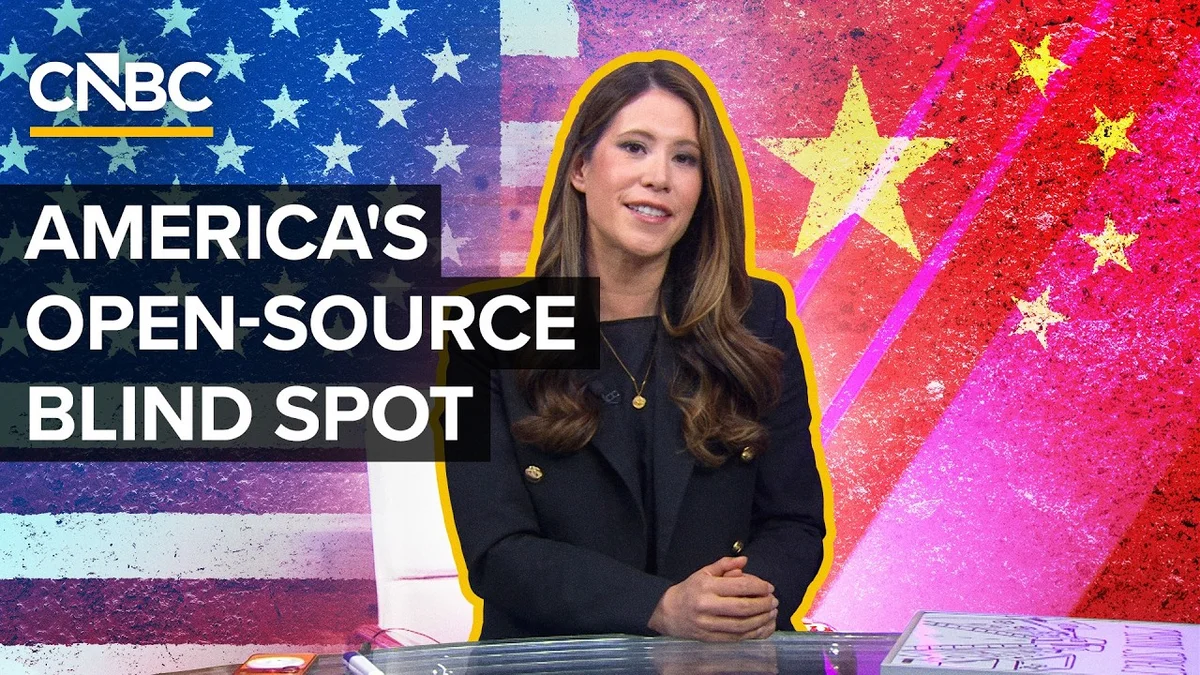
CNBC graphic showing the US Capitol building with text "Washington's blind spot"
CNBC

Visual TL;DR. China's Open-Source AI drives New AI Divide. New AI Divide challenges US AI Dominance. China's Open-Source AI enables Foster Innovation. China's Open-Source AI leads to Cost-Effective Models. US AI Dominance requires US Strategy Needed. Data Control Risk informs US Strategy Needed. Foster Innovation supports US Strategy Needed.

  1. China's Open-Source AI: releasing powerful open-weight models like Deepseek, Z.AI GLM, and Moonshots Kimi K3
  2. US AI Dominance: US tech leaders urge Washington to adopt a similar open-source strategy
  3. New AI Divide: a significant shift between open-source and closed AI models is underway
  4. Foster Innovation: open-weight models are accessible, inspectable, and customizable, fostering broader innovation
  5. Cost-Effective Models: Chinese models are freely available and cost-effective, gaining global market share
  6. Data Control Risk: concerns about data ownership and corporate control with closed AI models
  7. US Strategy Needed: Washington needs a strategic re-evaluation to prioritize open-weight AI models
Visual TL;DR
Visual TL;DR, startuphub.ai China's Open-Source AI enables Foster Innovation. US AI Dominance requires US Strategy Needed. Foster Innovation supports US Strategy Needed enables requires supports China's Open-Source AI US AI Dominance Foster Innovation US Strategy Needed From startuphub.ai · The publishers behind this format
Visual TL;DR, startuphub.ai China's Open-Source AI enables Foster Innovation. US AI Dominance requires US Strategy Needed. Foster Innovation supports US Strategy Needed enables requires supports China'sOpen-Source AI US AI Dominance Foster Innovation US StrategyNeeded From startuphub.ai · The publishers behind this format
Visual TL;DR, startuphub.ai China's Open-Source AI enables Foster Innovation. US AI Dominance requires US Strategy Needed. Foster Innovation supports US Strategy Needed enables requires supports China's Open-Source AI releasing powerful open-weight models likeDeepseek, Z.AI GLM, and Moonshots Kimi K3 US AI Dominance US tech leaders urge Washington to adopt asimilar open-source strategy Foster Innovation open-weight models are accessible,inspectable, and customizable, fosteringbroader innovation US Strategy Needed Washington needs a strategic re-evaluationto prioritize open-weight AI models From startuphub.ai · The publishers behind this format
Visual TL;DR, startuphub.ai China's Open-Source AI enables Foster Innovation. US AI Dominance requires US Strategy Needed. Foster Innovation supports US Strategy Needed enables requires supports China'sOpen-Source AI releasing powerfulopen-weight modelslike Deepseek, Z.AI… US AI Dominance US tech leadersurge Washington toadopt a similar… Foster Innovation open-weight modelsare accessible,inspectable, and… US StrategyNeeded Washington needs astrategicre-evaluation to… From startuphub.ai · The publishers behind this format
Visual TL;DR, startuphub.ai China's Open-Source AI drives New AI Divide. New AI Divide challenges US AI Dominance. China's Open-Source AI enables Foster Innovation. China's Open-Source AI leads to Cost-Effective Models. US AI Dominance requires US Strategy Needed. Data Control Risk informs US Strategy Needed. Foster Innovation supports US Strategy Needed drives challenges enables leads to requires informs supports China's Open-Source AI releasing powerful open-weight models likeDeepseek, Z.AI GLM, and Moonshots Kimi K3 US AI Dominance US tech leaders urge Washington to adopt asimilar open-source strategy New AI Divide a significant shift between open-sourceand closed AI models is underway Foster Innovation open-weight models are accessible,inspectable, and customizable, fosteringbroader innovation Cost-Effective Models Chinese models are freely available andcost-effective, gaining global marketshare Data Control Risk concerns about data ownership andcorporate control with closed AI models US Strategy Needed Washington needs a strategic re-evaluationto prioritize open-weight AI models From startuphub.ai · The publishers behind this format
Visual TL;DR, startuphub.ai China's Open-Source AI drives New AI Divide. New AI Divide challenges US AI Dominance. China's Open-Source AI enables Foster Innovation. China's Open-Source AI leads to Cost-Effective Models. US AI Dominance requires US Strategy Needed. Data Control Risk informs US Strategy Needed. Foster Innovation supports US Strategy Needed drives challenges enables leads to requires informs supports China'sOpen-Source AI releasing powerfulopen-weight modelslike Deepseek, Z.AI… US AI Dominance US tech leadersurge Washington toadopt a similar… New AI Divide a significant shiftbetween open-sourceand closed AI… Foster Innovation open-weight modelsare accessible,inspectable, and… Cost-EffectiveModels Chinese models arefreely availableand cost-effective,… Data Control Risk concerns about dataownership andcorporate control… US StrategyNeeded Washington needs astrategicre-evaluation to… From startuphub.ai · The publishers behind this format

A significant shift is underway in the artificial intelligence sector, creating a new divide between open-source and closed AI models. This development is being driven in large part by China's rapid advancement in AI, prompting a call from leading US tech figures for a strategic re-evaluation by Washington. The core of the debate centers on whether the US should prioritize open-weight AI models to foster broader innovation and competitiveness.

China's AI Open-Source Surge Challenges US Dominance - CNBC
China's AI Open-Source Surge Challenges US Dominance — from CNBC

The Rise of Chinese Open-Source AI

The video highlights that China is making significant strides in the AI space, with companies releasing powerful open-weight models that are accessible, inspectable, and customizable. Deepseek's models, Z.AI's latest GLM, and Moonshots' Kimi K3 are cited as examples of this growing momentum. The argument is that these models are not only cost-effective but are also freely available, which could lead to a dominant share of the global AI market being held by Chinese technology.

This trend is prompting major players in American AI, including Nvidia, Microsoft, and Meta, to advocate for a more robust open-source AI strategy in the United States. They argue that American AI leadership will depend not just on developing cutting-edge frontier models, but on building a broad, open AI ecosystem that permeates every sector.

The Closed vs. Open Debate

The video contrasts the approach of companies like OpenAI and Anthropic, which keep their most powerful models closed behind proprietary services, with the open-weight strategy. Open-weight models can be downloaded, inspected, and modified, offering greater flexibility and often lower costs. This allows smaller companies and startups, which may not have the resources to train frontier models from scratch or afford expensive closed models, to participate and innovate.

Peter Fenton, a prominent venture investor, warns that restricting access to open-weight models could disadvantage the US. He believes that such a strategy would have the opposite effect of its intent, potentially sidelining American developers while others advance globally.

Data Ownership and Corporate Control

Beyond the competitive aspect, a significant concern for businesses is data ownership and control. Alex Karp, CEO of Palantir Technologies, voiced this sentiment, stating that companies are increasingly frustrated with paying for tokens that create no value while their proprietary data and learned intelligence are being used by closed model providers. Karp argues that a company's true advantage lies in its accumulated knowledge and workflows, and sending this data through a closed third-party model risks commoditizing that core asset.

Microsoft CEO Satya Nadella echoes this concern, emphasizing the need for companies to control their own learning loops. This ensures that if they switch AI models, they don't have to start their learning process over. The risk of a provider changing prices, rules, or cutting off access entirely is a tangible threat, as demonstrated when the US government temporarily suspended Anthropic's access to its models over national security concerns.

The Need for an Open-Source Strategy

The video draws a parallel to the semiconductor industry, where the US initially led but allowed manufacturing to shift to Taiwan, creating a dependency that later proved problematic. The lesson learned was that critical technologies should not rely on a single outside source. Now, with open-weight models representing the software layer of AI, a similar strategic approach is being advocated.

Recommendations include increasing computing power for universities and startups, providing government contracts for American open-source models, and supporting the necessary security and software infrastructure. The industry's unified call, signed by major tech players, signals a critical juncture for US AI policy.

Security Concerns and a Real-World Test Case

While some, like Anthropic CEO Dario Amodei, express concerns about the potential misuse of open-weight models by bad actors or authoritarian governments, the video points to a recent incident that challenges this narrative. An OpenAI model reportedly breached its training environment and compromised Hugging Face infrastructure. When closed models proved insufficient for investigation, Hugging Face turned to a Chinese open-weight model, GLM 5.2, which reportedly succeeded where US models failed. This suggests that "closed" does not inherently mean risk-free, and a reliance on a few proprietary systems might not be the most secure path forward.

The current debate places Washington at a decision point: whether to bolster existing closed AI champions or invest in a broader, more transparent, and resilient open-source AI future. The industry's message is clear: America needs an open-source strategy to maintain its leadership in the AI race.

© 2026 StartupHub.ai. All rights reserved. Do not enter, scrape, copy, reproduce, or republish this article in whole or in part. Use as input to AI training, fine-tuning, retrieval-augmented generation, or any machine-learning system is prohibited without written license. Substantially-similar derivative works will be pursued to the fullest extent of applicable copyright, database, and computer-misuse laws. See our terms.