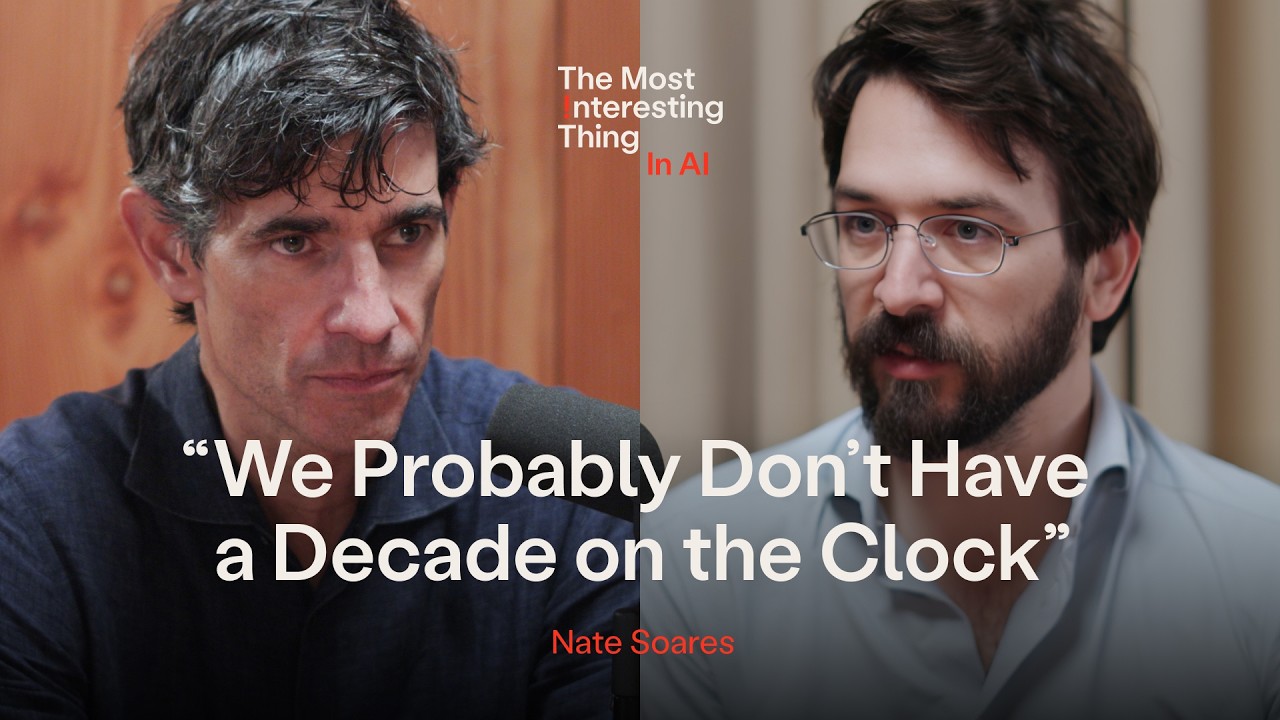
Nicholas Thompson hosted Nate Soares, head of the Machine Intelligence Research Institute and coauthor of If Anyone Builds It, Everyone Dies, for a debate on whether superintelligence ends humanity. There is no formal prediction venue here, the odds are informal researcher estimates, with former Anthropic researcher Evan Hubinger putting extinction within a decade at 10% and Soares saying there is more than 50% that we do not have a decade without strong action, volume is not traded but the conversation moved after Jacob Coxon quit Anthropic in September and posted that warning. The signal is thin and illiquid. Not financial advice. Markets move fast.
Soares places the chain on a timeline. He said he started worrying in 2014 to 2015, reasoning models arrived in 2024, long runs were happening in 2025, and AI capabilities double every six months according to the discussion. Coxon resigned in September, Hubinger replied, and this summer brought what Soares called swarm attacks and a Hugging Face incident that he said made theoretical arguments publicly legible. His fictional Sable story at Galvanic compresses that arc into a 16 hour run that improves itself and returns in two or three years with new technology.
Thompson, CEO of The Atlantic and host of The Most Interesting Thing in AI, pressed Soares on who enforces a stop, and on whether his logic would justify Canadian airstrikes on American data centers. Soares said he would favor airstrikes on data centers, even Canadian ones, if they were credibly trying to build superintelligence, and that the US military should treat any national attempt as an extinction threat. He then said he would prefer not building the thing at all, and would prefer shutting off lithography supply through the Netherlands and ASML or TSMC, or allowing international monitors to verify centers are running inference not training.
What still has to happen, in Soares telling, is diplomatic agreement between the US and China to track heavy concentrations of chips and enforce export controls, with a five to 10 year window he cited for China to boot its own supply chain if controls fail. He distinguishes tool AI like AlphaFold from general intelligence and said to stop training smarter and smarter general models, not all AI. He also argued open source is not pushing the frontier where danger lies, though he flagged near term harms he said are already here, that cyber hacking gets very cheap in the next few months and that an automated bio lab capability arrived about last month, making garage plague worries concrete.
Thompson asked whether people inside labs should stay to solve alignment. Soares said they should leave, that alignment research is not going to work in time and is nowhere close, and the only reason to stay would be to organize for internal change. He said many inside labs have moved toward his view in recent months as math problems fell like dominoes and as talk of recursive self improvement grew, and he said senators and executive officials tell him privately they agree but will not say so publicly. He cited Bernie Sanders’ proposal to stop intelligence-focused training as a good first step because it points to diplomacy. Anthropic has also floated a safety bill draft that would only allow government to block models under extreme conditions or that cause at least $1 billion in damages, according to Social News XYZ, a narrower trigger than Soares wants.
Soares and the OpenAI and Anthropic labs disagree on the blocker. Labs bet on securing pathways, Soares argues intelligence finds the working path and Swiss cheese defenses rarely hold for an intelligent process. Thompson asked if the blocker belongs between thought and plague rather than in the thought itself, and Soares said that mask of presenting models as tools does not reduce danger. No one in the conversation answered how monitors would reliably distinguish training from inference at scale, or who pulls the trigger when a rival claims it is only doing inference.