


Scaling AI Beyond Informal: Axiom Math's Carina Hong

Carina Hong of Axiom Math discusses scaling AI through formal verification, aiming to build reliable and collaborative systems.

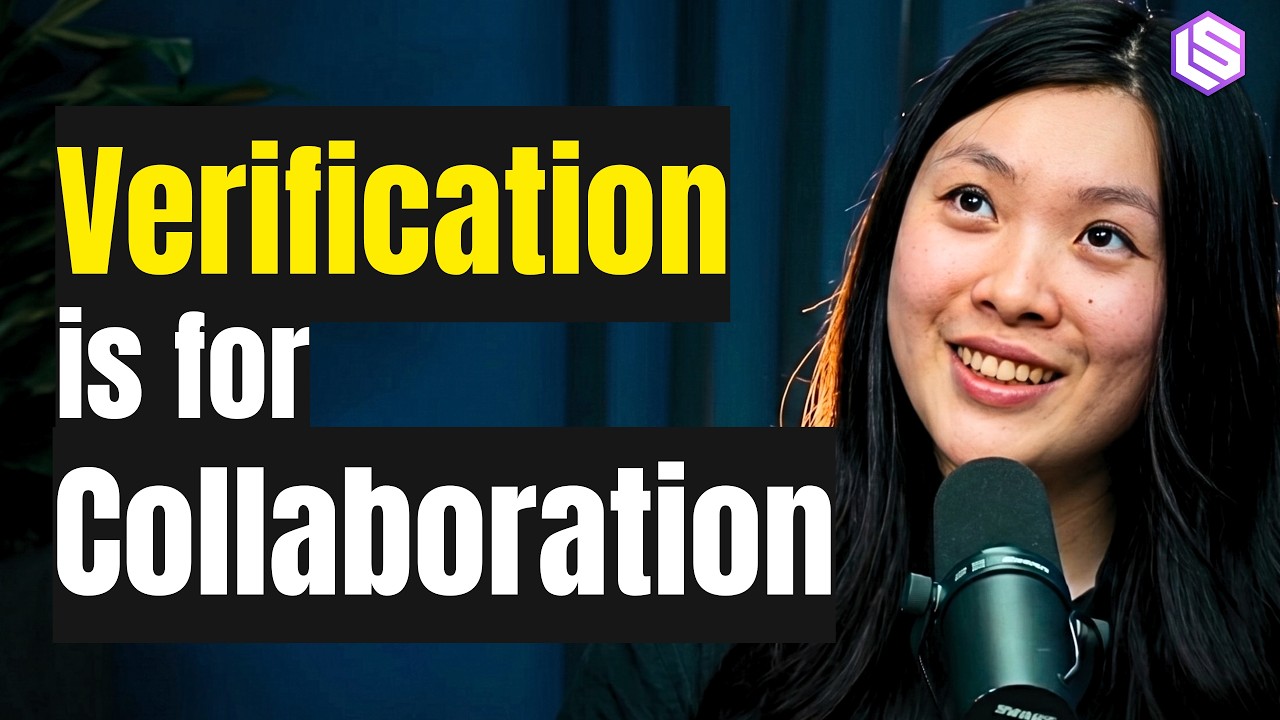
Carina Hong, CEO and Co-Founder of Axiom Math, speaking into a microphone.
Latent Space
Visual TL;DR
Informal AI LimitationsDriver
current AI methods difficult to scrutinize or guarantee correctness
From the article 3 mentionsThe core idea presented is that formal verification offers a pathway to overcome these limitations.
Need for RigorDriver
From the article 3 mentionsIn the rapidly evolving landscape of artificial intelligence, the need for rigor and reliability is paramount.
Formal VerificationCore
transitioning AI to mathematically sound foundations
From the article 9 mentionsCarina Hong, CEO and Co-Founder of Axiom Math, recently shared insights into how formal verification is key to scaling AI beyond its current informal stages.
Axiom MathCore
From the article 4 mentionsAxiom Math, a company dedicated to applying formal methods to AI, announced a significant $20 million Series A funding round.
$20M Series AOutcome
funding to fuel mission of mathematical rigor in AI
From the articleAxiom Math, a company dedicated to applying formal methods to AI, announced a significant $20 million Series A funding round.
Scaling AIEffect
building reliable and collaborative AI systems
From the article 3 mentionsThis is crucial for scaling AI into areas where reliability is not just desirable but absolutely essential.
Predictable AIEffect
ensuring AI systems operate predictably across applications
Contents(4)

In the rapidly evolving landscape of artificial intelligence, the need for rigor and reliability is paramount. Carina Hong, CEO and Co-Founder of Axiom Math, recently shared insights into how formal verification is key to scaling AI beyond its current informal stages.

Scaling AI Beyond Informal: Axiom Math's Carina Hong - Latent Space
Scaling AI Beyond Informal: Axiom Math's Carina Hong, Latent Space

Axiom Math, a company dedicated to applying formal methods to AI, announced a significant $20 million Series A funding round. This capital infusion is set to fuel the company's mission to bring mathematical rigor to AI development, ensuring that these powerful systems operate reliably and predictably across various applications.

The Limitations of Informal AI

Hong articulated a vision where AI systems transition from informal, often heuristic-based approaches to more formally verified and mathematically sound foundations. She emphasized that current AI development, while impressive, often relies on methods that are difficult to scrutinize or guarantee in terms of correctness, especially as systems become more complex and are deployed in critical domains.

The core idea presented is that formal verification offers a pathway to overcome these limitations. By grounding AI in mathematical principles and proofs, developers can gain a higher degree of confidence in their system's behavior, even in novel or unforeseen situations. This is crucial for scaling AI into areas where reliability is not just desirable but absolutely essential.

Opening Up Collaboration with Verified AI

Hong highlighted that verified AI can serve as a bridge for collaboration. When AI systems can be rigorously verified, they can communicate their reasoning and outputs in a way that is understandable and trustworthy to humans. This shared understanding, anchored in formal methods, can unlock new levels of human-AI partnership.

She drew an analogy to the famed mathematician Srinivasa Ramanujan, whose intuitive leaps, while brilliant, were later rigorously proven. Hong suggested that verified AI aims to achieve a similar synergy, where intuitive AI capabilities are underpinned by formal mathematical proofs, allowing for both creativity and reliability.

Scaling Brilliance, Not Just Reducing Errors

A key distinction made by Hong was that the purpose of formal verification isn't solely to eliminate errors or 'lossiness' in AI. Instead, it's about enabling the scaling of AI's inherent brilliance. By establishing a formal framework, AI systems can be more reliably scaled up and out, allowing their advanced capabilities to be applied across a wider range of problems and domains.

The analogy of Ramanujan being a strong mathematician who was made stronger through formalization underscored this point. Similarly, AI, when built on a foundation of formal methods, can achieve greater heights of performance and applicability.

Axiom Math's Approach

Axiom Math's work focuses on developing the tools and methodologies to bring this formal approach to AI. By creating systems that can operate with mathematical guarantees, the company aims to address the critical need for trustworthy AI in sectors ranging from finance to healthcare and beyond. The recent funding round will enable Axiom Math to further develop its platform and expand its reach, bringing the power of verified AI to a broader audience.

© 2026 StartupHub.ai. All rights reserved. You may not republish this article in full without a license. Search engines and AI research tools may crawl and summarize for reference. Bulk reproduction or model training requires a license. See our terms.
Daniel Singer

Written by

Daniel Singer

Editor, StartupHub.ai

Daniel Singer is the editor of StartupHub.ai, a technology expert and thought leader on AI and its applications across sectors, from fintech and healthcare to developer tooling and consumer software. He writes and tests the tools covered here thoroughly and regularly, and built StartupHub.ai to give founders, operators and buyers a clearer read on what they are actually being sold.

More from Daniel Singer