

Today, vFunction, the first and only platform purpose-built for cloud native modernization, announces the availability of the vFunction Application Transformation Engine and the expanded vFunction Modernization Platform, with new, advanced capabilities that enable enterprises to automatically assess, analyze, and manage the full modernization and migration process from start to finish. vFunction also announces $26M in Series A funding led by Zeev Ventures and Hewlett Packard Enterprise. Existing investors who participated in the round include Engineering Capital, Primera Capital, and Shasta Ventures. vFunction will use the new investment to drive global expansion, beyond North America and Europe, and into Latin America, while responding to the increased enterprise demand for automated, scalable app modernization initiatives accelerated by massive adoption of the cloud.
Enterprises today are still in the very early stages of application assessment, deep in technical debt, and struggling to build their own business cases for modernization. Developers today lack a data-driven approach and instead rely on outdated code analysis tools and high-level assessment technology for their modernization initiatives. Throughout the years, enterprises have amassed backlogs of 1,000’s of legacy monolithic applications, while spending years decomposing and refactoring these applications, one service at a time, with 6-18+ months spent per application. This manual process is tedious, time-consuming and prone for error. Adding to this complexity, all monolithic applications vary significantly in scale, size, and priority.
Introducing New Application Transformation Product and Assessment Capabilities
vFunction is the only modernization solution that offers a scalable, repeatable factory model that allows architects and developers to manage and scale the full modernization and migration process from assessment to decomposition. vFunction’s new Application Transformation Engine (vAXE) and expanded vFunction Modernization Platform (vMP) introduce these new capabilities:
- Database Dependency Discovery & Analysis: The new vAXE analysis discovers, detects, and reports on which database tables are used by which services while decomposing a monolith with vFunction and optimizes service decomposition accordingly based on this information. This enables architects to not only extract microservices with minimal database interdependencies, but also plan the modernization of the data layer.
- Domain-Driven Observability: vFunction vAXE is the only modernization refactoring solution utilizing deep domain-driven observability via a passive JVM agent to accurately analyze flows, classes, usage, memory, and resources to detect and unearth critical business domain functions buried within a monolith. This dynamic analysis enables high degrees of scalability for even “megalith” - large monolithic - applications to untangle complex, old, and dense dependencies for applications of over 10 million lines of code and over 10,000 Java classes. When synthesized with static byte code analysis, the resulting decomposition enables unequaled acceleration, precision, and microservice decomposition results.
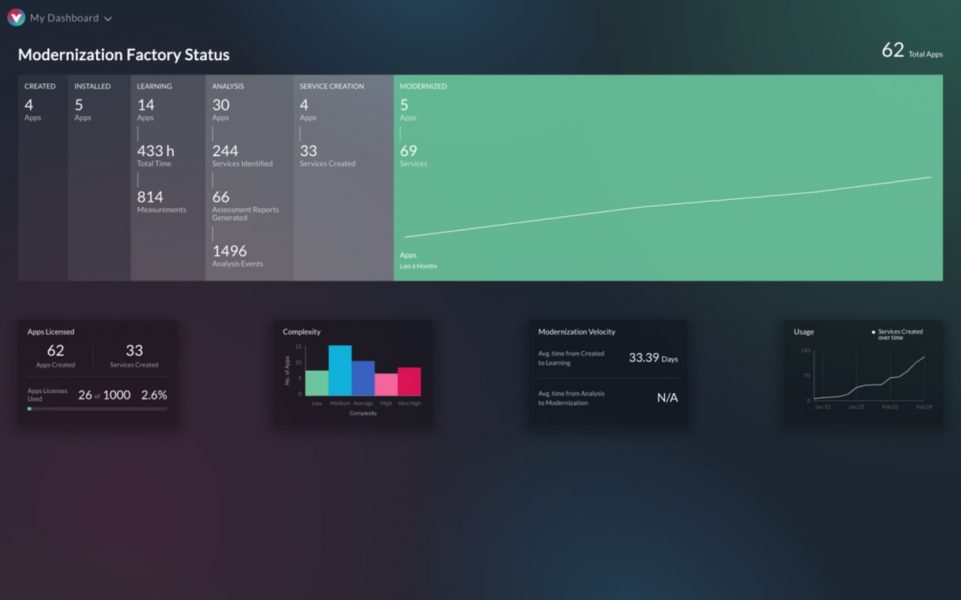
- Single Pane of Glass to Manage Broad Assessment, Migration, and Modernization: Unlike existing modernization assessment and migration tools, the vFunction Modernization Platform now provides a single pane of glass that manages and tracks full cloud migration and modernization projects across an enterprise application estate. The expanded modernization dashboard manages, tracks, and coordinates the full migration and modernization process. This includes applications that are marked for Refactoring, Retention/Retirement, Replatforming, or Rewriting. Broader integration and application support has been added to include older versions of Java including Java 6, Alpine Linux, AIX, and more versions of Oracle WebLogic, IBM WebSphere, Red Hat JBoss, and Tomcat.
“The rate at which enterprises are needing to innovate in order to retain competitive market positioning is unprecedented, and those without a data-backed modernization approach will be outpaced,” said Moti Rafalin, CEO and Co-founder, vFunction. “vFunction’s new capabilities represent a critical breakthrough in modernization, as development teams can now tap into data-driven assessments and get a clear view of application complexity, functional domains, and dependencies. With these automated insights, enterprises avoid the time-consuming, manual modernization approaches that exist today and can finally tackle mounting technical debt head-on.”
“I am thrilled to be partnering with vFunction as they drive global expansion, beyond North America and Europe," said Oren Zeev. "vFunction experiencing a massive 20x spike in demand for application modernization in 2021 speaks to the effectiveness of its platform, as businesses triple down on their digital transformation investments in order to innovate, maintain competitive positioning, and scale.”